What is corporate espionage? Prevention techniques
Corporate espionage, also known as industrial espionage, is a significant threat that businesses face today. In an era where data is often referred to as “the new oil,” protecting sensitive information has become a top priority for organizations worldwide. But what exactly is corporate espionage, and how can businesses safeguard themselves against it?
In this blog, we’ll explore the concept of corporate espionage, the methods used by attackers, the consequences it can have on businesses, and effective prevention techniques.
Additionally, we’ll highlight how tools like CyberArrow Awareness Platform can help organizations mitigate this risk by empowering their employees through automated cyber security awareness training.
What is corporate espionage?
Corporate espionage refers to the unauthorized acquisition of confidential business information by competitors, individuals, or foreign entities for financial, strategic, or competitive advantage. The stolen data can include trade secrets, proprietary technology, customer databases, pricing strategies, or even intellectual property.
Corporate espionage can take many forms, including:
- Hacking into networks or systems to access sensitive data.
- Planting insider threats to leak confidential information.
- Social engineering attacks to manipulate employees into revealing critical details.
Unlike cybercrime, which often has financial gain as its primary motive, corporate espionage focuses on gaining a competitive edge by stealing information that provides strategic value.
Methods used in corporate espionage
Understanding how corporate espionage is carried out can help businesses recognize and respond to threats more effectively. Here are some common tactics used by attackers:
1. Phishing attacks
Attackers send fake emails, messages, or websites designed to trick employees into revealing passwords, confidential information, or system access.
2. Insider threats
An insider threat involves an employee, contractor, or business partner intentionally or unintentionally leaking sensitive information. Insiders may be bribed, blackmailed, or manipulated into providing access.
3. Physical theft
Corporate spies may physically steal documents, laptops, or USB drives containing sensitive information.
4. Social engineering
Using psychological manipulation, attackers deceive employees into divulging information, such as login credentials or access codes, often posing as someone trustworthy.
5. Malware and spyware
Attackers deploy malicious software to infiltrate systems and exfiltrate data without detection.
6. Eavesdropping
Corporate spies may intercept communications, such as emails, calls, or video conferences, to gather information.
7. Supply chain exploits
Attackers compromise third-party vendors or suppliers to gain access to an organization’s network or data.
The impact of corporate espionage
Corporate espionage can have devastating consequences for businesses, including:
1. Loss of competitive advantage
Stolen trade secrets or strategies can allow competitors to replicate products or services, undermining a company’s unique position in the market.
2. Financial loss
The cost of espionage includes lost revenue, legal fees, regulatory fines, and the expense of investigating and mitigating breaches.
3. Reputation damage
When customers or partners lose trust in a company’s ability to protect sensitive information, the brand’s reputation suffers.
4. Operational disruption
Espionage activities can cause system downtime, data loss, and interruptions in day-to-day operations.
5. Legal and regulatory consequences
Failing to protect sensitive data may result in penalties under regulations such as GDPR or ISO 27001 compliance requirements.
Prevention techniques for corporate espionage
Preventing corporate espionage requires a multi-layered approach that addresses both technological and human factors. Here are some key strategies businesses can implement:
1. Employee awareness and training
One of the most effective ways to prevent espionage is by educating employees about cyber security threats, such as phishing, social engineering, and insider risks. Employees are often the first line of defense, and their vigilance can significantly reduce the likelihood of a successful attack.
Solution: CyberArrow Awareness Platform offers automated cyber security awareness training to transform your employees into human firewalls. With engaging, easy-to-understand training modules, CyberArrow ensures that your workforce is prepared to identify and counteract potential threats.
2. Implement strong access controls
Limit access to sensitive data based on employees’ roles and responsibilities. Use the principle of least privilege (PoLP) to ensure that individuals only have access to the information they need to perform their tasks.
3. Regular security audits
Conduct routine audits of systems, networks, and physical premises to identify vulnerabilities and ensure compliance with security policies.
4. Use encryption
Encrypt sensitive data both at rest and in transit to prevent unauthorized access, even if it is intercepted or stolen.
5. Deploy advanced cyber security tools
Utilize firewalls, intrusion detection systems (IDS), and endpoint protection software to safeguard networks and devices against cyber threats.
6. Monitor for insider threats
Implement tools that monitor user behavior and flag suspicious activities, such as unauthorized access to sensitive files or attempts to bypass security controls.
7. Secure the supply chain
Work closely with vendors and partners to ensure they adhere to robust cyber security practices. Supply chain vulnerabilities can easily be exploited for corporate espionage.
8. Implement physical security measures
Protect your office premises with physical security measures, such as surveillance cameras, access badges, and visitor logs, to prevent unauthorized access to sensitive areas.
9. Strengthen communication channels
Use secure communication platforms with end-to-end encryption for sharing sensitive information.
10. Update and patch systems
Ensure all software, hardware, and firmware are regularly updated and patched to address known vulnerabilities.
How CyberArrow Awareness Platform can help
Cyber security isn’t just a technical issue, it’s a human issue. Most breaches, including those caused by corporate espionage, involve some form of human error or manipulation. This is why empowering your employees with the right knowledge and skills is crucial.
Why Choose CyberArrow Awareness Platform?
- Automated training: CyberArrow simplifies the process of educating employees by automating cyber security awareness training.
- Engaging content: The platform delivers training in an interactive and engaging format, ensuring employees retain the information.
- Customizable modules: Training can be tailored to address specific risks and threats relevant to your organization.
- Measurable results: CyberArrow tracks progress and provides insights into the effectiveness of the training, helping you measure ROI.
- Fast implementation: CyberArrow Awareness Platform can be deployed quickly, allowing you to start transforming your employees into human firewalls in no time.
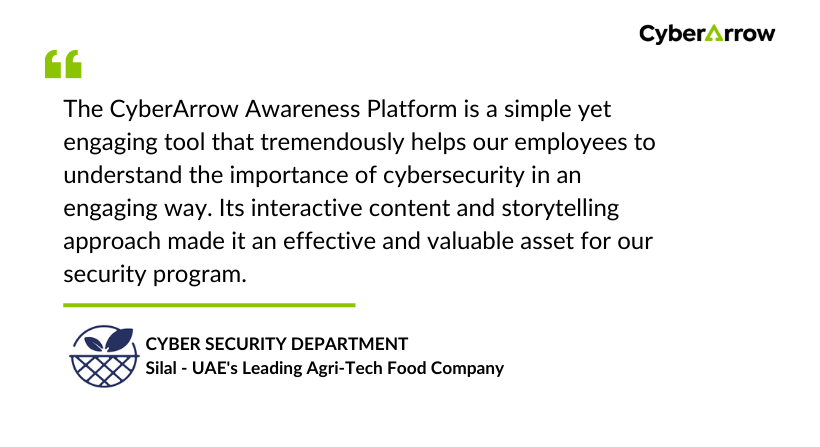
Read how CyberArrow Awareness Platform increased security awareness among Silal’s employees.
See what Silal has to say about CyberArrow Awareness Platform: