Risk assessment methodology: Key components and common types
What if a single oversight could cost your organization millions of dollars? What if a preventable incident tarnishes your reputation overnight? Risks are everywhere—hidden in supply chains, embedded in processes, and lurking in daily operations. The question isn’t whether risks exist; it’s whether your organization can identify and manage them effectively.
Risk is inevitable in any organization, but managing it effectively can be the difference between success and failure. A well-defined risk assessment methodology provides a structured approach to identifying, analyzing, and addressing risks. It goes beyond simply identifying potential issues and helps you gauge their impact, determine their urgency, and decide on the best course of action.
This article explains the concept of risk assessment methodology, explores different approaches, and provides examples to help you understand how to apply them.
What is a risk assessment methodology?
A risk assessment methodology is a process used to evaluate potential risks and their impact on an organization. It involves identifying risks, analyzing their likelihood and consequences, prioritizing them, and determining appropriate actions to mitigate or manage them.
The methodology is a blueprint to ensure consistent and objective risk evaluations, enabling better decision-making.
Why is risk assessment important?
Organizations face risks daily—whether financial, operational, technological, or reputational. Without a structured methodology, assessing these risks can become subjective and inconsistent. Here’s why a risk assessment methodology is essential:
- Informed decision-making: Helps prioritize actions based on the likelihood and impact of risks.
- Compliance and regulation: Ensures adherence to industry-specific standards (e.g., ISO 27001 and GDPR).
- Resource allocation: Guides investments in controls and risk mitigation strategies.
Key components of a risk assessment methodology
A risk assessment methodology is built on several core components that guide organizations in identifying, analyzing, and managing risks. These components ensure a consistent and thorough approach to handling uncertainties.
1. Risk identification
The first step is pinpointing all potential risks affecting an organization’s objectives. This process involves uncovering risks from all possible sources, whether internal (e.g., operational inefficiencies) or external (e.g., market fluctuations).
How it’s done
- Conduct workshops or brainstorming sessions with relevant teams and stakeholders.
- Examine operational workflows, organizational policies, and external trends.
- Analyze historical data, incident records, and lessons learned from past projects.
2. Risk analysis
After identifying risks, understand their nature by assessing their likelihood of occurrence and the severity of their impact. This step provides insight into the threat level each risk poses and aids in informed decision-making.
How it’s done
- Use qualitative or quantitative methods to estimate likelihood and impact.
- Apply tools like risk matrices, where risks are categorized by probability and severity.
- Leverage statistical models or simulations for detailed assessments when quantitative data is available.
3. Risk evaluation
Risk evaluation involves prioritizing identified risks based on their overall significance. By ranking risks, organizations can allocate resources effectively and focus on the most critical threats first.
How it’s done
- Compare risks against predefined risk tolerance or acceptance criteria.
- Develop a priority list, starting with risks with high impact and probability.
- Collaborate with decision-makers to align prioritization with organizational goals.
4. Risk treatment
This step focuses on determining the best course of action to address each risk. Organizations may choose to mitigate, transfer, accept, or avoid risks depending on their analysis and priorities.
How it’s done
- Develop actionable strategies, such as implementing controls or contingency plans.
- Allocate necessary resources to implement risk management measures.
- Collaborate with relevant teams to ensure the feasibility and effectiveness of chosen solutions.
5. Monitoring and review
Risk assessment is not a one-time process; continuous monitoring and evaluation are essential to ensure risks remain controlled. This step involves tracking risks and reviewing the effectiveness of implemented measures.
How it’s done
- Set up regular review cycles to revisit risk assessments.
- Use key performance indicators (KPIs) or dashboards to monitor changes.
- Update risk registers and methodologies as new information or risks emerge.
Quick link: Inherent vs. residual risk assessments
Types of risk assessment methodologies
Risk assessment methodologies help organizations analyze and address risks in different ways. Each method is tailored to specific needs, industries, or scenarios. Below is a detailed explanation of each methodology.
1. Quantitative methodology
Quantitative risk assessment uses data and numbers to define and measure risks. This method calculates risks’ probability and potential impact using mathematical models, formulas, and statistical tools. It is highly objective and best suited for industries with precise data, such as finance, construction, and engineering.
Quantitative analysis often includes techniques like Monte Carlo simulations, decision trees, or cost-benefit analysis to predict potential losses, time delays, or operational setbacks. While it offers accuracy, its effectiveness depends on having complete and reliable data.
2. Qualitative methodology
Qualitative risk assessment evaluates risks based on descriptive and subjective factors, focusing on likelihood and impact categories rather than numerical measurements. This methodology relies on expert judgment, interviews, and brainstorming to understand potential threats and vulnerabilities.
Qualitative analysis is commonly used when precise data is unavailable or risks are intangible, such as reputational harm or customer dissatisfaction. Risk matrices and scenario analysis are popular tools in this approach.
3. Semi-quantitative methodology
Semi-quantitative risk assessment combines the descriptive nature of qualitative methods with numerical scoring systems. This approach helps organizations rank and prioritize risks by assigning values to their likelihood and impact. It provides more structure than qualitative analysis without requiring extensive data like quantitative methods.
4. Asset-based methodology
Asset-based risk assessment focuses on identifying and protecting critical assets within an organization, such as physical infrastructure, intellectual property, or sensitive data. The approach emphasizes understanding the value of each asset and the risks they face to develop targeted strategies for their protection.
5. Threat-based methodology
This methodology centers around specific threats rather than assets, focusing on the nature, source, and potential impact of each threat. Organizations can develop strategies to mitigate or prevent threats by understanding the characteristics of threats. This approach is widely used in industries like cybersecurity and emergency management.
6. Vulnerability-based methodology
Vulnerability-based risk assessment highlights weaknesses within an organization or system that threats could exploit. The goal is to identify these vulnerabilities and address them to minimize risk exposure. This method is often used in cybersecurity, infrastructure management, and compliance audits.
Quick link: What is a risk assessment matrix?
How to choose the right risk assessment methodology
Selecting the right risk assessment methodology ensures that your organization can effectively identify, evaluate, and manage risks. Here are some key considerations to help guide your decision:
- Consider the type of risks you face: Different risks require different assessment methods. If you are dealing with easily quantifiable risks—such as financial risks, project delays, or operational costs—a quantitative approach might be more suitable. On the other hand, if your risks are less tangible, a qualitative or semi-quantitative approach might be more effective.
- Availability and accuracy of data: If you have reliable, detailed data available, a quantitative approach may be the best option, as it provides precise and measurable results. In cases where data is scarce, asset-based or vulnerability-based methodologies may help focus attention on specific areas of concern.
- The complexity of your organization: The size and complexity of your organization also play a significant role in choosing the right methodology. Smaller organizations with fewer processes might find qualitative or semi-quantitative assessments sufficient. However, larger organizations with more intricate operations may benefit from a more formal, data-driven quantitative methodology.
- Risk tolerance and strategic goals: Your organization’s risk tolerance should influence your choice of methodology. Qualitative or semi-quantitative methods may be appropriate if you accept a higher level of uncertainty in decision-making. However, if you need to minimize risk exposure and make highly informed decisions, quantitative assessments can provide the precision required to manage risks effectively.
- Industry standards and regulations: Certain industries may have specific risk assessment standards or regulatory requirements dictating the methodology you must adopt. For example, industries like healthcare (HIPAA) and finance (SOX) often require risk assessments to follow specific frameworks or methodologies.
Overcome compliance risk challenges with CyberArrow
Managing compliance risks is critical for any organization, especially when dealing with complex regulatory standards. CyberArrow offers a streamlined solution for automating risk assessments and managing compliance risks. By providing real-time insights into potential compliance gaps and vendor risks, CyberArrow helps you stay ahead of regulatory demands while minimizing your exposure to non-compliance.
Why choose CyberArrow?
- Automated risk assessments: Replace manual risk evaluation processes with automated assessments that ensure compliance management accuracy, efficiency, and consistency.
- Centralized risk visibility: Get a comprehensive view of compliance risks across your organization with a centralized platform that consolidates all relevant data into a single, easy-to-access location.
- Real-time risk monitoring: Monitor compliance risks continuously and in real time, enabling proactive decision-making to address potential compliance issues before they become major problems.
- Customizable risk frameworks: Tailor your risk management frameworks to align with your organization’s specific needs, regulatory requirements, and industry standards.
- Comprehensive reporting: Generate detailed, actionable compliance reports to simplify audits, meet regulatory requirements, and provide transparency to internal stakeholders.
- Vendor risk management: Perform consistent, automated risk assessments for all third-party vendors, with continuous monitoring to ensure that they remain compliant with your organization’s standards and regulations.
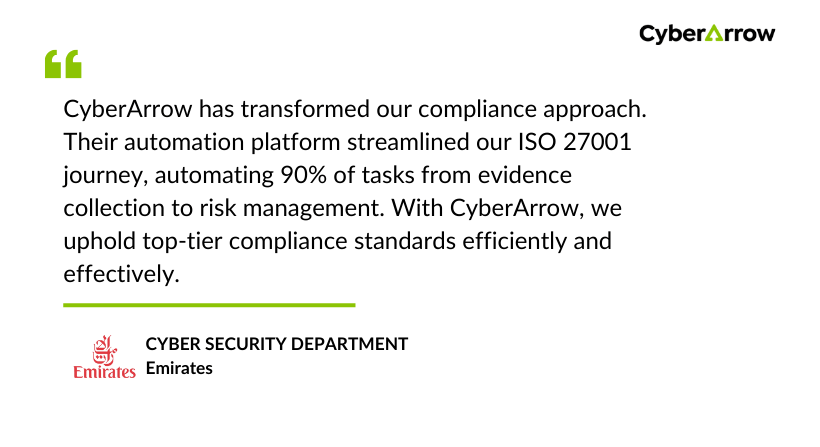
See what companies like Emirates say about CyberArrow GRC: