Cyber security roadmap: A step-by-step guide to safeguard your organization
Did you know that cybercrime is projected to cost the world $10.5 trillion annually by 2025?
With a well-structured cyber security roadmap, you can protect your business from potential threats and safeguard sensitive data.
In this guide, we’ll walk you through the essential steps to create an effective cyber security roadmap, ensuring your organization stays secure in a constantly evolving digital world.
- What is a cyber security roadmap?
- Why do you need a cyber security roadmap?
- Key components of a cyber security roadmap
- 1. Assessment of current security posture
- 2. Define security goals and objectives
- 3. Identify risks and prioritize actions
- 4. Develop a multi-layered defense strategy
- 5. Invest in cyber security awareness training
- 6. Implement the right tools and technologies
- 7. Create an incident response plan (IRP)
- 8. Monitor and review regularly
- Building a cyber security roadmap: A step-by-step guide
- Challenges in creating a cyber security roadmap
- How CyberArrow GRC can simplify your cyber security roadmap
What is a cyber security roadmap?
A cyber security roadmap is a strategic plan that helps organizations systematically address their cyber security needs. It outlines the steps, tools, and best practices required to build a strong security posture.
Think of it as a blueprint that guides your company from its current security state to a well-protected future. It not only highlights the immediate actions but also sets long-term goals to ensure continued security improvements.
Why do you need a cyber security roadmap?
Every organization faces unique risks based on its size, industry, and operations. A cyber security roadmap ensures:
- Clarity and direction: It provides a clear plan to follow, helping teams avoid confusion and delays.
- Risk management: Identifies and mitigates potential threats before they become breaches.
- Cost efficiency: Reduces unexpected expenses by planning resources and investments wisely.
- Employee awareness: Ensures that all team members understand their role in maintaining security.
Key components of a cyber security roadmap
1. Assessment of current security posture
Before creating a roadmap, you must understand where your organization stands. This includes:
- Evaluating existing security policies and tools.
- Identifying vulnerabilities in your systems and processes.
- Reviewing past incidents to learn from previous mistakes.
Pro Tip: Use penetration testing or vulnerability scanning tools to uncover hidden gaps.
2. Define security goals and objectives
Set clear and measurable goals for your cyber security program. These goals might include:
- Reducing phishing attacks by 50%.
- Achieving compliance with specific regulations.
- Securing all endpoints within a defined period.
Ensure your goals align with your organization’s overall business objectives.
3. Identify risks and prioritize actions
Not all risks are created equal. Once you’ve identified potential threats, categorize them based on their likelihood and potential impact.
- High-priority risks: Require immediate action, such as patching critical vulnerabilities or securing access to sensitive systems.
- Low-priority risks: Can be addressed over time, like upgrading less critical systems.
Example: If your organization handles financial data, protecting payment systems should be a top priority.
4. Develop a multi-layered defense strategy
A strong cyber security roadmap includes multiple layers of defense to protect against various threats. These layers might include:
- Network security: Firewalls, intrusion detection systems (IDS), and VPNs.
- Endpoint security: Antivirus software and device management tools.
- Data protection: Encryption and regular backups.
- Application security: Regular software updates and secure coding practices.
By combining these layers, you create a robust defense against cyberattacks.
5. Invest in cyber security awareness training
Employees are often the weakest link in cyber security. Regular training ensures your team recognizes and avoids threats like phishing emails and social engineering attacks.
Pro Tip: Use simulated phishing tests to measure employee awareness and improve training effectiveness.
6. Implement the right tools and technologies
Technology is a key component of any cyber security roadmap. Some essential tools include:
- Security Information and Event Management (SIEM) systems for monitoring and alerting.
- Endpoint Detection and Response (EDR) solutions.
- Governance, Risk, and Compliance (GRC) platforms to streamline compliance and risk management.
7. Create an incident response plan (IRP)
Despite your best efforts, breaches may still occur. An IRP ensures your organization is prepared to respond effectively. Key elements of an IRP include:
- Detection and analysis: Identifying the breach quickly.
- Containment and eradication: Limiting the damage and removing the threat.
- Recovery and post-incident review: Restoring systems and learning from the incident.
Having a solid IRP minimizes downtime and helps maintain customer trust.
8. Monitor and review regularly
Cyber threats evolve rapidly, so your cyber security roadmap must adapt. Regularly review and update your plan to address new challenges.
- Conduct quarterly security audits.
- Stay informed about emerging threats.
- Update your tools and policies as needed.
Building a cyber security roadmap: A step-by-step guide
Here’s a quick overview of how to build your roadmap:
- Assess current security posture: Identify gaps and risks.
- Set goals: Define clear objectives for your cyber security strategy.
- Prioritize risks: Focus on the most critical threats first.
- Implement defense layers: Use a combination of tools and processes for comprehensive protection.
- Train employees: Educate your team on recognizing and avoiding cyber threats.
- Create an incident response plan: Be ready to handle breaches effectively.
- Monitor and improve: Regularly review and refine your roadmap.
Challenges in creating a cyber security roadmap
While a cyber security roadmap is essential, it’s not without challenges. Common obstacles include:
- Limited budget: Many organizations struggle to allocate sufficient funds for cyber security.
- Lack of expertise: Small businesses often lack in-house security experts.
- Employee resistance: Some team members may view security measures as inconvenient.
- Evolving threat landscape: Cyber threats constantly change, requiring continuous updates to your roadmap.
By addressing these challenges proactively, organizations can build a more effective and sustainable security strategy.
How CyberArrow GRC can simplify your cyber security roadmap
Building and maintaining a cyber security roadmap can be overwhelming, especially for organizations with limited resources. This is where CyberArrow GRC can help.
CyberArrow GRC is an advanced platform designed to automate governance, risk, and compliance processes. It offers:
- Comprehensive risk assessments: Quickly identify and address vulnerabilities in your systems.
- Simplified compliance management: Stay on top of regulations like ISO 27001, GDPR, and NIS2.
- Employee awareness training: Automate training sessions to keep your team informed and alert.
- Incident management tools: Prepare for and respond to security incidents efficiently.
With CyberArrow GRC, you can streamline your cyber security efforts, save time, and reduce costs—all while ensuring your organization is well-protected against threats.
A well-structured cyber security roadmap is essential for protecting your organization from ever-evolving threats. By assessing your current security posture, setting clear goals, and implementing a multi-layered defense strategy, you can create a robust plan that safeguards your assets and ensures compliance.
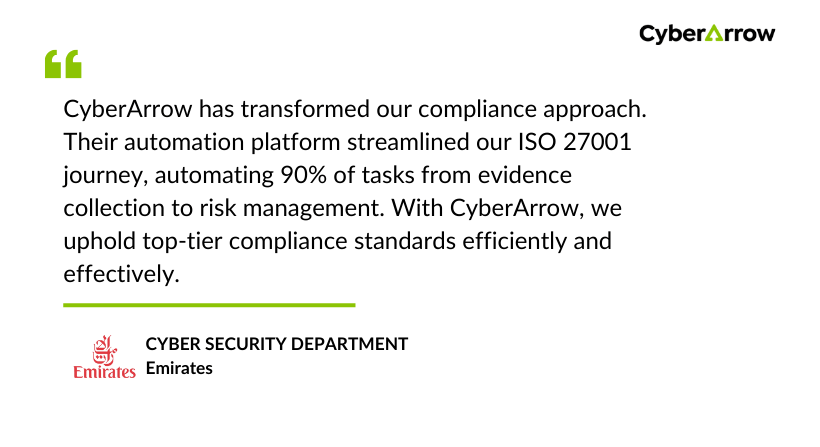
Read how Emirates enhanced Information Security by automating ISO 27001 with CyberArrow GRC.
See what Emirates has to say about CyberArrow GRC: