How many controls in ISO 27001: A complete guide
Are you struggling to understand ISO 27001 controls and their relevance to your organization? Perhaps you’re wondering how to efficiently monitor and maintain compliance with this essential standard. Plus, with the latest ISO 27001:2022 updates, it’s crucial to stay informed about the changes that impact your security management framework.
This guide provides a deep dive into ISO 27001 controls, focusing on the 2022 version, and demonstrates how CyberArrow GRC’s automation features can transform your compliance journey. By the end, you’ll have a clear understanding of these controls and why automated solutions are the future of compliance management.
What Is ISO 27001?
ISO 27001 is an international standard for establishing, implementing, maintaining, and continually improving an information security management system (ISMS). This framework ensures organizations can systematically manage sensitive data, mitigate risks, and ensure compliance with various regulatory requirements like GDPR and HIPAA.
The standard includes Annex A, a comprehensive set of controls to address potential risks and safeguard information assets. The latest 2022 version has streamlined these controls, making them more relevant to today’s digital landscape.
Understanding ISO 27001:2022 controls
ISO 27001:2022 introduces a revamped structure of 93 controls in Annex A. This is a reduction from the 114 controls in the 2013 version due to merging similar controls and introducing 11 new ones tailored for modern cybersecurity challenges.
Categories of controls
The controls are divided into four categories:
| Category | Description | Number of controls |
| Organizational | Focus on governance, risk management, and policies | 37 |
| People | Address human-related security risks | 8 |
| Physical | Secure physical assets and environments | 14 |
| Technological | Protect IT systems and data | 34 |
Breakdown of ISO 27001 controls
Organizational controls
Organizational controls include risk management, incident response planning, and information security policies. These controls form the backbone of your ISMS.
| Control | Objective |
| Information security policies | Ensure clear, documented policies are in place |
| Risk assessment | Identify, evaluate, and mitigate risks |
| Asset management | Maintain a register of information assets |
People controls
These controls focus on minimizing human error and insider threats through training and user access management.
| Control | Objective |
| Security awareness training | Educate staff on security best practices |
| Background checks | Ensure the integrity of personnel |
| User access management | Restrict access based on roles and needs |
Physical controls
Physical controls secure the physical premises, hardware, and infrastructure.
| Control | Objective |
| Secure areas | Limit access to sensitive areas |
| Equipment maintenance | Ensure hardware functions reliably |
| Physical access controls | Prevent unauthorized physical access |
Technological controls
Technological controls are vital for safeguarding IT systems, networks, and data.
| Control | Objective |
| Endpoint security | Protect devices from threats |
| Data encryption | Ensure data confidentiality |
| Vulnerability management | Identify and mitigate technical vulnerabilities |
What’s new in ISO 27001:2022?
The 2022 version includes 11 new controls designed to address emerging security risks:
- Threat intelligence
- Information security for the use of cloud services
- Information and communications technology for business continuity
- Physical security monitoring
- Configuration management
- Information deletion
- Data masking
- Data leakage prevention
- Monitoring activities
- Web filtering
- Secure coding
Why are ISO 27001 controls important?
Implementing ISO 27001 controls is essential for:
- Risk mitigation: Minimize vulnerabilities and enhance resilience.
- Regulatory compliance: Meet legal and industry requirements like GDPR.
- Customer trust: Demonstrate your commitment to data security.
- Operational efficiency: Streamline security management processes.
Challenges in managing ISO 27001 controls
While ISO 27001 provides a solid framework, managing its controls can be challenging:
- Complex documentation: Tracking policies, procedures, and evidence manually is time-consuming.
- Evolving threats: Security risks are constantly changing, requiring regular updates.
- Resource constraints: Small teams often struggle to dedicate sufficient time to compliance tasks.
How CyberArrow GRC simplifies ISO 27001 compliance
Achieving and maintaining ISO 27001 compliance is no small feat. It involves meticulous planning, constant monitoring, and regular updates to your ISMS (Information Security Management System). This can be time-consuming and prone to human error. CyberArrow GRC takes the guesswork out of the equation and provides a streamlined, automated approach to compliance management.
Here’s how CyberArrow GRC makes your ISO 27001 compliance journey seamless:
1. Automated control monitoring
CyberArrow GRC enables organizations to monitor their ISO 27001 controls in real time. Instead of relying on manual updates, the platform integrates with your existing systems to provide live updates on the effectiveness of your controls. Alerts and notifications ensure you’re informed when any control falls below the required standard, allowing you to act quickly and efficiently.
2. Comprehensive compliance dashboard
The CyberArrow GRC platform offers a user-friendly dashboard that gives you a bird’s-eye view of your compliance status. Whether you need to track the implementation of Annex A controls or assess the progress of corrective actions, all the information is available at your fingertips. This centralized view ensures that your team stays on the same page and eliminates unnecessary delays.
3. Effortless document management
ISO 27001 requires extensive documentation for audits and certification. CyberArrow GRC simplifies document management by storing all necessary policies, procedures, and evidence in one secure location. It also supports version control, ensuring you always have the latest documents ready for review.
4. Risk assessment and treatment
With CyberArrow GRC, conducting a risk assessment becomes a straightforward process. The platform automates risk identification, categorization, and treatment plans, helping you address vulnerabilities without excessive manual effort. It also aligns risk management processes with ISO 27001 requirements, ensuring nothing is overlooked.
5. Audit readiness made easy
Preparing for ISO 27001 audits can be stressful and time-consuming. CyberArrow GRC ensures your organization is always audit-ready by maintaining accurate records, generating comprehensive reports, and tracking corrective actions. With all your compliance data in one place, auditors can easily verify your adherence to ISO 27001 standards.
6. Seamless collaboration across teams
Compliance often requires input from multiple departments, and managing communication can be a challenge. CyberArrow GRC facilitates collaboration by assigning tasks, tracking progress, and ensuring accountability across teams. This not only reduces silos but also fosters a culture of proactive compliance.
7. Scalability for growing organizations
Whether you’re a small business just starting with ISO 27001 or a large enterprise with complex requirements, CyberArrow GRC scales to meet your needs. Its customizable features allow you to adapt the platform to your unique processes, ensuring continued compliance as your organization grows.
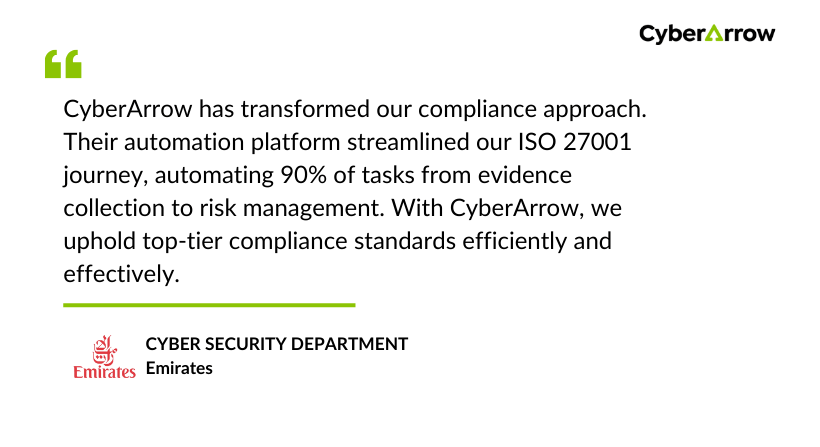
See what Emirates has to say about CyberArrow GRC: