What is SaaS security? Everything you need to know
SaaS security refers to the measures and practices that protect software-as-a-service (SaaS) applications from unauthorized access, data breaches, and cyber threats. SaaS platforms have become essential for businesses, offering convenience, scalability, and cost-efficiency. However, they also pose unique security challenges due to their reliance on cloud environments and shared infrastructure.
This blog will dive into SaaS security, the risks involved, the standards that govern SaaS businesses, and how you can secure your applications. We’ll also explore how tools like CyberArrow GRC can help you meet compliance requirements and safeguard your SaaS business.
What is SaaS?
SaaS (Software-as-a-Service) is a cloud-based delivery model where applications are hosted by a service provider and accessed by users over the internet. Examples of popular SaaS applications include Google Workspace, Microsoft 365, Salesforce, and Slack.
Unlike traditional software, SaaS eliminates the need for physical installations, making it easier for businesses to scale and manage their operations. But with these benefits come security risks that need robust safeguards.
Why is SaaS security important?
SaaS applications often handle sensitive business and customer data, making them prime targets for cyberattacks. Without proper security measures, businesses risk exposing their data to breaches, losing customer trust, and facing regulatory penalties.
Key reasons why SaaS security matters:
- Data protection: SaaS platforms store large volumes of sensitive information. A breach could result in significant financial and reputational damage.
- Compliance: Businesses must comply with security standards like GDPR, CCPA, or ISO 27001 to avoid fines.
- Business continuity: Attacks like ransomware can disrupt operations, leading to costly downtime.
- User trust: Securing SaaS applications builds confidence among users and stakeholders.
Common SaaS security risks
1. Data breaches
Unauthorized access to sensitive data is one of the most significant risks. Breaches can result from weak passwords, phishing attacks, or misconfigured settings.
2. Misconfigurations
Improperly configured SaaS platforms can create vulnerabilities, leaving data exposed to attackers.
3. Account hijacking
Hackers can gain access to user accounts through stolen credentials, enabling them to exploit sensitive information or systems.
4. Lack of visibility
Organizations often lack visibility into who accesses their SaaS applications and how data is used, leading to unchecked risks.
5. Third-party risks
SaaS providers often rely on third-party integrations. If these integrations are not secure, they can become an entry point for attackers.
SaaS security best practices
1. Access control
- Use strong authentication methods like multi-factor authentication (MFA) to ensure that only authorized users can access your applications.
- Implement role-based access controls (RBAC) to limit user permissions based on their responsibilities.
2. Data Encryption
- Encrypt data at rest and in transit to prevent unauthorized access, even if it is intercepted.
- Ensure your SaaS provider follows robust encryption protocols.
3. Regular audits and monitoring
- Conduct regular security audits to identify and fix vulnerabilities.
- Use monitoring tools to track access and identify unusual activity.
4. Backup and recovery
- Regularly back up your data and have a disaster recovery plan in place to minimize downtime in case of a breach or failure.
5. Vendor assessment
- Ensure your SaaS provider complies with relevant security standards and has a solid track record of protecting customer data.
6. User training
- Educate employees about security risks like phishing and social engineering to reduce the chances of human error leading to breaches.
Quick link: CCPA vs GDPR
Compliance standards for SaaS businesses
SaaS providers and users must adhere to specific security and privacy regulations. Some of the key standards include:
1. General Data Protection Regulation (GDPR)
This European regulation requires businesses to protect personal data and provide transparency on how it is used.
2. California Consumer Privacy Act (CCPA)
CCPA mandates businesses to give California residents control over their personal information, including the right to access and delete data.
3. ISO/IEC 27001
This international standard provides a framework for information security management systems (ISMS) to ensure data protection.
4. SOC 2 (Service Organization Control 2)
SOC 2 focuses on data security, availability, processing integrity, confidentiality, and privacy. It is a key requirement for SaaS businesses.
5. HIPAA (Health Insurance Portability and Accountability Act)
SaaS providers handling healthcare data must comply with HIPAA to ensure patient information is protected.
6. PCI DSS (Payment Card Industry Data Security Standard)
For SaaS businesses dealing with payment data, PCI DSS compliance is essential for securing cardholder information.
How CyberArrow GRC simplifies SaaS security
SaaS security is not just an option; it’s a necessity in today’s digital age. As SaaS adoption grows, so do the risks associated with data breaches, misconfigurations, and compliance failures. Following best practices, adhering to relevant standards, and leveraging tools like CyberArrow GRC can help you secure your SaaS applications effectively.
Why choose CyberArrow GRC?
CyberArrow GRC offers an all-in-one platform to help SaaS businesses:
- Automate compliance: CyberArrow GRC streamlines compliance with standards like GDPR, CCPA, and ISO 27001, saving time and reducing manual effort.
- Improve data security: The platform helps identify risks, enforce access controls, and ensure data protection measures are in place.
- Monitor and report: Gain real-time insights into your compliance status and generate detailed reports for audits.
- Simplify risk management: CyberArrow GRC provides tools to assess and mitigate risks, ensuring your SaaS applications remain secure.
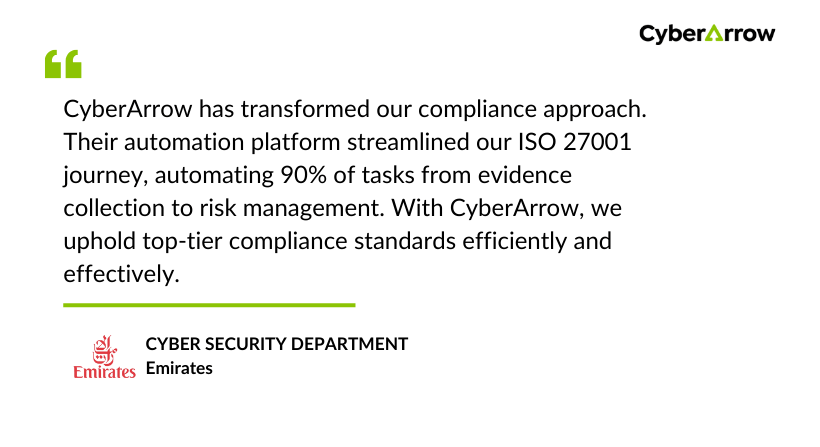
Read how Emirates enhanced Information Security by automating ISO 27001 with CyberArrow.
See what Emirates has to say about CyberArrow GRC: