What is a HIPAA-covered entity?
Think about all the personal details you share at a doctor’s office—from your medical history to insurance information. We trust healthcare providers to keep this sensitive information private. But with so much of today’s healthcare system going digital, protecting that data has become a big challenge. The U.S. government created HIPAA, a set of rules that specific healthcare organizations must follow to ensure patient information stays safe.
These organizations, called “HIPAA-covered entities,” include hospitals, insurance companies, and other groups that handle patient data. Being a HIPAA-covered entity means following specific rules to keep information secure and private.
So, what exactly makes an organization a HIPAA-covered entity, and what does that mean for them and their patients?
Let’s break down the basics and why it’s essential for healthcare today.
- What is a HIPAA-covered entity?
- Rights and responsibilities of HIPAA-covered entities
- Examples of HIPAA-covered entities in practice
- HIPAA-covered entity vs. business associate: What's the difference?
- Common challenges faced by HIPAA-covered entities
- How to achieve and maintain HIPAA compliance as a covered entity
- Overcome HIPAA compliance challenges with CyberArrow
What is a HIPAA-covered entity?
A HIPAA-covered entity is an organization that must comply with HIPAA regulations to protect sensitive health information. HIPAA broadly defines these entities as healthcare providers, health plans, and healthcare clearinghouses that electronically transmit patient health information. Covered entities must follow HIPAA’s Privacy, Security, and Breach Notification Rules to ensure they handle patient data responsibly.
Covered entities are responsible for protecting patient data confidentiality, securing electronic transactions, and providing specific rights to patients regarding their health information.
Types of HIPAA-covered entities
To understand whether an organization qualifies as a HIPAA-covered entity, it’s helpful to look at the three primary types of covered entities defined under HIPAA:
- Healthcare providers: These include doctors, dentists, psychologists, hospitals, and pharmacies. Any healthcare provider that electronically transmits health information, such as for billing or insurance claims, is a covered entity.
- Health plans: Organizations that pay for medical care, such as health insurance companies, HMOs, Medicare, Medicaid, and employer-sponsored health plans. They handle sensitive information on a large scale, making HIPAA compliance essential.
- Healthcare clearinghouses: Clearinghouses act as intermediaries that process or facilitate electronic transactions between healthcare providers and insurers. They standardize data and ensure that claims and other information are in the correct format.
Each entity type has unique requirements under HIPAA, though all share the responsibility of securing health information.
Rights and responsibilities of HIPAA-covered entities
Being classified as a HIPAA-covered entity comes with specific rights and responsibilities.
Here’s what each entity needs to keep in mind:
- Patient data protection
Covered entities must take proactive steps to protect patient information, such as implementing security measures like encryption, data access controls, and staff training.
- Data sharing limitations
Covered entities can only share patient information with authorized individuals or entities and must obtain patient consent when necessary.
- Patient rights
Patients have the right to access their health records, request corrections, and receive information about who has accessed their data. Covered entities must ensure patients can exercise these rights easily.
- Breach notification
In the event of a data breach, covered entities must notify affected individuals and report the breach to the Department of Health and Human Services (HHS) if it affects more than 500 individuals.
These responsibilities are critical for maintaining trust between healthcare providers and patients and ensuring compliance with HIPAA’s strict standards.
Examples of HIPAA-covered entities in practice
To make things clearer, let’s look at some practical examples of HIPAA-covered entities:
- A small clinic using an electronic health record (EHR) system
Even small clinics that use EHR systems to handle patient information must comply with HIPAA regulations, as they electronically transmit patient data.
- A pharmacy submitting claims electronically to insurance companies
Pharmacies that submit claims electronically are considered covered entities. They must take extra steps to secure patient prescriptions and healthcare records.
- Health insurance companies managing members’ medical claims
As health plans, insurance companies are covered entities responsible for keeping policyholders’ medical and billing information private.
HIPAA-covered entity vs. business associate: What’s the difference?
Not every organization handling patient data is a covered entity. Some are classified as “business associates.” Business associates are individuals or entities that perform certain services for or on behalf of a covered entity involving access to patient data. This includes third-party billing firms, cloud service providers, and IT consultants.
While business associates are not covered entities, they are bound by HIPAA rules through Business Associate Agreements (BAAs), which set out how to protect patient data. Business associates play a critical support role for covered entities, ensuring HIPAA compliance at every level of data processing and handling.
HIPAA rules for business associates
- Security measures:
- Administrative, physical, and technical safeguards must be implemented to protect PHI, similar to the requirements for covered entities.
- Breach reporting:
- Required to report any PHI breaches within 60 days.
- Some Business Associate Agreements (BAAs) may require faster reporting.
- Privacy provisions:
- Limit the use and disclosure of PHI strictly to what is necessary for their work.
- Cooperate with investigations by the Department of Health and Human Services (HHS).
- Avoid retaliation against individuals who file HIPAA complaints.
- Ensure that any subcontractors also comply with HIPAA requirements.
Common challenges faced by HIPAA-covered entities
HIPAA compliance can be challenging, especially for smaller organizations or those new to the healthcare industry. Common issues include:
- Complexity of regulations: HIPAA’s Privacy and Security Rules are extensive, making it challenging for some entities to understand and implement them fully.
- Risk of data breaches: Covered entities, particularly those handling large volumes of data, face significant risks of cyberattacks. Implementing adequate security measures can be costly and technically challenging.
- Maintaining patient trust: A data breach can erode patient trust. To reassure patients, covered entities must constantly work to maintain high standards of data protection.
How to achieve and maintain HIPAA compliance as a covered entity
For covered entities, achieving and maintaining HIPAA compliance requires a proactive approach and dedication to safeguarding patient information. Here are some key steps to help ensure compliance:
- Conduct regular risk assessments: Regular risk assessments are essential for identifying vulnerabilities within an organization’s systems. By understanding these risks, covered entities can address weaknesses before they lead to data breaches.
- Provide thorough employee training: Educating employees on HIPAA regulations and best practices for data security helps reduce the likelihood of accidental breaches. Regular training sessions ensure staff members are up-to-date on the latest compliance requirements.
- Implement strong security measures: Robust security controls are critical for protecting patient data. Covered entities should use encryption, two-factor authentication, and physical safeguards to secure digital and physical records.
- Monitor and audit consistently: Regular monitoring of data access and conducting periodic audits can help detect any potential compliance issues early. This ongoing oversight ensures that organizations remain compliant over time and can quickly resolve any security lapses.
Overcome HIPAA compliance challenges with CyberArrow
Managing HIPAA compliance is no small task, especially when the stakes involve protecting sensitive patient information. CyberArrow offers a comprehensive solution for covered entities looking to streamline their compliance efforts.
CyberArrow is a compliance automation platform that assists healthcare providers, insurers, and other covered entities in easily managing HIPAA requirements.
Why choose CyberArrow?
- Automated compliance tracking: Monitor HIPAA compliance in real-time and ensure you’re always HIPAA audit-ready.
- Centralized Documentation: Store and manage HIPAA-related documents securely in one place for easy access during audits.
- Risk assessment tools: Identify and mitigate risks efficiently with built-in assessment tools tailored for healthcare organizations.
- Streamlined reporting: Report incidents quickly and accurately, ensuring compliance with breach reporting timelines.
- Dedicated support: Get help from CyberArrow’s support team for guidance on compliance challenges.
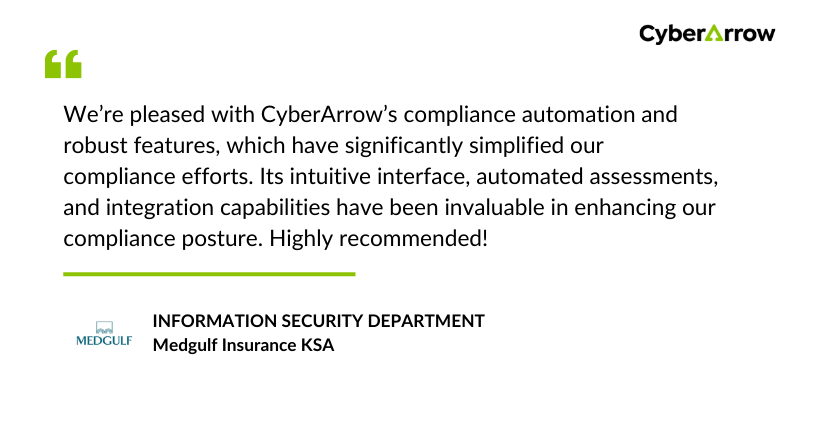
See what companies like Medgulf Insurance say about CyberArrow: