


Inherent vs. residual risk assessments: Understanding the difference
Every business faces risks. From data breaches to financial losses, risks are everywhere. But not all risks are the same. Some are present from the start, while others emerge after you’ve taken action to control them. These are known as inherent risks and residual risks. Understanding the difference between them can transform your approach to managing threats.
Without a clear grasp of inherent and residual risks, businesses often end up with weak controls and missed opportunities. Ineffective risk management not only puts your business at risk but also can lead to compliance issues, penalties, and a damaged reputation.
This guide will break down the meaning of inherent risk and residual risk, why they matter, and how to manage them effectively. Plus, we’ll show you how automating the process through tools like CyberArrow GRC can simplify and strengthen your risk management strategy.
What is inherent risk?
Inherent risk refers to the level of risk that exists before any control measures are applied. It is the baseline level of risk stemming from business activities, processes, or technologies.
Example of inherent risk
Consider a business that processes online transactions. From the start, it faces an inherent risk of cyberattacks due to the sensitive data involved. Before any security controls, such as firewalls or encryption, this level of risk is purely inherent.
Key Points:
- Independent of controls: It represents the risk before any controls are put in place.
- Industry and nature dependence: Inherent risk levels vary based on industry specifics and business activities.
What is residual risk?
Residual risk is what remains after applying controls to reduce inherent risk. It represents the “leftover” risk that persists despite risk management efforts.
Example of residual risk
Returning to our online transaction example, assume that strong controls are put in place, such as data encryption and multifactor authentication. These measures lower the risk of cyberattacks but do not eliminate it. This remaining risk is known as residual risk.
Key points:
- Post-control risk: Residual risk reflects the level of risk after control measures have been implemented.
- Continuous monitoring: Residual risks require ongoing management to ensure they remain acceptable.
Why understanding inherent and residual risk matters
1. Better risk strategies
Identifying inherent risks helps you prioritize which areas need the most attention. Meanwhile, understanding residual risks shows you how effective your controls are and whether more is needed.
2. Cost efficiency
Focusing on inherent risks helps allocate resources wisely. Monitoring residual risks ensures you’re not overspending or underinvesting in controls.
3. Compliance requirements
Many regulations, like ISO 27001, require businesses to identify and manage both inherent and residual risks as part of their compliance efforts.
How to assess inherent and residual risks
- Identify risks: Create a list of potential risks affecting your organization, such as data breaches, compliance violations, or operational failures.
- Assess inherent risks: Assign risk levels (low, medium, high) based on the likelihood and impact of each risk, ignoring any existing controls.
- Implement controls: Develop measures, such as policies, processes, or technologies, to reduce risk exposure.
- Assess residual risks: Re-evaluate the risks, this time considering the controls in place. This score represents your residual risk.
- Regular monitoring: Continuously review and update your assessments to stay ahead of new threats and changing conditions.
Key differences between inherent and residual Risk
| Aspect | Inherent Risk | Residual Risk |
| Definition | Risk before controls | Risk after applying controls |
| Control Influence | Not affected by controls | Considers controls and mitigations |
| Purpose | Sets the baseline for risk management | Measures effectiveness of controls |
| Focus Area | Highlights the need for controls | Shows remaining risk level after mitigation |
Common challenges in risk assessment
Misjudging risks: Underestimating inherent or residual risks can lead to gaps in controls.
- Resource allocation: Inefficient use of resources may occur if risks are misunderstood.
- Non-compliance: Failing to manage residual risks can result in compliance failures.
Automating risk management with CyberArrow GRC
Managing inherent and residual risks manually is complex and prone to error. This is where CyberArrow GRC’s automated risk management module shines.
Why CyberArrow GRC?
- Automatic risk scoring: Effortlessly calculate inherent and residual risks, freeing up valuable time.
- Integrated control mapping: Easily map controls to specific risks, track their effectiveness, and make informed decisions.
- Real-time monitoring: Stay informed on risk levels and adjust quickly to evolving threats.
- Compliance made simple: Keep your risk management practices aligned with industry standards, including ISO, NIST, and others.
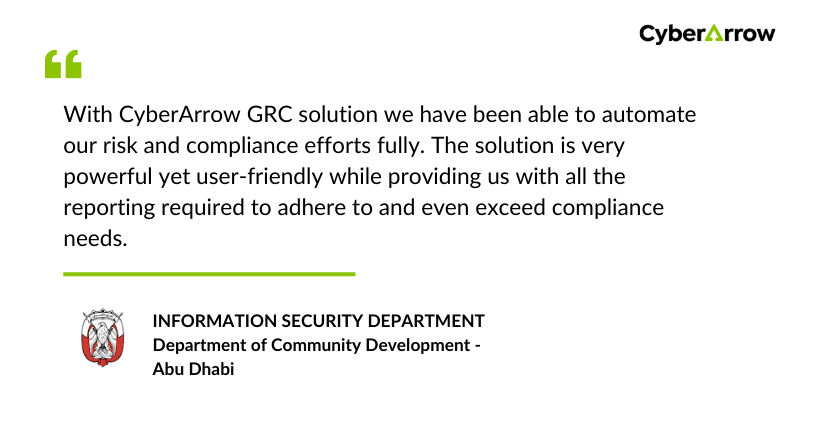
See what DCD – Abu Dhabi has to say about CyberArrow GRC:
Conclusion
Understanding the difference between inherent risk and residual risk is key to building a strong risk management strategy. By evaluating both types of risks, you can make smarter decisions, allocate resources efficiently, and strengthen your overall risk posture. Automated tools like CyberArrow GRC take it a step further, simplifying risk assessments and helping organizations stay compliant in an ever-changing landscape.
