What is Kerberoasting? How to prevent it?
Attackers are always looking for ways to breach networks and steal sensitive information. One of the lesser-known but highly dangerous attack methods is called Kerberoasting. While this term may sound complicated, the concept behind it is something every business should be aware of.
In this blog, we’ll break down what Kerberoasting is, how attackers use it, and most importantly, how you can protect your business from falling victim to this type of attack.
What is Kerberoasting?
Kerberoasting is a type of cyber attack that targets a company’s Kerberos authentication system. Kerberos is a security protocol that authenticates users and devices on a network, commonly used in Windows environments. It helps users securely log in to systems by issuing tickets instead of sending passwords over the network.
In a Kerberoasting attack, hackers exploit the way Kerberos handles service tickets. These tickets contain information that hackers can crack to get access to a user’s password. If successful, attackers can gain control of sensitive user accounts, such as those with administrative privileges. Once inside, they can steal data, take over systems, or perform other malicious activities.
How does Kerberoasting work?
Here’s a step-by-step breakdown of how a Kerberoasting attack works:
1. Reconnaissance: The attacker gains initial access to the network. This could be through phishing emails, weak passwords, or exploiting vulnerabilities in the system. Once inside, they start gathering information about the network.
2. Requesting service tickets: The attacker requests a service ticket from the Kerberos system. This ticket is used by Kerberos to authenticate users and is tied to a specific service account. Service accounts often have higher privileges than regular user accounts.
3. Extracting ticket data: Once the attacker has the service ticket, they can extract its encrypted data, including the hashed password of the service account. This information is saved locally for further cracking.
4. Password cracking: The attacker then uses special tools to crack the password hash offline. Since this process happens outside the network, traditional detection systems may not catch it. Passwords that are weak or commonly used are cracked more quickly.
5. Gaining privileged access: After successfully cracking the service account’s password, the attacker can log in as that user. If the account has administrative privileges, they can now move freely across the network, steal data, or cause other damage.
Why is Kerberoasting dangerous?
Kerberoasting is particularly dangerous for several reasons:
1. Targets high-privilege accounts: Kerberoasting often focuses on service accounts, which typically have more access than regular user accounts. Once attackers gain access to these accounts, they can control large parts of the network.
2. Offline password cracking: One of the key dangers of Kerberoasting is that the actual password cracking happens offline. This makes it much harder for security teams to detect the attack until it’s too late.
3. Weak password vulnerability: Weak or easily guessable passwords make the process of cracking service accounts faster and easier for attackers. Many businesses still use weak passwords, leaving them exposed to this type of attack.
4. Hard to detect: Since Kerberos tickets are a normal part of network authentication, it can be hard to detect when an attacker is misusing them. The attack blends in with regular network activity, making traditional security tools less effective.
Quick link: SiFi automates PDPL compliance with CyberArrow
How to prevent Kerberoasting attacks
Preventing Kerberoasting attacks requires a proactive approach. Below are the best strategies businesses can implement to reduce the risk of a successful attack:
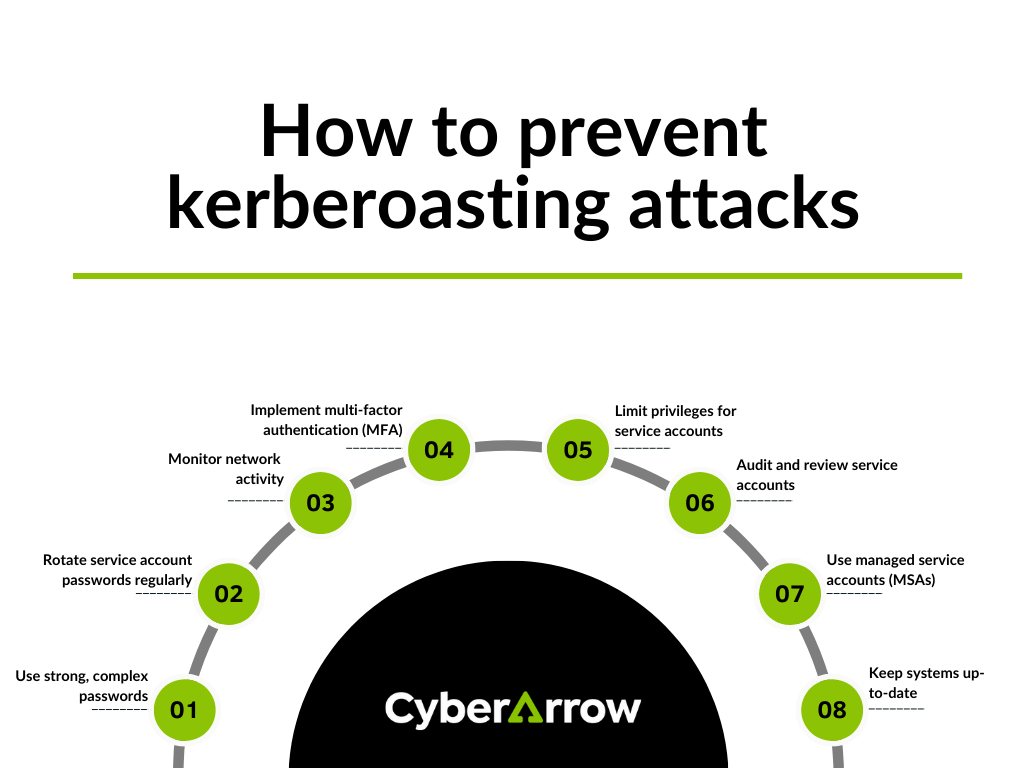
1. Use strong, complex passwords
One of the most important steps in preventing Kerberoasting is using strong passwords for service accounts. Avoid using simple or common passwords, as these are much easier for attackers to crack. Instead, use long and complex passwords that combine letters, numbers, and special characters. Passwords should be at least 12-16 characters long.
2. Rotate service account passwords regularly
Many organizations fail to change their service account passwords on a regular basis. This makes it easier for attackers to crack them over time. By rotating service account passwords every few months, you reduce the window of opportunity for attackers to break in.
3. Monitor network activity
Monitoring your network for unusual activity is key to detecting potential Kerberoasting attacks. Set up alerts to notify your security team if there are an unusual number of service ticket requests. This can help catch an attacker early in the process before they extract or crack any ticket data.
4. Implement multi-factor authentication (MFA)
Multi-factor authentication adds an extra layer of security to your accounts. Even if an attacker manages to crack a service account’s password, they won’t be able to log in without the second form of authentication, such as a text code or an authentication app. This reduces the effectiveness of Kerberoasting attacks.
5. Limit privileges for service accounts
Make sure that service accounts have the minimum amount of access needed to perform their duties. Don’t give service accounts unnecessary administrative privileges, as this increases the damage an attacker can do if they gain access.
6. Audit and review service accounts
Regularly audit all service accounts to ensure they are still needed. Remove any unused or outdated service accounts to reduce the attack surface. This reduces the number of targets that an attacker can use for kerberoasting.
7. Use Managed Service Accounts (MSAs)
Managed Service Accounts (MSAs) automatically handle password management and rotation for service accounts. By using MSAs, you can reduce the risk of weak or expired passwords and make it harder for attackers to exploit Kerberos tickets.
8. Keep systems up-to-date
Always keep your software and systems up-to-date. Kerberoasting attacks often target vulnerabilities in older systems or outdated security patches. By regularly updating your system, you close security holes that could otherwise be exploited.
How CyberArrow Awareness Platform can help!
Kerberoasting attacks can cause serious damage to your business, but with the right security practices, you can defend your network. One of the most effective ways to strengthen your defenses is through security awareness and training.
The CyberArrow Awareness Platform is designed to help businesses stay ahead of cyber security threats by automating security awareness programs for employees. With CyberArrow, your team can learn how to recognize and respond to advanced cyberattacks like Kerberoasting before they become a problem.
The platform also provides customizable training modules that cover real-world attack scenarios, helping employees at all levels understand the importance of strong passwords, multi-factor authentication, and other security best practices.
See what Silal has to say about CyberArrow: