

CyberArrow vs. OneTrust: Which is the best GRC platform for your business?
Choosing the right Governance, Risk, and Compliance (GRC) platform is a crucial decision for businesses today. With regulatory requirements increasing in complexity, companies need a solution that helps them manage compliance, streamline processes, and reduce risks. Two popular options in the market are CyberArrow and OneTrust. Both offer powerful tools to manage compliance, but they serve different business needs.
In this article, we’ll examine both platforms, compare their features, and help you decide which one is the best GRC software and a better fit for your business.
What does CyberArrow offer?
CyberArrow is a powerful GRC platform designed to simplify compliance, risk management, and governance processes, especially for businesses looking for an integrated approach. The platform offers several key features that make it a great choice for organizations that want to manage their risks efficiently and ensure ongoing compliance.
One of CyberArrow’s standout features is its enterprise risk management capabilities. CyberArrow GRC enables different parts of the business to collaborate on governance, risk, and compliance by breaking down barriers between departments.
Its intuitive interface and user-friendly features, CyberArrow makes it easy for teams across the organization to work together on risk management and compliance. Users can access real-time reports and updates on risks, ensuring they stay informed and compliant.
Moreover, this OneTrust alternative automates many GRC tasks, including risk analysis, compliance reporting, and audit processes. This saves businesses time and reduces the chance of human error.
What does OneTrust offer?
OneTrust is a GRC platform that helps organizations manage risks and ensure security compliance. The platform centralizes policy management using pre-built templates and real-time reporting, allowing businesses to stay compliant more efficiently.
OneTrust offers automation features like evidence collection to streamline compliance tasks, but its complexity can be overwhelming for some users, especially smaller businesses. It also supports third-party risk management by tracking vendor information through a centralized inventory, although it may not provide the simplicity and flexibility that CyberArrow offers.
The platform also simplifies external auditor collaboration, making it easier for organizations to manage audits and ensure compliance with various regulations.
CyberArrow vs. OneTrust: At a glance
To help you decide which platform is best for your business, we’ve created a quick comparison table highlighting key features of CyberArrow and OneTrust.
While both platforms offer essential GRC tools, CyberArrow GRC excels in areas such as ease of use, automation, and cost-efficiency, making it a stronger choice for many businesses.
| Features | CyberArrow | OneTrust |
| Ease of use | Simple, intuitive UI and easy to use | More complex interface with a steeper learning curve |
| Automation capabilities | Fully automated GRC coverage (risk, governance, audit). Ideal for organizations that require broader GRC capabilities | Robust but less tailored automation options |
| Risk management | Advanced risk management Integrated, real-time risk insights with clear dashboards for faster decision-making | Offers risk management but lacks real-time unified insights |
| Customization | Highly customizable workflows and reports to fit specific business needs | Extensive customization but may require additional resources |
| Policy management | Flexible policy management with easy-to-update templates and custom workflows | Pre-built templates with less room for customization |
| Audit management | Automates audit trails and evidence collection, making audits more efficient | Strong audit features, but with a heavier manual setup |
| Integrations | Broad integrations with other enterprise tools | Extensive integrations, but more challenging to configure and maintain |
CyberArrow vs. OneTrust: In-depth feature comparison
When choosing the right GRC platform for your business, it is crucial to understand the critical differences between CyberArrow and OneTrust. Below is a closer look at each platform’s core features.
1. Ease of use
- CyberArrow: One of the standout aspects of CyberArrow GRC is its user-friendly interface. The platform is designed with simplicity, allowing technical and non-technical users to navigate the system easily. This makes it ideal for businesses with a quick learning curve and minimal training requirements.
- OneTrust: While OneTrust offers a wide range of powerful features, it tends to have a steeper learning curve, especially for smaller teams or businesses without dedicated GRC experts. Its interface is robust but can feel cluttered.
2. Automation capabilities
- CyberArrow: CyberArrow excels at automation, offering extensive capabilities for automating compliance tasks, evidence collection, risk assessments, and audit trails. Its flexible automation engine allows businesses to easily configure workflows to meet specific regulatory requirements without manual intervention.
- OneTrust: While OneTrust also offers automation, it tends to be more rigid. The platform provides automated solutions for evidence collection and compliance tracking, but its automation settings lack depth. Moreover, linking policies to controls and mapping them to the readiness project requires manual intervention.
3. Risk management
- CyberArrow: CyberArrow provides a comprehensive, real-time view of enterprise risks, including third- and fourth-party risks. It integrates risk data from various departments, ensuring a holistic view.
- OneTrust: OneTrust offers strong risk management capabilities, but it is better suited for larger organizations with more complex needs. While it covers third-party risk management, its extensive features can be overwhelming for smaller businesses.
4. Customization
- CyberArrow: One of CyberArrow’s significant advantages is its high level of customization. Businesses can tailor workflows, reports, and dashboards to meet specific needs, ensuring the platform works precisely as required. This flexibility is especially beneficial for companies of all sizes that need to adapt their GRC processes quickly to comply with new regulations or market demands.
- OneTrust: OneTrust offers some customization but tends to be more rigid than CyberArrow. It’s more template-driven, and while this can be useful for enterprises looking for predefined solutions, it might not offer the same level of flexibility for businesses that need more tailored processes.
5. Audit management
- CyberArrow: CyberArrow truly shines in audit management. The platform automates audit trails, evidence collection, and reporting, ensuring businesses are always audit-ready. This makes audits faster, more efficient, and less prone to errors, a major advantage for businesses with limited resources for compliance tasks.
- OneTrust: OneTrust offers solid audit management features but requires more manual setup and management than CyberArrow. While it automates evidence collection, the overall audit process may require more hands-on involvement, which can disadvantage teams.
7. Integrations
- CyberArrow: CyberArrow offers seamless integration with other business tools and systems, ensuring that GRC processes are fully integrated into the broader IT landscape. These integrations are easy to configure, allowing businesses to connect their GRC workflows with existing systems without complications.
- OneTrust: OneTrust has many integrations, but configuring them can be more complex and time-consuming. While the platform supports numerous systems, it often requires more technical expertise to set up and maintain these integrations effectively.
Why CyberArrow is the better choice
CyberArrow and OneTrust offer powerful GRC capabilities, but CyberArrow stands out for its ease of use, flexibility, and comprehensive automation. For SMBs, large enterprises, or organizations that need a highly customizable, user-friendly platform to manage risk and compliance, CyberArrow is a clear choice.
Its intuitive interface and advanced automation make it a perfect fit for industries with fast-paced regulatory environments.
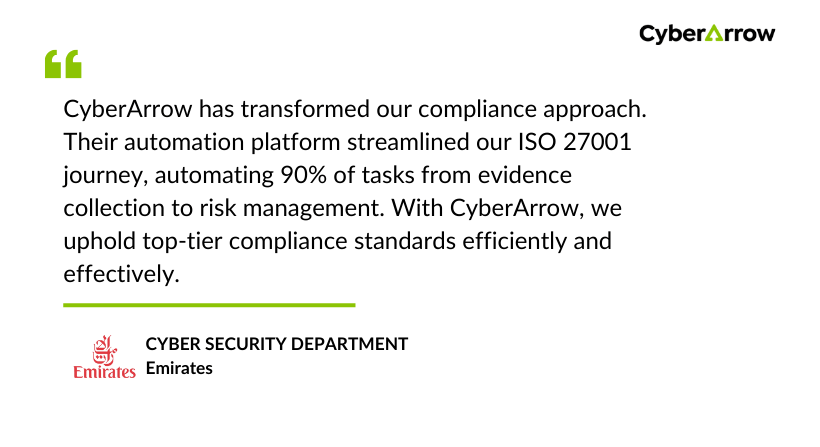
Don’t take our word for it; see what companies like Emirates say about CyberArrow GRC:
Are you ready to simplify compliance risk management and enhance your organization’s resilience?
