What is a whaling phishing attack?
Phishing attacks are one of the most common forms of cyber threats today. However, not all phishing attacks are the same. One of the most dangerous types is called whaling phishing. In this blog, we’ll break down exactly what a whaling phishing attack is, why it’s so harmful to organizations, and what you can do to protect your business from it.
By the end, you’ll understand how these attacks target high-level executives and why your organization should take them seriously.
What is whaling phishing?
A whaling phishing attack is a specific type of phishing attack aimed at senior executives, such as CEOs, CFOs, or other high-ranking employees. The term “whaling” comes from the idea that these attacks target “big fish” (executives) within an organization, making them more dangerous and valuable to cybercriminals.
Unlike regular phishing attacks, which may target any employee, whaling phishing attacks are carefully planned and executed to deceive high-level decision-makers. Hackers use detailed information to make their emails look legitimate, often impersonating trusted contacts or business partners.
How does a whaling phishing attack work?
Whaling phishing attacks usually follow a set pattern, making them hard to spot if you’re not aware of the warning signs. Here’s how a typical attack unfolds:
Research and planning: Hackers first gather information about the target. They might search through social media, company websites, or public records to find out details about the executive’s role, business partners, or upcoming events.
Creating a fake message: Once they have enough information, the attackers craft a message that looks legitimate. This could be an email, a message on LinkedIn, or even a phone call. The message will usually ask the executive to approve a financial transaction, provide sensitive information, or click on a malicious link.
Deception: The message is carefully designed to appear urgent and important, often mimicking communication from a trusted source like a business partner, colleague, or legal entity. Because the target is a senior executive, the attackers assume they may be too busy to carefully examine the message.
The attack: If the target takes the bait—clicking on the link or providing the requested information—the attackers can steal data, gain access to corporate accounts, or even transfer money.
Examples of whaling phishing attacks
To better understand how dangerous whaling phishing can be, here are a few real-life examples of these attacks:
- Ubiquiti Networks (2015): Hackers targeted the CFO of Ubiquiti Networks with a whaling phishing attack, tricking the executive into transferring over $46 million to a fraudulent account. The company was able to recover some of the money, but the incident caused significant damage to their reputation.
- FACC (2016): An aerospace manufacturer fell victim to a whaling phishing attack where attackers posed as the CEO and instructed an employee to transfer nearly $55 million. The result was a major financial loss and led to the firing of the CEO.
These examples show that even large, well-established companies can fall victim to whaling phishing if proper safeguards are not in place.
Why whaling phishing is so dangerous
Whaling phishing attacks pose a greater threat than typical phishing attempts for several reasons:
Targeting executives: High-ranking executives have access to sensitive information, large amounts of money, and decision-making power. If a hacker gains control of an executive’s account, they can do serious damage.
Sophisticated deception: Whaling attacks are not random or poorly executed. Cybercriminals often spend weeks or months gathering information to make their emails look as convincing as possible. These attacks are personalized, which makes them much harder to detect.
Huge financial losses: Because executives have the authority to approve large financial transactions, whaling phishing attacks can result in the loss of millions of dollars in a single incident.
Reputation damage: Even if a company recovers from the financial impact of a whaling attack, the damage to its reputation can be long-lasting. Clients and investors may lose trust in the company’s ability to protect its data and finances.
Quick link: What is quishing (A QR code scam)?
How to prevent whaling phishing attacks
Preventing whaling phishing attacks requires a multi-layered approach. Here are some essential steps to protect your organization:
1. Train your executives on cyber security
Executives are often the primary targets of whaling attacks, so they need to be well-trained in cyber security practices. Some key topics to cover in training sessions include:
- Recognizing suspicious emails: Executives should know how to spot red flags in emails, such as unknown sender addresses, urgent requests, or unusual links.
- Verifying requests: Before approving any financial transactions or sharing sensitive data, executives should confirm the request through a trusted channel (e.g., a phone call to the sender).
- Using secure communication: Encourage executives to use encrypted communication methods for discussing sensitive business matters.
Regular training will help keep your leadership team informed about the latest threats and how to respond to them.
2. Implement strong email security
Email is the most common delivery method for whaling phishing attacks. Strengthening your email security can help block these attacks before they reach their target. Here’s how to improve email security:
- Use email filtering tools: Advanced email filters can scan incoming messages for known phishing patterns and block suspicious emails before they arrive in your inbox.
- Enable Multi-Factor Authentication (MFA): MFA adds an extra layer of security by requiring users to verify their identity using more than just a password.
- Monitor for unusual activity: Set up alerts to notify you of any unusual email activity, such as logins from unfamiliar devices or locations.
3. Protect sensitive information
Attackers rely on public information to craft convincing whaling phishing emails. To reduce the risk, limit the amount of sensitive data that is publicly accessible:
- Limit public profiles: Review the information available on company websites and social media profiles to ensure you’re not exposing details that could help attackers.
- Use privacy settings: Make sure that executives use privacy settings on social media to restrict who can view their posts and personal information.
By controlling the flow of information, you make it harder for cybercriminals to gather details about your executives and their business activities.
4. Create a verification process
Develop a strict verification process for approving financial transactions or sharing sensitive data. This could include:
- Dual authorization: Require at least two senior employees to approve any high-value transaction.
- Verbal confirmation: For large or unusual requests, require verbal confirmation from the requester before proceeding.
This process ensures that no single individual can authorize a transaction without proper verification.
Safeguard your organization with CyberArrow Awareness Platform
Whaling phishing attacks are a growing threat, and they specifically target high-level executives who have the power to make decisions that affect the entire organization. To protect your business, you need a combination of executive training, email security, and strong internal processes.
But staying ahead of these sophisticated attacks can be challenging without the right tools and resources. CyberArrow Awareness Platform automates cyber security training for your entire team, including top-level executives, ensuring that everyone is aware of the latest threats like whaling phishing. With regular training, you can equip your organization to spot and avoid these attacks before they cause damage.
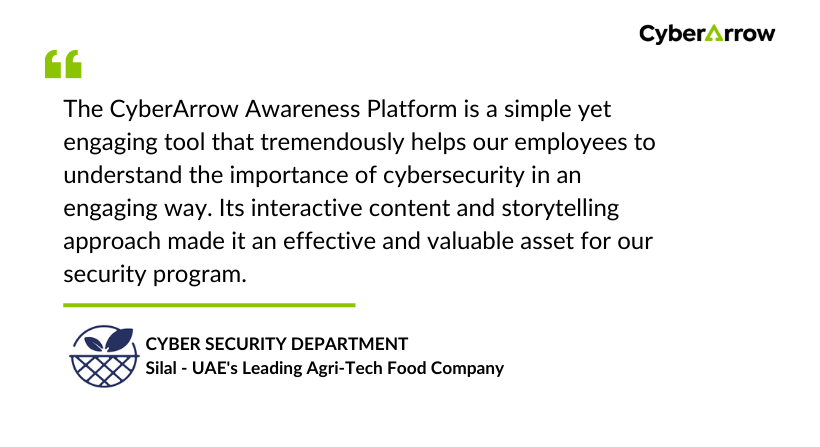
See what Silal has to say about CyberArrow Awareness Platform: