


ISO 20000 checklist: Implementation guide + free ISO 20000 checklist template
Many organizations struggle to deliver consistent, high-quality IT services while meeting operational demands. Unmanaged processes, inefficiencies, and service disruptions can lead to dissatisfied customers and wasted resources.
So, how can businesses ensure their IT services run smoothly while minimizing risks?
The solution is to implement ISO 20000, the global standard for IT service management.
Adopting this standard can streamline organizations’ operations, reduce risks, and enhance service quality. In this guide, we’ll walk through the steps for implementing ISO 20000, including a practical ISO 20000 checklist to ensure your business achieves and maintains compliance efficiently.
- What is ISO 20000?
- Why do you need an ISO 20000 checklist?
- Steps for implementing ISO 20000 in your organization
- 1. Define the scope and objectives (clause 4)
- 2. Secure leadership commitment (clause 5)
- 3. Plan the ITSMS (clause 6)
- 4. Allocate resources and ensure competence (clause 7)
- 5. Execute service management processes (clause 8)
- 6. Monitor and measure performance (clause 9)
- 7. Internal audits and continual improvement (clause 10)
- 8. Certification audit
- Simplify your ISO 20000 compliance journey with CyberArrow
What is ISO 20000?
ISO 20000 is the international standard for IT Service Management (ITSM), designed to help organizations deliver efficient, consistent, and high-quality IT services. It provides guidelines for establishing and maintaining a Service Management System (SMS) that aligns IT services with the businesses’ and customers’ needs.
It’s divided into two sections:
- ISO/IEC 20000-1, which defines the essential ISO 20000 requirements
- ISO/IEC 20000-2, offering further guidance to assist with implementation.
Why do you need an ISO 20000 checklist?
Achieving ISO 20000 compliance isn’t a simple task. Organizations often face multiple challenges, from understanding the broad range of requirements to ensuring that every aspect of their IT Service Management System (ITSMS) is effectively implemented.
Additionally, the continuous need for monitoring, measuring, and improving the ITSMS can make it hard to stay on track without missing key steps. This complexity can result in gaps or delays in achieving certification.
How an ISO 20000 checklist helps
A well-structured 20000 compliance checklist is a powerful tool to streamline this process. Breaking down the standard’s requirements into clear, manageable tasks, helps organizations stay organized and ensures nothing is overlooked during implementation.
A checklist simplifies the complex ISO 20000 framework by outlining each action step, from defining the scope to managing non-conformities. It also keeps track of progress, ensuring that each part of the standard is addressed in a logical sequence.
Steps for implementing ISO 20000 in your organization
We have made an implementation guide based on different ISO 20000 clauses to help you with the implementation process.
Follow these steps:
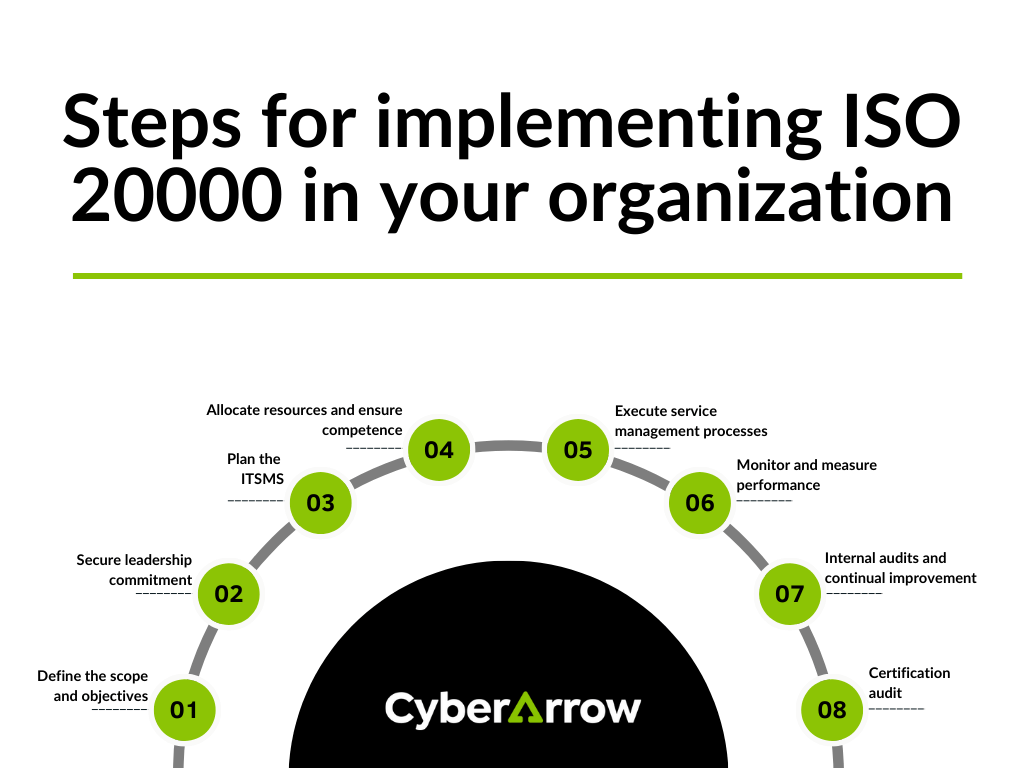
1. Define the scope and objectives (clause 4)
Define the scope of your IT Service Management System (ITSMS). Determine which services will be covered, the boundaries of your system, and the objectives you aim to achieve.
Why it matters: Having a clear scope ensures that all relevant factors are considered when designing and implementing the ITSMS while also aligning with business goals.
2. Secure leadership commitment (clause 5)
Ensure top management is actively involved in supporting the ITSMS by establishing and communicating service management policies, assigning roles, and providing resources.
Why it matters: Leadership involvement is crucial for driving the ITSMS forward, ensuring alignment with organizational strategy, and securing the necessary resources.
3. Plan the ITSMS (clause 6)
Set clear service management objectives and develop a detailed plan that includes risk assessment, mitigation strategies, and resource allocation. Note that the ISO 20000-1:2018 is based on the “Plan-Do-Check-Act” (PDCA) cycle.
Why it matters: Proper planning helps anticipate potential risks, sets realistic goals, and ensures that every step in the SMS is intentional and organized.
4. Allocate resources and ensure competence (clause 7)
Ensure that your team has the right skills, tools, and resources to implement and maintain the ITSMS. Set up effective communication channels and ensure knowledge management.
Why it matters: Adequate support and resources prevent bottlenecks and enable smooth execution, ensuring all team members understand their responsibilities.
5. Execute service management processes (clause 8)
Implement and manage key processes such as service design, planning, change management, and assurance. Follow a structured approach for each stage of the service lifecycle.
Why it matters: Operational excellence ensures that your services are delivered efficiently and consistently meet customer expectations.
6. Monitor and measure performance (clause 9)
Establish key metrics to monitor the ITSMS’s performance regularly. Conduct internal audits and management reviews to identify areas for improvement.
Why it matters: Continuous monitoring ensures that the ITSMS stays aligned with objectives, and internal audits help maintain compliance with ISO 20000.
7. Internal audits and continual improvement (clause 10)
Conduct internal audits to evaluate ISO 20000 compliance and pinpoint areas for improvement. Implement corrective actions for any nonconformities found.
Why it matters: Internal audits ensure that the ITSMS functions as intended, drive continual improvement, and prepare your organization for external audits by maintaining a culture of accountability and excellence.
8. Certification audit
After internal audits and refinements, schedule and undergo a formal external audit conducted by an accredited certification body. This audit will assess your ITSMS against the ISO 20000 standard to determine if your organization meets all requirements.
Why it matters: Successfully passing the external audit results in ISO 20000 certification, demonstrating to customers and stakeholders that your organization follows best practices in service management.
Quick link: Your partner in Africa for GRC excellence
Simplify your ISO 20000 compliance journey with CyberArrow
Organizations often face significant challenges in maintaining or achieving ISO 20000 compliance manually. The process can be complex and resource-intensive, making it difficult to ensure that all requirements are met consistently and efficiently.
CyberArrow is here to make compliance easier. It automates up to 90% of the ISO 20000 implementation work, allowing you to focus on your core business. With features like certification automation, a dedicated virtual ITSMS Manager, and zero-touch audits, CyberArrow streamlines the entire compliance process.
Why choose CyberArrow:
- Automated certification: Obtain ISO 20000 certification quickly and easily with our advanced automation and cross-standard mappings.
- Expert support: Access a dedicated team and virtual ITSMS Manager to guide you through every step of your compliance journey.
- Zero-touch audits: Enjoy hassle-free annual audits conducted through the system with minimal effort on your part.
- Ongoing monitoring: Say goodbye to manual tracking—CyberArrow automatically gathers evidence and supports 50+ integrations.
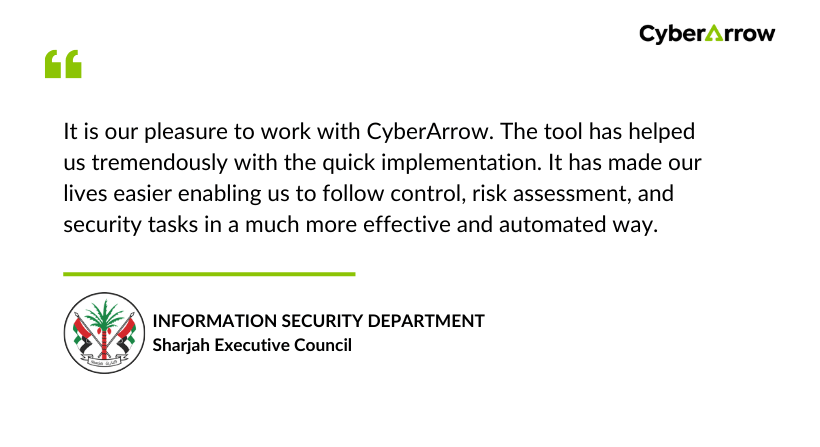
Don’t take our word for it; see what companies like Sharjah Executive Council Say about CyberArrow:
Don’t let the complexity of ISO 20000 compliance hold you back. With CyberArrow, you can achieve certification in record time and effortlessly maintain ongoing compliance.
Get started today: Download our free ISO 20000 checklist template to see how CyberArrow can simplify your compliance journey. Download Now!
