A comprehensive guide to complying with SAMA Cyber Security Framework in Saudi Arabia
The SAMA Cyber Security Framework is a critical benchmark for ensuring the resilience and security of financial institutions and organizations within the Kingdom of Saudi Arabia. In response to the evolving landscape of cyber threats, SAMA has established a robust framework that outlines essential principles and requirements to safeguard against potential risks.
Compliance with the SAMA Cyber Security Framework is not just a regulatory obligation but a strategic imperative for organizations operating in the financial sector. As cyber threats grow in sophistication and frequency, adherence to the framework becomes crucial in strengthening defenses, preserving trust, and protecting sensitive information.
This article explores the core aspects of the SAMA Cyber Security Framework and the practical implications of compliance, emphasizing the need for a proactive approach to cyber security to mitigate risks effectively.
Understanding the SAMA Cyber Security Framework
SAMA introduced the SAMA Cyber Security Framework to assist organizations in securing vital information assets and online services. The primary objective of establishing the Cyber Security Framework is to enhance cyber resilience by incorporating the most effective practices.
Drawing from various government frameworks and industry standards such as NIST, PCI DSS, ISO 27001/27002, and Basel II, the SAMA Cyber Security Framework is a comprehensive guide. Its implementation aids organizations in attaining a baseline security level to manage and defend against the threats in cyber security effectively.
Who does the SAMA Cyber Security Framework apply to?
The SAMA Cyber Security Framework (CSF) applies broadly to all Member Organizations under the regulation of SAMA. This includes various financial entities such as:
- Banks,
- Insurance/reinsurance companies,
- Financing companies,
- Credit bureaus, and
- Financial market infrastructure.
While the framework uniformly covers all these domains in the banking sector, there are exceptions for other financial institutions. These exceptions involve specific mandates and exclusions for certain subdomains within the broader financial landscape.
How to comply with SAMA CSF in saudi arabia?

Navigating the complexities of the SAMA Cyber Security Framework requires a comprehensive approach that extends beyond policy adoption. Here, we will explore the practical strategies for implementing and reporting SAMA compliance, crucial components in strengthening an organization’s cyber security posture.
So, let’s get started!
1. Cultivating a cyber security culture
Enabling a cyber security culture is essential for organizations aiming to comply with the SAMA Cyber Security Framework. This involves instilling a proactive and security-conscious mindset among employees. By promoting awareness of cyber threats and the importance of adhering to cybersecurity policies, organizations can create a resilient internal environment that actively contributes to cybersecurity goals.
2. Employee training and awareness programs
Employee training and awareness platforms, such as the CyberArrow Awareness Platform, are the foundation of SAMA compliance efforts. Regular training sessions equip employees with the knowledge and skills necessary to recognize and respond to cyber threats effectively. These programs contribute to a well-informed workforce that is actively engaged in securing the organization’s digital assets.
3. Utilizing cyber security technologies and tools
Implementing cyber security technologies and tools, like the CyberArrow Compliance Automation Platform, aligned with SAMA guidelines is crucial in strengthening an organization’s defenses. Automating SAMA Compliance enables advanced threat detection to simplify compliance processes. This strategy ensures the organization remains at the forefront of cyber security, leveraging state-of-the-art tools to mitigate cyber threats.
4. Documenting requirements under SAMA guidelines
Rigorous documentation is essential for SAMA compliance. Organizations must record and outline their cyber security policies and procedures. This helps demonstrate adherence to SAMA guidelines and proves a valuable resource for internal audits and continuous improvement.
5. Regular reporting and audit procedures
Establishing a systematic schedule for reporting and audit procedures ensures the organization’s cyber security measures are regularly evaluated. Routine assessments provide insights into the effectiveness of existing security protocols. This proactive approach aids in meeting SAMA compliance requirements and helps in identifying and addressing vulnerabilities promptly.
6. Demonstrating continuous improvement
Demonstrating a commitment to continuous improvement is a crucial aspect of SAMA compliance. Organizations should cultivate a culture that values learning from audits and evolving cyber security strategies accordingly. This process of refinement, based on audit findings and emerging threats, ensures the organization remains resilient in the face of evolving cyber security challenges.
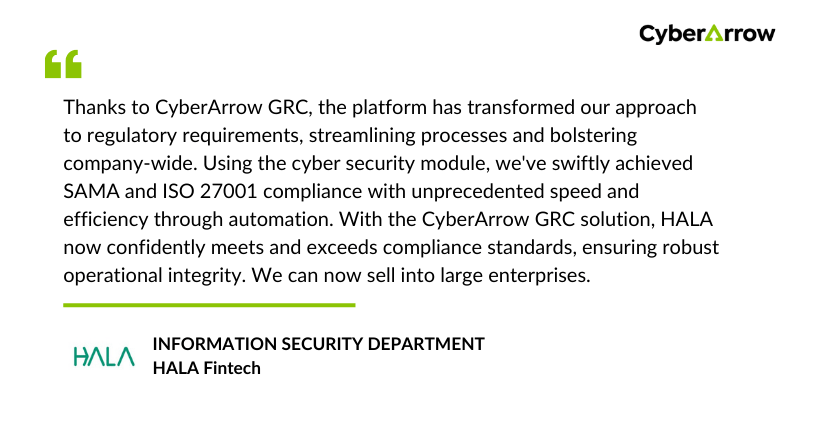
Case study: HALA achieves SAMA compliance in record speed with automation
HALA, a prominent fintech player in the MENAP region, successfully navigated the challenges posed by the SAMA Cybersecurity Framework. Focused on SMEs, HALA aimed to streamline financial services and empower businesses. Facing the need for SAMA compliance, HALA adopted the CyberArrow Compliance Automation Tool.
This solution allowed them to automate GRC tasks, reducing the burden on staff and enabling a more efficient focus on business development.
The result:
- Efficient compliance: HALA streamlined SAMA Cyber Security Framework compliance, reducing time and effort.
- Business focus: Adopting CyberArrow freed up resources, allowing HALA to prioritize strategic business development.
- Documentation simplicity: Farewell to manual spreadsheets, with simplified compliance documentation through CyberArrow GRC.
- Real-time monitoring: HALA maintained a maturity level above the required threshold (level 3) through automated KPIs and real-time compliance status monitoring.
- Enhanced security measures: CyberArrow features, including security reports and risk assessments, fortified HALA’s overall cyber security posture.
- Expert support: HALA accessed chat support from CyberArrow’s compliance experts, ensuring guidance and assistance as needed.
The implementation demonstrated HALA’s commitment to cyber security and enhanced its operational efficiency in fintech.
Want to comply with the SAMA Cyber Security Framework as HALA did with CyberArrow? Schedule a free demo to get started on your compliance automation journey today!
FAQs
What is the SAMA Cyber Security Framework?
The SAMA Cyber Security Framework is a set of guidelines established by the Saudi Arabian Monetary Authority to enhance cyber security practices within financial institutions operating in Saudi Arabia. It outlines principles and requirements to safeguard against cyber threats and ensure the security of critical information assets.
What does SAMA CSF stand for?
SAMA CSF stands for Saudi Arabian Monetary Authority Cyber Security Framework. It’s a comprehensive set of guidelines devised by SAMA to regulate and improve cyber security practices among financial institutions in Saudi Arabia.
What are the top 3 cyber security frameworks?
The top three cyber security frameworks include:
- NIST Cyber Security Framework (CSF): Developed by the National Institute of Standards and Technology in the U.S., it provides a risk-based approach to improving cybersecurity.
- ISO 27001: The International Organization for Standardization’s standards for information security management systems offer a globally recognized framework.
- CIS Controls: The Center for Internet Security (CIS) provides Critical Security Controls (CIS Controls), a set of best practices for cyber security.
See what HALA has to say about CyberArrow GRC: