Streamline your cyber security management with SAMA compliance automation
In an era where the digital landscape is central to nearly every aspect of modern businesses, the importance of robust cyber security management can’t be overstated. The increasing frequency and sophistication of cyber threats have placed organizations under an ever-evolving risk, making the security of sensitive information a crucial concern. As technology advances, so do the challenges in maintaining compliance. The imperative to adhere to stringent cyber security standards, particularly those mandated by the Saudi Arabian Monetary Authority (SAMA), adds a layer of challenge for entities operating in the Kingdom. Among these challenges emerges a solution – SAMA compliance automation.
This article explores the challenges businesses face in compliance adherence and how implementation of SAMA compliance automation can navigate the complexities of cyber security in the Kingdom of Saudi Arabia.
The significance of compliance management
Cyber threats are on the rise, and they’re getting smarter. Businesses are constantly at risk from advanced viruses and targeted attacks that can disrupt operations or steal sensitive information. This is where cyber security management comes into play – it’s like a shield that businesses use to protect themselves from these digital threats.
But it’s not just about protection; there are rules to follow. Governments and industry groups set standards for cyber security, and businesses need to meet these standards to keep things safe and maintain trust with clients and partners.
Now, managing cyber security isn’t easy. The digital landscape is always changing, and so are the risks. What worked yesterday might not work tomorrow. Plus, businesses are connected in ways we’ve never seen before, which means a security issue in one place can quickly become a problem for others.
Challenges in traditional compliance management
Let’s explore some of the challenges businesses face due to traditional compliance management processes.
- Manual processes and their limitations: Traditional compliance management often relies on manual processes, which come with inherent limitations. These manual methods involve repetitive tasks and are prone to errors due to the human factor. Employees manually handling compliance procedures can inadvertently overlook details or make mistakes.
- Time-consuming tasks and resource-intensive nature of compliance: One of the challenges in traditional compliance management is the considerable amount of time and resources it consumes. Manual compliance processes are typically labor-intensive, requiring significant human effort to gather, process, and verify data. This resource-intensive nature slows down the compliance workflow and strains organizational resources.
- Risks associated with human error in manual compliance processes: Whether it’s data entry mistakes, oversight of critical details, or misinterpretation of compliance requirements, these errors can lead to compliance breaches and expose organizations to unnecessary risks. The potential repercussions of these errors may include regulatory penalties, reputational damage, and compromised security.
Introduction to SAMA compliance automation

SAMA compliance, governed by the Saudi Arabian Monetary Authority, outlines the regulatory framework essential for financial entities operating in Saudi Arabia. It sets the standards and guidelines to ensure the security and integrity of financial systems, making adherence crucial for businesses in the region.
Advantages of SAMA compliance automation
SAMA compliance automation introduces a transformative approach to meeting regulatory requirements. Its key features include streamlined processes, real-time monitoring, and automated documentation.
Some of its benefits are:
- Efficiency gains through automation: SAMA compliance automation brings efficiency to compliance processes by automating repetitive tasks. This streamlines workflows, accelerates response times, and allows organizations to allocate resources more strategically.
- Reduction of human error and improvement in accuracy: SAMA compliance automation significantly reduces the risk of human error by minimizing reliance on manual input. This improvement in accuracy ensures compliance activities adhere to SAMA standards, mitigating the potential for regulatory breaches.
- Real-time monitoring and proactive threat response: SAMA compliance automation provides real-time monitoring capabilities, enabling organizations to stay vigilant against evolving threats. This proactive approach allows for immediate detection and response to potential security issues, fortifying the overall cyber security posture.
- Cost-effectiveness and resource optimization: The automated nature of SAMA compliance processes leads to cost-effectiveness and resource optimization. By reducing manual labor and streamlining workflows, organizations can allocate financial and human resources more efficiently.
Also learn about NDMO.
FAQs
What is SAMA Compliance, and why is it significant for businesses in Saudi Arabia?
SAMA compliance refers to adherence to the regulatory framework set by the Saudi Arabian Monetary Authority. It is crucial for businesses operating in Saudi Arabia, as it establishes standards and guidelines to ensure the security and integrity of financial systems in the region.
How does SAMA Compliance automation enhance cyber security management?
SAMA Compliance automation improves cyber security management by automating repetitive tasks, reducing human error, and providing real-time monitoring. It streamlines compliance processes, fortifying an organization’s ability to meet SAMA standards efficiently and precisely.
What advantages does SAMA compliance automation offer over traditional manual compliance methods?
SAMA compliance automation brings efficiency gains through automation, reduces the risk of human error, enables real-time monitoring for proactive threat response, and ensures cost-effectiveness by optimizing resources. It outperforms traditional methods, offering a strategic and technologically advanced approach to meet SAMA compliance requirements.
Case Study: How CyberArrow helped HALA automate SAMA compliance
In Riyadh, Saudi Arabia, the fintech powerhouse HALA recognized the need to align with the SAMA Cyber Security Framework to fortify its operations in the dynamic financial technology sector. Recognizing the laborious nature of manual governance, risk, and compliance activities, HALA sought a transformative solution.
CyberArrow compliance automation tool – a game-changer for HALA. Leveraging CyberArrow, HALA liberated its workforce from the burdens of manual compliance tasks, enabling it to channel its energy into strategic business development initiatives. Using the pre-approved documentation and seamless technical integrations, HALA bid farewell to manual spreadsheets and embraced an automated approach to compliance.
The adoption of CyberArrow’s features, including chat support from compliance experts, security reports, KPI monitoring, and dedicated support, propelled HALA’s compliance journey.
The Result
HALA not only achieved SAMA compliance in record time but also experienced a heightened level of efficiency, streamlined processes, and real-time compliance readiness through automated KPI monitoring and support features.
Looking to automate SAMA compliance and enhance your cyber security posture as HALA did with CyberArrow? Schedule a free demo today to explore the compliance automation process of CyberArrow and how it can streamline compliance, enhance staff efficiency, and deliver robust control management.
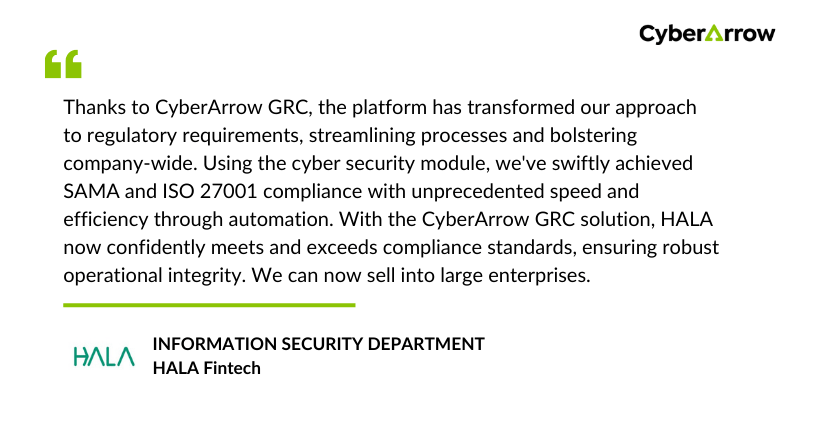
See what HALA have to say about CyberArrow GRC: