


The impact of human errors on organizations’ security posture
As businesses and organizations become increasingly reliant on technology, the risks posed by cybercriminals grow more significant by the day. Unfortunately, the truth is that the most significant threat to cyber security is not just from external factors but also from within the organization. Human error has become one of the biggest contributing factors to cyber security breaches, and it is not just limited to one industry or sector.
According to the Verizon 2022 Data Breach Investigations Report, “human error remains a key driver of 82% of breaches.” Additionally, malware and stolen credentials can serve as a potent second step for attackers after a successful social engineering attack.
So how do human errors impact an organization’s cyber security? And what measures can businesses take to mitigate this risk? Let’s explore in this article.
Common human errors & their impact
Here are some common human errors that lead to organizational cyber security breaches. (Read about cybersecurity threats in our blog Cyber security threats to watch out for.)
- Use of weak Passwords: Weak passwords are a common cause of cyber security breaches, with 80% of such breaches resulting from stolen or compromised user credentials. Common and easily guessable passwords, password reuse, and writing down or sharing passwords are among the common mistakes that can put businesses at risk of cyberattacks.
- Delayed patching: Cybercriminals frequently target software vulnerabilities to exploit enterprise networks, systems, and data. A delay in applying patches can give cybercriminals time to compromise systems and steal data.
- Poor access control: Inadequate access control is a significant human error in cybersecurity breaches that can allow bad actors to take over enterprise networks. Proper access controls are critical in preventing unauthorized access and reducing the impact of potential attacks.
- Use of unauthorized software: Installing unauthorized applications can result in attacks and unauthorized access to an organization’s IT infrastructure and applications. Such actions often occur without the knowledge and approval of IT teams, leaving the organization vulnerable to various security threats. Unauthorized software installations can create exploitable vulnerabilities, provide backdoors to cyber criminals, and compromise sensitive data.
- Email misdelivery: Email misdelivery, or sending information to the wrong recipient, is a prevalent threat to corporate data security. Using auto-suggest features in email clients can easily lead to the inadvertent disclosure of confidential information.
Best practices to prevent human errors
While human error poses a significant cyber security risk, organizations can take proactive steps to mitigate its impact. Here are some best practices for reducing human errors in a business environment. (Also, learn about phishing attacks and ways to prevent them here.)
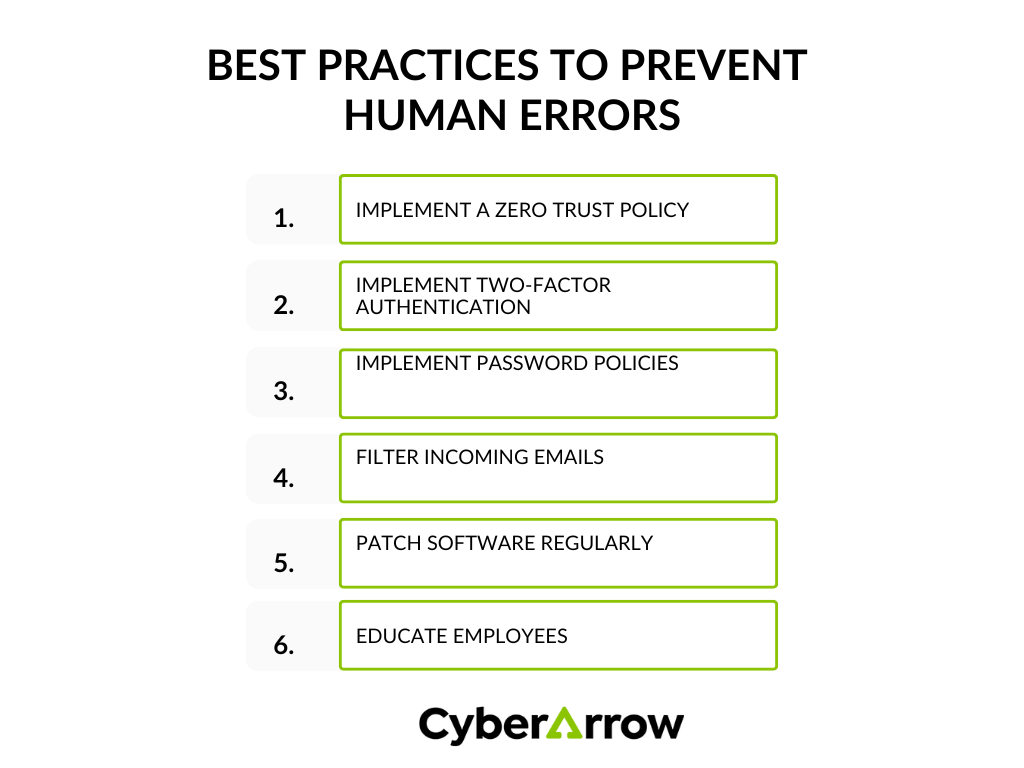
Implement a zero trust policy
A Zero Trust Policy means no one inside or outside the organization is automatically trusted. Every request for access to data or systems is verified and authenticated. This approach provides a higher level of security than traditional perimeter-based security, which is no longer sufficient in today’s threat landscape.
Implement two-factor authentication
Two-factor authentication (2FA) adds an extra layer of security to protect against unauthorized access. In addition to a password, 2FA requires a second factor, such as a code sent to the user’s phone, to authenticate access. This makes it harder for bad actors to gain access even if they have stolen a user’s password.
Implement password policies
Password policies are essential to prevent weak or reused passwords, which can be easily guessed or hacked. A strong password policy requires users to create complex passwords with a mix of characters, numbers, and symbols and to change them regularly.
Filter incoming emails
Email is a primary vector for phishing attacks and malware delivery. Filtering incoming emails can block malicious emails before they reach users’ inboxes. Advanced email filtering can also detect and quarantine emails that contain suspicious attachments or links.
Patch software regularly
Software vulnerabilities are a common way for cybercriminals to gain access to systems and data. Regularly patching software vulnerabilities is critical to keep systems and applications up-to-date and prevent exploitation.
Educate employees
Employees can be a significant cybersecurity risk if they are unaware of potential threats and best practices. Educating employees on identifying and reporting potential cybersecurity incidents and best practices for password management, email security, and safe Internet browsing can help reduce the risk of human error.
Read also: How CyberArrow awareness platform increased security awareness among Silal’s employees efficiently.
FAQs
What are the two most common types of human error in cyber security?
The two most common types of human error in cyber security are weak password practices and clicking on malicious links leading to phishing attacks.
What is the solution to human error in cyber security?
While human errors can not be completely mitigated, organizations can follow some best practices to decrease the impact of human errors as much as possible. These best practices include implementing a zero-trust policy and ensuring employees follow strong password practices. Furthermore, employees must regularly patch software to keep their systems updated. Also, security awareness training plays a crucial role in minimizing the impact of human errors.
How do cyber security risks impact organizations?
The impact of cyber security risks on organizations can be severe, including financial losses resulting from the theft of money or information and disruption to business operations. In addition, cyber attacks can damage a company’s reputation and relationships with other organizations it relies on to conduct business. Recovering from a cyber attack can also be costly, requiring investment to restore affected systems and notify relevant authorities and institutions of the incident.
Strengthen your security with CyberArrow Awareness Platform
Human errors can have a serious impact on an organization’s security posture, leading to breaches, data loss, and costly damages. As discussed in this blog, even the most advanced security systems can’t fully protect against mistakes made by employees who aren’t well-prepared or aware of security risks.
To tackle this challenge, it’s essential to invest in ongoing employee training and awareness programs. CyberArrow Awareness Platform can help your organization by turning your workforce into your strongest line of defense.
Why choose CyberArrow Awareness Platform?
- Comprehensive training programs: Equip your employees with the knowledge they need to identify and prevent security threats like phishing, social engineering, and malware.
- Real-time simulations: Test your employees’ readiness with real-time threat simulations and phishing campaigns.
- Engaging learning modules: Provide interactive, engaging content that ensures employees retain crucial cybersecurity practices.
- Tracking and reporting: Monitor training progress and identify areas that need improvement through easy-to-use dashboards.
A healthcare organization implemented the CyberArrow Awareness Platform to reduce security risks caused by human errors. After launching regular training sessions and phishing simulations, they saw a 60% drop in employee-related security incidents, resulting in a stronger overall security posture.
