


What is end-to-end encryption (E2EE)?
In an age where data breaches and cyber threats are becoming more common, protecting sensitive information is more important than ever. Whether you’re sending a personal message, sharing confidential business documents, or conducting financial transactions, you want to be sure that your data is secure. This is where End-to-End Encryption (E2EE) comes into play.
End-to-End Encryption, or E2EE, is a method of data protection that ensures only the sender and the intended recipient can read the messages being sent. Unlike other forms of encryption, E2EE prevents third parties, including service providers, hackers, or even government agencies, from accessing your data. This level of security makes E2EE an essential tool for safeguarding privacy in today’s digital world.
In this blog, we’ll explore what End-to-End Encryption is, how it works, and why it’s crucial for protecting your digital communications. Whether you’re a business looking to secure your data or an individual concerned about privacy, understanding E2EE is key to staying safe online.
What are the different types of end-to-end encryption?
Symmetric encryption and asymmetric encryption are the two most frequent methods of end-to-end encryption. It is possible to utilize the same key for both encryption and decryption with symmetric encryption, as opposed to asymmetric encryption in which various keys are utilized to encrypt and decode the message, resulting in a more secure communication channel.
Symmetric encryption
Symmetric encryption is a kind of end-to-end encryption that uses two keys to protect the data. One key (the secret key) is used to both encrypt and decode electronic information in symmetric encryption; this is a kind of encryption in which only one key (the secret key) is utilized. During symmetric encryption, the entities interacting with one other must exchange their keys so that the keys may be utilized in the decryption process.
This encryption technique varies from symmetric encryption, which uses a pair of keys, one public and one private, to encrypt and decrypt communications. Symmetric encryption uses a single key to encode and decode messages.
By using symmetric encryption techniques, data is changed into a format that is incomprehensible to anybody who does not have access to the secret key that is required to decode the data. As soon as the message has been sent to the intended receiver, who is in possession of the key, the algorithm reverses its operation, restoring the message to its original and comprehensible form.
The secret key that is used by both the sender and the receiver might be a particular password or code, or it could be a random string of letters or numbers that have been produced using a secure random number generator to ensure that the message is sent securely (RNG). A random number generator (RNG) that has been validated according to industry standards, such as FIPS 140-2, must be used to generate symmetric keys for banking-grade encryptions.
Symmetric encryption methods
Algorithms that block are called block algorithms. With the use of a secret key, a set of bit lengths are encrypted in blocks of electronic data to protect the integrity of the data. While the data is being encrypted, the system keeps a copy of it in its memory while it waits for whole blocks of data to arrive.
Algorithms are stream processing instead of being stored in the system’s memory, data is encrypted as it is streamed through the system.
What is symmetric encryption used for?
Although symmetric encryption is a more old-fashioned technique for protecting data, it is also quicker and more efficient than asymmetric encryption, which has a negative impact on network speed due to concerns with data size and high CPU use.
Compared to asymmetric encryption, symmetric cryptography provides higher performance and quicker speed, and as a result, symmetric cryptography is generally used for bulk encryption/encrypting huge volumes of data, such as in the case of database encryption. In the case of a database, the secret key may only be accessible to the database itself for the purpose of encrypting or decrypting data.
Asymmetric encryption
Asymmetric encryption is a kind of encryption that is not symmetric. Asymmetric encryption, in contrast to “regular” (symmetric) encryption, encrypts and decrypts data using two independent cryptographic keys that are mathematically coupled to one another. These keys are referred to as a ‘Public Key’ and a ‘Private Key,’ respectively. They are referred to as a ‘Public and Private Key Pair’ when they are used together.
Asymmetric encryption methods
Asymmetric encryption makes use of two keys that are separate yet connected to one another. It is necessary to employ two keys for encryption and decryption. One key is called the Public Key and the other is called the Private Key. Despite its name, the Secret Key is designed to remain private, so that only the verified receiver may decode the message sent with it.
What is asymmetric encryption used for?
Using asymmetric encryption, you would be able to generate public keys for the agents to use when transmitting their information, and a private key for use at headquarters that would be the sole method to decode anything. This offers an impenetrable sort of one-way communication that cannot be intercepted.
What is the process through which the two keys are generated?
Asymmetric encryption is based on a cryptographic algorithm, which is at the core of the process. To produce a key pair, this technique makes use of a key generation protocol (which is a kind of mathematical function). There is a mathematical connection between the two key combinations. It varies from algorithm to algorithm i.e., how this connection is formed between the keys.
The algorithm is essentially a mixture of two functions – the encryption function and the decryption function – that are performed in parallel. It should go without saying that the encryption function encrypts the data, and the decryption function decrypts the data.
Why do you need end-to-end encryption e2ee?
End-to-end encryption gives you peace of mind and security when transferring and handling confidential data, whether it’s banking information, healthcare-related records, official documents, legal proceedings, or even just private conversations with your friends that you don’t want anyone else to hear.
Despite its shortcomings, end-to-end encryption (e2ee) is presently the most secure method of transferring private data, which is why an increasing number of communication services are adopting it as a security measure.
Conclusion
Understanding and implementing E2EE is essential for anyone looking to safeguard their digital communications, whether for personal use or business purposes.
However, encryption is just one aspect of a comprehensive cybersecurity strategy. To truly protect your organization from evolving threats, it’s crucial to have a robust system in place that continuously monitors your cybersecurity controls and ensures they are effectively implemented.
CyberArrow GRC is a comprehensive solution designed to help organizations manage their governance, risk, and compliance activities, including cybersecurity controls like encryption. Here’s how CyberArrow GRC can help you enhance your security posture:
- Continuous Monitoring: CyberArrow GRC provides continuous monitoring of your cybersecurity controls, ensuring they remain effective and up to date.
- Automated Implementation: Easily implement essential security controls, such as encryption, through automated processes that save time and reduce human error.
- Comprehensive Management: Manage all aspects of your cybersecurity, from risk assessments to compliance, in one integrated platform.
- Customizable Reporting: Access detailed reports to understand your security posture and make informed decisions about your cybersecurity strategy.
See what clients say about CyberArrow GRC:
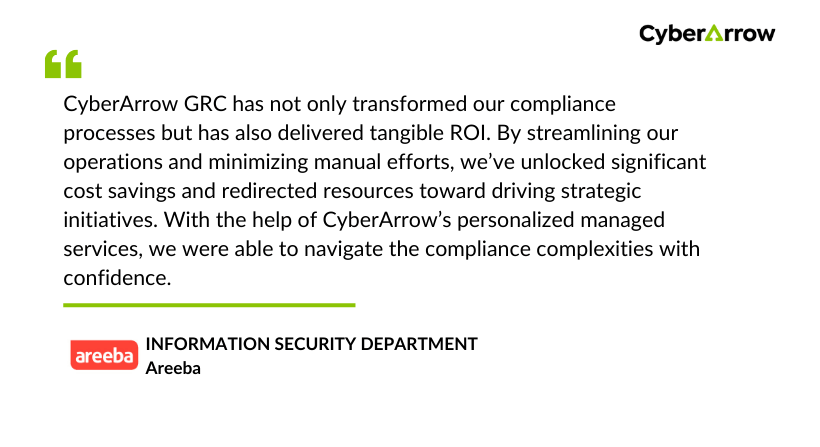
With CyberArrow GRC, you can ensure that your organization’s encryption practices and other security controls are always operating at their best. Protect your data and stay ahead of cyber threats with a comprehensive, automated approach to governance, risk, and compliance.
