

ISO 27001 for CISOs: Responsibilities, controls, audit checklist
Chief Information Security Officers play a central role in information security. They are responsible for protecting data, managing cyber risks, guiding security teams, and reporting risk to leadership. When an organization decides to adopt ISO 27001, the CISO becomes one of the most important owners of the program.
ISO 27001 is not only a technical standard. It is a management framework that requires leadership, planning, and continuous improvement. This guide explains ISO 27001 for CISOs, including their responsibilities, key controls they must oversee, and a practical audit checklist to help them stay compliant and prepared.
Why ISO 27001 matters for CISOs
ISO 27001 is widely recognized as the global standard for information security management. Customers, regulators, partners, and auditors trust it as proof of a mature security program.
For CISOs, ISO 27001 matters because it:
- Creates a structured security program.
- Reduces cyber and operational risks.
- Supports regulatory compliance.
- Improves visibility into security posture.
- Helps communicate risk to executives.
- Builds trust with customers and partners.
- Supports long term security maturity.
ISO 27001 gives CISOs a clear framework to manage security at scale.
The role of the CISO in ISO 27001
ISO 27001 requires strong leadership and accountability. While many teams contribute, the CISO usually acts as the main security owner.
The CISO is responsible for:
- Defining the security strategy.
- Overseeing the Information Security Management System.
- Ensuring risks are identified and treated.
- Making sure controls are implemented.
- Monitoring security performance.
- Supporting audits and reviews.
Without CISO involvement, ISO 27001 often becomes a paper exercise instead of a real security program.
CISO responsibilities under ISO 27001
ISO 27001 does not list job titles, but many clauses clearly map to CISO responsibilities.
Leadership and governance responsibilities
ISO 27001 Clause 5 focuses on leadership.
CISO responsibilities include:
- Supporting the information security policy.
- Ensuring security objectives align with business goals.
- Assigning security roles and responsibilities.
- Promoting a security culture across teams.
The CISO must ensure that security is not isolated within IT but embedded across the organization.
Risk management responsibilities
Risk management is a core part of ISO 27001.
CISO responsibilities include:
- Defining the risk assessment methodology.
- Approving risk acceptance criteria.
- Reviewing risk assessments.
- Ensuring risks are treated properly.
- Reporting high risks to leadership.
The CISO must ensure risks are not ignored or accepted without proper justification.
Policy and control oversight
ISO 27001 requires documented policies and controls.
CISO responsibilities include:
- Approving information security policies.
- Ensuring policies are updated regularly.
- Making sure controls are implemented correctly.
- Ensuring controls match real risks.
Policies without enforcement create false confidence.
Operational security oversight
The CISO oversees daily security operations.
Responsibilities include:
- Monitoring security events.
- Reviewing incident reports.
- Ensuring logging and monitoring are in place.
- Overseeing vulnerability management.
- Supporting incident response.
Operational security proves that ISO 27001 works in practice.
Training and awareness responsibilities
Human error is a major risk.
CISO responsibilities include:
- Ensuring security awareness training exists.
- Making sure training covers real risks.
- Reviewing training completion reports.
- Supporting phishing simulations or exercises.
ISO 27001 expects staff to understand their security responsibilities.
Audit and compliance responsibilities
ISO 27001 requires regular audits.
CISO responsibilities include:
- Supporting internal audits.
- Reviewing audit findings.
- Ensuring corrective actions are completed.
- Supporting external audits.
- Reporting audit results to leadership.
Audits are not only about certification but about improvement.
Key ISO 27001 controls CISOs must oversee
Annex A of ISO 27001 includes many controls. CISOs do not manage each control directly, but they must ensure coverage and effectiveness.
Below are the most important control areas from a CISO perspective.
Access control
Access control protects systems and data.
CISO focus areas:
- Least privilege access.
- Role based access management.
- Multi factor authentication.
- Regular access reviews.
Access control failures are a common cause of breaches.
Asset management
You cannot protect what you do not know.
CISO focus areas:
- Asset inventory.
- Data classification.
- Ownership assignment.
- Protection levels.
This includes systems, data, cloud services, and devices.
Cryptography and data protection
Encryption is critical for confidentiality.
CISO focus areas:
- Encryption at rest.
- Encryption in transit.
- Key management.
- Secure storage of secrets.
This protects sensitive and regulated data.
Operations security
Operations security keeps systems stable.
CISO focus areas:
- Logging and monitoring.
- Patch management.
- Malware protection.
- Backup and recovery.
These controls reduce downtime and security incidents.
Incident management
ISO 27001 requires structured incident handling.
CISO focus areas:
- Incident response plans.
- Detection and escalation.
- Root cause analysis.
- Lessons learned.
Fast response reduces damage and impact.
Supplier and third-party security
Third parties introduce risk.
CISO focus areas:
- Vendor risk assessments.
- Security requirements in contracts.
- Ongoing vendor monitoring.
Many incidents originate from vendors.
Business continuity
Security includes availability.
CISO focus areas:
- Disaster recovery plans.
- Backup testing.
- Redundancy.
- Crisis communication.
Downtime impacts trust and revenue.
ISO 27001 audit checklist for CISOs
Below is a practical audit checklist that CISOs can use to prepare for internal and external audits.
ISMS and governance checklist
- Information security policy approved.
- ISMS scope defined.
- Roles and responsibilities documented.
- Leadership commitment documented.
Risk management checklist
- Risk assessment methodology defined.
- Risk register updated.
- Risk treatment plans approved.
- Risk acceptance decisions documented.
Policy and documentation checklist
- Policies reviewed and updated.
- Procedures documented.
- Version control in place.
- Staff access to policies confirmed.
Control implementation checklist
- Access controls enforced.
- Encryption implemented.
- Logging enabled.
- Backups tested.
- Incident response plan tested.
Training and awareness checklist
- Security training completed.
- Training records available.
- Awareness materials updated.
Vendor management checklist
- Vendor inventory maintained.
- Vendor risk assessments completed.
- Security clauses included in contracts.
Monitoring and review checklist
- Internal audits completed.
- Management reviews documented.
- Non-conformities tracked.
- Corrective actions closed.
Audit evidence checklist
- Evidence stored centrally.
- Logs available.
- Screenshots current.
- Reports easy to access.
Keeping this checklist updated throughout the year reduces audit stress.
Common ISO 27001 challenges CISOs face
Many CISOs struggle with:
- Manual evidence collection.
- Scattered documentation.
- Limited visibility into control status.
- Too many spreadsheets.
- Audit preparation pressure.
- Limited time and resources.
These challenges reduce the value of ISO 27001.
How CyberArrow GRC helps CISOs manage ISO 27001
CyberArrow GRC is designed to support CISOs throughout the ISO 27001 lifecycle.
Key benefits for CISOs include:
- Centralized ISO 27001 control library.
- Automated evidence collection.
- Risk assessment workflows.
- Policy management with approvals.
- Vendor risk management.
- Cross framework mapping.
- Real-time dashboards for leadership.
- Audit-ready documentation at all times.
CyberArrow GRC reduces manual work and gives CISOs clarity and control over the entire security program.
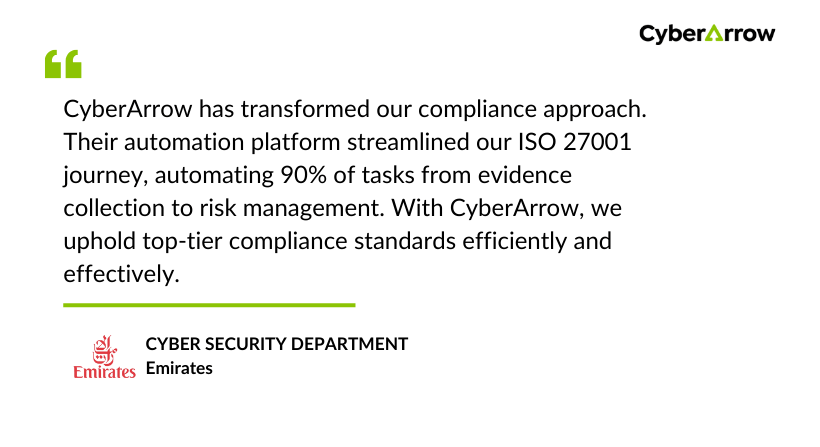
Read how Emirates enhanced Information Security by automating ISO 27001 with CyberArrow.
See what Emirates has to say about CyberArrow GRC:
Conclusion
ISO 27001 is a powerful framework for CISOs who want to build a structured, trusted, and scalable security program. It defines clear responsibilities, requires strong controls, and enforces continuous improvement.
However, managing ISO 27001 manually increases workload and risk. CISOs need automation, visibility, and consistency to succeed.
CyberArrow GRC provides the tools CISOs need to manage ISO 27001 responsibilities, oversee controls, and stay audit-ready without unnecessary complexity. It allows CISOs to focus on strategy while maintaining strong security and compliance.
For CISOs looking to lead effective ISO 27001 programs, CyberArrow GRC is the right platform to support long term success.
FAQs
What is the role of a CISO in ISO 27001 compliance?
The CISO is responsible for overseeing the information security program, managing risks, approving policies, ensuring controls are implemented, and supporting audits. The CISO also reports security posture and risks to leadership.
Which ISO 27001 controls should CISOs focus on most?
CISOs should focus on access control, risk management, incident response, encryption, vendor security, logging and monitoring, and business continuity. These controls reduce the highest security risks and are closely reviewed during audits.
How can CISOs stay audit-ready for ISO 27001 all year?
CISOs can stay audit-ready by maintaining an up-to-date risk register, keeping evidence centralized, reviewing controls regularly, and automating compliance tasks. Platforms like CyberArrow GRC help reduce manual work and provide real-time visibility into compliance status.
