


Best GRC software for FinTechs to achieve PCI DSS
FinTech companies handle large amounts of sensitive financial data. Many of them process, store, or transmit cardholder information through apps, payment systems, wallets, gateways, and digital platforms. This means they must follow PCI DSS, one of the most important global standards for protecting card data.
PCI DSS has strict rules. It requires clear controls, strong security practices, and ongoing monitoring. Many FinTechs try to handle these tasks with spreadsheets, shared folders, and manual tracking. This works for a short time, but it quickly becomes slow, confusing, and risky.
To meet PCI DSS expectations, FinTech companies need smart tools that help them stay compliant with less effort. This is where GRC software becomes valuable. It gives teams a strong system to manage all controls, tasks, evidence, and risks from one central place.
This blog explains why PCI DSS matters, the challenges FinTech teams face, and a review of the best GRC software options. It also explains why CyberArrow GRC is a leading choice for modern FinTechs.
- Why PCI DSS matters for FinTech companies
- Key challenges FinTechs face when preparing for PCI DSS
- Why FinTechs need GRC software for PCI DSS compliance
- Top GRC software for FinTechs to achieve PCI DSS
- Comparison summary
- How to choose the right GRC software for PCI DSS
- Final thoughts
- Conclusion: Why CyberArrow GRC is the best choice
- FAQs
Why PCI DSS matters for FinTech companies
FinTech users share financial information through apps and platforms every day. They expect companies to protect their card data at all times. PCI DSS supports these expectations by creating clear rules for securing cardholder information.
PCI DSS is important for FinTech companies because:
- It protects customer trust: Users expect their card information to stay safe when they use FinTech services.
- It reduces the risk of fraud and data theft: PCI DSS sets controls that help prevent the most common attacks.
- It helps avoid fines: Card brands may impose penalties on companies that fail to follow PCI DSS.
- It supports business growth: Investors, partners, and merchants prefer working with compliant FinTech companies.
- It strengthens internal systems: PCI DSS improves how teams handle networks, servers, and user data.
FinTech companies operate in highly competitive markets. Clear proof of PCI DSS compliance increases credibility and opens more opportunities.
Key challenges FinTechs face when preparing for PCI DSS
FinTech companies grow quickly. They release new features, scale their systems, and adopt new technologies at a fast pace. This makes PCI DSS compliance more complex.
Here are the main challenges FinTechs deal with:
1. Large number of technical controls
PCI DSS has many detailed requirements. FinTech teams must review, track, and implement each control correctly. Without structure, this becomes overwhelming.
2. Manual evidence collection
PCI DSS requires clear proof for almost every control. Manual evidence collection across emails and folders slows teams down and increases mistakes.
3. Fast changing systems
Most FinTechs use cloud services, APIs, microservices, and modern architectures. Rapid updates and new deployments make it harder to keep documentation accurate.
4. Limited visibility across teams
PCI DSS tasks are shared across engineering, security, DevOps, compliance, and product teams. Without a central system, leaders cannot see where gaps exist.
5. Difficulty maintaining ongoing compliance
PCI DSS is not a once per year project. FinTechs must show continuous monitoring and ongoing control effectiveness. Manual tracking does not support this well.
These challenges show why modern FinTech companies need GRC software. It creates order, improves consistency, and reduces the stress of PCI DSS work.
Why FinTechs need GRC software for PCI DSS compliance
GRC software helps FinTech teams manage PCI DSS tasks with clarity and structure. It replaces messy spreadsheets with a centralized system where teams can collaborate and track work.
GRC software supports PCI DSS by offering:
- A single source of truth: All controls, tasks, and evidence stay in one platform.
- Automatic reminders: Teams receive alerts so tasks are not forgotten.
- Clear ownership: Each control can be assigned to the right person or team.
- Stronger collaboration: Everyone can see comments, updates, and progress.
- Better audit readiness: Evidence stays organized, making audits smoother.
- Real time visibility: Leaders can track PCI DSS status at any moment.
- Fewer manual errors: Automation reduces repeated work and confusion.
With these features, GRC software helps FinTech companies save time, improve accuracy, and reach PCI DSS compliance faster.
Top GRC software for FinTechs to achieve PCI DSS
Here is a detailed comparison of the best GRC software options for PCI DSS compliance.
1. CyberArrow GRC
CyberArrow GRC is designed for organizations that want simple, fast, and automated compliance. It fits FinTech companies of all sizes because it offers clear dashboards, automated workflows, and easy evidence management.
CyberArrow GRC supports PCI DSS efforts with:
- Centralized compliance dashboards.
- Smart workflows that reduce manual work.
- Task assignments for different teams.
- Real time progress tracking.
- Evidence storage and management.
- Built in frameworks aligned with global standards.
- Audit readiness support.
- Fast onboarding and easy setup.
CyberArrow GRC is designed to be simple for both technical and non technical teams. It helps FinTechs stay organized and maintain continuous compliance.
2. Drata
Drata is a well known platform that focuses on automation and integrations. It works well for smaller FinTechs that need quick support for compliance frameworks. It supports PCI DSS, but some features may require additional configuration for complex environments.
3. Vanta
Vanta is popular among startups and early stage FinTech companies. It offers automation for controls and evidence collection. It supports PCI DSS but may feel limited for larger companies or advanced technical setups.
4. ServiceNow GRC
ServiceNow GRC is a strong choice for very large financial organizations. It offers detailed workflows and many integration options. However, it requires a long setup time and technical support, making it less suitable for smaller FinTechs or fast moving environments.
5. MetricStream
MetricStream is a mature GRC platform with strong risk, audit, and compliance modules. It works well for enterprise companies but can be more complex than needed for mid size FinTechs.
Comparison summary
Here is a simple comparison to help FinTechs choose the right platform:
| Feature | CyberArrow GRC | Drata | Vanta | ServiceNow GRC | MetricStream |
| Ease of use | Very easy | Easy | Easy | Medium | Medium |
| PCI DSS support | Strong | Medium | Medium | Strong | Strong |
| Automation | Strong | Strong | Medium | Strong | Medium |
| Setup speed | Fast | Fast | Fast | Slow | Slow |
| Best for | FinTechs of all sizes | Small teams | Startups | Large enterprises | Large enterprises |
CyberArrow GRC provides the best balance of speed, simplicity, and automation. This makes it ideal for FinTech companies working toward PCI DSS.
How to choose the right GRC software for PCI DSS
FinTech companies should look at several factors when choosing GRC software for PCI DSS:
- Ease of use: Teams should understand the platform without long training.
- Full PCI DSS control support: The platform must help track and map controls.
- Automation: The tool should reduce manual work.
- Evidence management: Teams should upload and manage proof easily.
- Fast onboarding: FinTechs should not wait months for setup.
- Reporting features: Leaders need clear visibility.
- Audit readiness tools: The software should support smooth audits.
- Scalability: The platform must grow with the company.
CyberArrow GRC covers all these requirements and supports FinTech companies through every stage of compliance.
Final thoughts
PCI DSS is one of the most important standards for FinTech companies. It protects cardholder data, builds trust, reduces risk, and supports business growth. But the process becomes difficult when teams rely on manual methods.
GRC software helps FinTechs simplify PCI DSS work. It creates structure, improves accuracy, and gives teams a clear path toward continuous compliance. With the right platform, companies can manage PCI DSS with far less stress and much more confidence.
Conclusion: Why CyberArrow GRC is the best choice
CyberArrow GRC is a complete compliance automation platform that helps FinTech companies manage PCI DSS controls in a simple and organized way. It provides clear dashboards, strong workflows, evidence support, and real time tracking. This helps teams stay compliant and audit ready without wasting time on manual tasks.
FinTech companies that want a smooth and reliable PCI DSS journey choose CyberArrow GRC because it makes the entire process easier, cleaner, and faster.
If your FinTech is ready to reach PCI DSS compliance with less effort, CyberArrow GRC is the strongest solution.
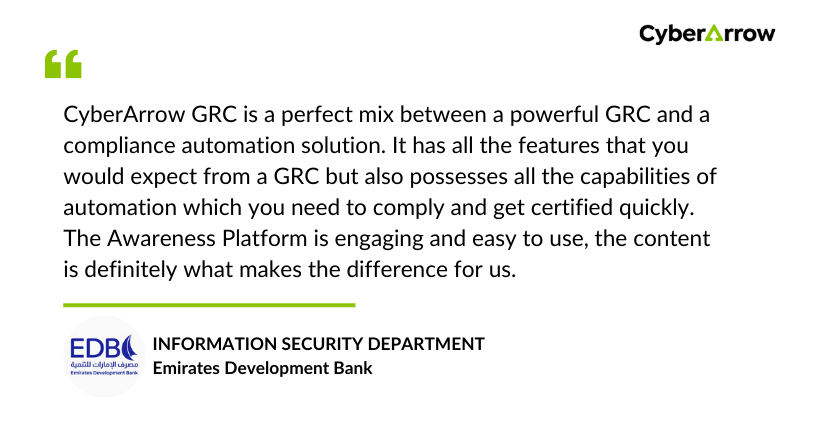
See what our clients have to say about CyberArrow GRC:
FAQs
Why do FinTech companies need GRC software for PCI DSS?
FinTech companies handle sensitive card information, so they must meet PCI DSS rules. GRC software helps them stay organized, reduce manual work, and keep all controls, policies, and evidence in one place. This makes audits easier and improves overall security.
Does GRC software replace the need for a PCI DSS auditor?
No. GRC software does not replace auditors. It simply helps FinTech companies collect evidence, manage tasks, track controls, and stay prepared. Auditors still perform the final review, but the process becomes much faster and smoother.
Is CyberArrow GRC good for PCI DSS compliance?
Yes. CyberArrow GRC is a strong choice for PCI DSS because it helps FinTechs organize their controls, manage policies, handle risks, and prepare for audits. It supports multi frameworks and gives a clear view of compliance progress, which helps companies stay ready all year.
