

Best GRC software for healthcare providers to achieve HIPAA
Healthcare organizations today face growing risks from data breaches, ransomware, and regulatory fines. Protecting patient information is no longer just an IT responsibility; it’s a legal and ethical requirement. The Health Insurance Portability and Accountability Act (HIPAA) sets clear standards for safeguarding health data, and compliance with it is mandatory for all healthcare providers, insurers, and partners that handle patient information.
Managing HIPAA compliance, however, can be a major challenge. The rules are strict, documentation requirements are extensive, and audits can happen at any time. That’s why more healthcare organizations are turning to GRC software to simplify compliance, reduce risks, and maintain trust.
This guide will help you understand how GRC software supports HIPAA compliance, what to look for in a platform, and how top tools compare in terms of features, automation, and ease of use.
- Understanding HIPAA in simple terms
- What is GRC software, and why does healthcare need it
- Key features to look for in GRC software for HIPAA
- Comparative review: Best GRC software for HIPAA compliance
- Comparison summary
- How GRC software simplifies HIPAA compliance
- Practical steps to implement GRC software in healthcare
- Common HIPAA compliance challenges
- The future of compliance in healthcare
- Conclusion: Why CyberArrow GRC is the best choice for HIPAA compliance
- FAQs
Understanding HIPAA in simple terms
HIPAA is a U.S. federal law that ensures patient health information stays private and secure. It applies to hospitals, clinics, insurance companies, and any third-party service that processes or stores health data.
HIPAA includes three main rules that healthcare providers must follow:
- Privacy rule: Controls how personal health information (PHI) is used and shared.
- Security rule: Sets technical and administrative safeguards to protect electronic PHI.
- Breach notification rule: Requires organizations to notify affected individuals and the government after data breaches.
To stay compliant, healthcare providers must continuously monitor risks, train staff, and document every policy and control. This can be overwhelming without a structured system, which is where GRC software becomes essential.
What is GRC software, and why does healthcare need it
GRC software stands for Governance, Risk, and Compliance. It helps healthcare organizations manage policies, monitor risks, and stay audit-ready. Instead of juggling spreadsheets and emails, teams can automate controls, store evidence, and generate compliance reports in one central platform.
Here is how GRC software helps healthcare providers meet HIPAA requirements:
- Centralized compliance management: Tracks all HIPAA controls in one place.
- Risk assessment automation: Identifies vulnerabilities in systems and workflows.
- Incident management: Records, investigates, and reports security incidents.
- Policy management: Maintains policies, assigns ownership, and collects employee acknowledgments.
- Vendor risk tracking: Monitors compliance for third-party business associates.
- Audit preparation: Generates reports and evidence for auditors quickly.
With the right GRC software, healthcare providers can turn compliance into a proactive, automated process that saves time and reduces the risk of penalties.
Key features to look for in GRC software for HIPAA
When choosing a GRC platform, healthcare organizations should focus on these essential features:
- Pre-built HIPAA framework: The software should come with ready-made HIPAA templates and control libraries.
- Risk and incident management: Tools to assess risks, document incidents, and track remediation.
- Automation and integrations: Ability to connect with IT and cloud systems to collect evidence automatically.
- Training and policy management: Built-in modules for employee training and policy acknowledgment.
- Audit-ready reporting: Easy-to-generate compliance reports for internal and external audits.
- Scalability: Flexibility to grow with your organization as regulations evolve.
Comparative review: Best GRC software for HIPAA compliance
Below is a comparison of leading GRC software platforms that help healthcare providers achieve HIPAA compliance efficiently.
1) CyberArrow GRC
Best for: Healthcare providers that want full automation and easy-to-use compliance management.
Why it stands out:
CyberArrow GRC is designed for organizations that want to simplify compliance without losing control. It includes built-in HIPAA frameworks, automated task tracking, and role-based dashboards that make compliance management intuitive.
The platform helps automate evidence collection from cloud and security tools while maintaining clear visibility across departments. It also provides policy templates and training modules to strengthen employee awareness.
Key features:
- Pre-built HIPAA compliance library
- Automated risk and vendor management
- Real-time dashboards and compliance tracking
- Integration with security and IT systems
- Audit-ready documentation export
CyberArrow GRC is a great choice for healthcare providers who want to maintain continuous HIPAA compliance while minimizing manual work.
2) LogicGate Risk Cloud
Best for: Mid-size healthcare organizations that need workflow customization.
Why it stands out:
LogicGate allows users to design compliance workflows tailored to specific departments. Its drag-and-drop interface makes it easy to build processes like policy reviews, vendor assessments, or risk approvals.
Limitations:
It requires some technical setup, and smaller healthcare practices might find it more complex than necessary.
3) ServiceNow GRC
Best for: Large healthcare systems with integrated IT operations.
Why it stands out:
ServiceNow offers enterprise-grade automation and deep integration with IT service management tools. It’s ideal for hospitals and healthcare networks that already use ServiceNow for other business functions.
Limitations:
Setup and customization can take time, and the cost may be higher for small to mid-size providers.
4) RiskWatch GRC
Best for: Hospitals seeking a compliance-focused solution with strong risk scoring.
Why it stands out:
RiskWatch provides built-in frameworks for HIPAA and other healthcare standards. It includes risk analysis tools that calculate compliance scores and highlight gaps.
Limitations:
The interface feels less modern compared to newer platforms, and reporting customization can be limited.
5) MetricStream GRC
Best for: Healthcare organizations needing a robust enterprise system with analytics.
Why it stands out:
MetricStream provides a detailed control framework and strong data visualization capabilities. It’s suitable for compliance teams that need comprehensive reports for executive review.
Limitations:
It requires configuration support, and smaller teams may find it too feature-heavy.
Comparison summary
| Feature | CyberArrow GRC | LogicGate | ServiceNow | RiskWatch | MetricStream |
| Ease of use | Excellent | Good | Good | Moderate | Excellent |
| HIPAA framework | Yes | Custom | Yes | Yes | Yes |
| Automation level | High | Medium | Medium | Medium | Medium |
| Vendor management | Yes | Yes | Yes | Yes | Yes |
| Training and policy tools | Yes | Yes | Yes | Limited | Yes |
| Best for | All healthcare size | Mid-size | Large | Hospitals | Hospitals |
How GRC software simplifies HIPAA compliance
A strong GRC platform helps healthcare organizations align with every aspect of HIPAA through:
- Centralized Documentation: All policies, audits, and incidents stored in one platform.
- Continuous Monitoring: Automated checks to ensure controls stay active.
- Evidence collection: Integrations that pull logs and configurations directly from systems.
- Employee training: Built-in awareness modules to ensure a compliance culture.
- Audit readiness: Automated reports that show compliance progress.
This makes audits smoother and allows compliance teams to focus on improving patient care rather than chasing paperwork.
Practical steps to implement GRC software in healthcare
- Define scope: Identify departments and systems that process PHI.
- Select the right platform: Choose software that fits your organization’s size and complexity.
- Upload current policies: Import your existing HIPAA policies and procedures.
- Automate evidence collection: Connect your GRC tool to IT and security systems.
- Assign roles: Define control owners and responsibilities.
- Run risk assessments: Identify and mitigate gaps in compliance.
- Monitor continuously: Use dashboards to track progress and prepare for audits.
By following these steps, healthcare organizations can create a culture of compliance that runs smoothly year-round.
Common HIPAA compliance challenges
- Managing third-party vendors that handle PHI.
- Keeping policies and training up to date.
- Tracking security incidents and follow-up actions.
- Maintaining complete documentation for audits.
- Ensuring staff understand their compliance roles.
GRC software addresses these challenges by automating key processes and improving visibility across teams.
The future of compliance in healthcare
With increasing cyberattacks on hospitals and clinics, automation is becoming essential. GRC software is no longer a tool for large corporations, it’s a necessity for healthcare providers of all sizes. By centralizing compliance efforts and automating manual tasks, healthcare organizations can maintain patient trust while meeting regulatory standards.
Conclusion: Why CyberArrow GRC is the best choice for HIPAA compliance
For healthcare providers seeking a simple, efficient, and scalable way to manage HIPAA compliance, CyberArrow GRC stands out as the top choice.
CyberArrow GRC combines automation, visibility, and ease of use in one platform. It comes with built-in HIPAA controls, audit-ready templates, and seamless integrations with healthcare IT systems. Its automated workflows and policy management tools help providers maintain continuous compliance without wasting time on manual tracking.
CyberArrow GRC also supports multiple frameworks such as ISO 27001, GDPR, and NIST, making it ideal for healthcare organizations that must comply with multiple regulations.
By choosing CyberArrow GRC, healthcare providers can:
- Automate risk and compliance tasks.
- Simplify HIPAA audits.
- Strengthen patient data protection.
- Build a lasting culture of security and trust.
CyberArrow GRC empowers healthcare organizations to stay compliant, secure, and focused on what matters most, delivering quality care to their patients.
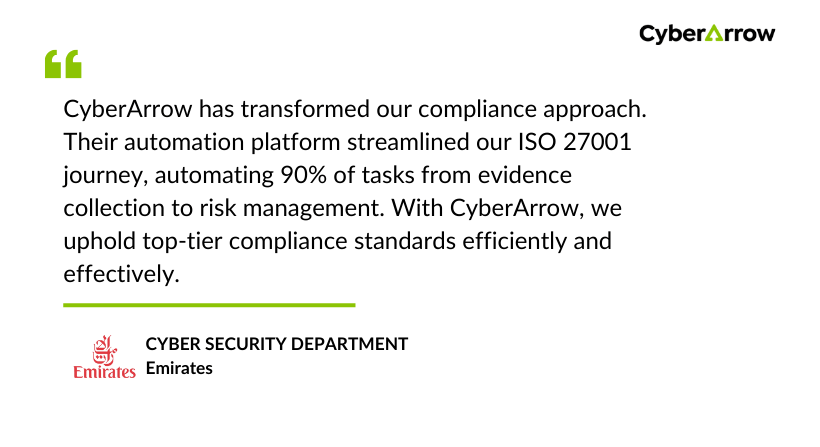
See what clients have to say about CyberArrow GRC:
FAQs
What is GRC software in healthcare?
GRC software in healthcare helps organizations manage governance, risk, and compliance in one place. It automates HIPAA controls, tracks incidents, manages policies, and ensures continuous monitoring to keep patient data safe and meet all regulatory requirements.
How does GRC software support HIPAA compliance?
GRC software supports HIPAA compliance by providing built-in frameworks, automated risk assessments, and audit-ready reports. It monitors policies, tracks employee training, and gathers evidence from IT systems to help healthcare providers stay compliant without manual paperwork.
Why is CyberArrow GRC a good choice for healthcare providers?
CyberArrow GRC is ideal for healthcare providers because it automates HIPAA compliance, offers ready-to-use templates, and integrates with common healthcare IT systems. It simplifies audits, reduces manual work, and helps organizations maintain strong data protection across all departments.
