

Best GRC software for startups to achieve SOC 2: A comparative review
Early-stage startups live on speed, trust, and focus. You need to ship fast, win customers, and prove that their data is safe. For B2B SaaS and data companies, that proof often means SOC 2. The fastest path to SOC 2 is rarely a folder of spreadsheets. It is a smart GRC software stack that guides your team, automates the busywork, and keeps you audit-ready.
This guide explains what GRC software does for startups, how SOC 2 works in simple terms, and what you should look for when choosing a platform. You will also find a side-by-side review of leading options that help new teams reach SOC 2 without slowing product velocity. Everything is written in clear, simple English so you can act right away.
- What GRC software does for startups
- SOC 2 in simple terms
- How to choose GRC software for SOC 2
- Comparative review of leading GRC software for startups
- Feature comparison snapshot
- A step-by-step plan to reach SOC 2 with GRC software
- Common pitfalls and how to avoid them
- How GRC software helps sales
- Building an internal culture of security
- Return on investment for startups
- Conclusion: Why CyberArrow GRC is a strong pick for startups
- FAQs
What GRC software does for startups
GRC stands for governance, risk, and compliance. A modern GRC platform helps you plan controls, track tasks, collect evidence, and report progress. Instead of emailing screenshots or chasing approvals, you use one place to manage policies, risks, training, vendors, and audits.
For a startup, the right GRC software should:
- Turn SOC 2 rules into a step-by-step plan.
- Map controls to tools you already use.
- Pull evidence from cloud and identity systems.
- Remind owners about tasks and due dates.
- Keep a clean audit trail that an auditor can verify.
- Scale as the team, product, and customers grow.
If the platform does these well, your team spends less time on admin and more time building the product.
SOC 2 in simple terms
SOC 2 is an independent report about how your company handles customer data. Auditors review your controls across five Trust Services Criteria. Security is required. The others are Availability, Processing Integrity, Confidentiality, and Privacy. Most startups start with Security, then add more as enterprise buyers ask for them.
There are two types of SOC 2 reports:
- Type I checks the design of controls at a point in time.
- Type II checks design and operation over a period, usually 3 to 12 months.
Buyers often prefer Type II because it shows real operation over time. Good GRC software makes both easier by keeping evidence organized and controls running on schedule.
How to choose GRC software for SOC 2
When you evaluate platforms, use practical criteria that match a startup’s reality.
- Ease of setup: Can a small team get started in days, not months? Is there a clear checklist and helpful templates?
- Integrations: Does it connect to your cloud, code, ticketing, identity, and monitoring tools? Common systems include AWS, GCP, Azure, GitHub, GitLab, Jira, Linear, Okta, Google Workspace, Microsoft 365, Slack, Datadog, and your CI pipeline.
- Evidence automation: Can the platform pull logs and settings automatically so you are not taking endless screenshots?
- Policy and training: Are there plain language policy templates? Can you assign training, track completion, and collect acknowledgments?
- Risk and vendor management: Does the tool provide a simple risk register and vendor due diligence that does not feel like overkill?
- Audit support: Does the platform help you pick an auditor, prepare the request list, and share evidence with read-only access?
- Total cost and value: Consider license price, time saved, and the chance to close bigger deals. A lower price that costs your team many hours is not a savings.
- Scalability: As you add people, regions, and products, can the platform expand without a painful migration?
Comparative review of leading GRC software for startups
Below is a practical, founder-friendly review of popular options that startups use to reach SOC 2. Each can help you get the job done. Your best choice depends on what you already run and how you sell.
1) CyberArrow GRC
Best for startups that want a single hub for multiple frameworks with strong automation and clear dashboards.
Why startups like it
CyberArrow GRC gives you a guided SOC 2 path with role-based tasks, control libraries, and cross mapping for ISO 27001, GDPR, HIPAA, and more. It integrates with common cloud and collaboration tools to pull evidence. Policy templates are simple, and the workflow keeps owners on track. Reporting is clean enough for board slides and sales decks. Teams that plan to grow into multi-framework compliance appreciate the future-ready design.
Watch for
As with any platform, plan one owner for setup, decide naming rules early, and align controls with how your engineers actually work.
Download your free SOC 2 checklist and assess your SOC 2 audit-readiness in minutes.
Book a free demo
2) Vanta
Best for startups that want quick wins with many plug-and-play integrations.
Why startups like it
Setup feels fast due to a large integration catalog and automated tests. Evidence collection is strong for cloud and identity tools. The dashboard shows clear gaps. Good for teams that want a familiar, widely used tool with auditor partnerships.
Watch for
Make sure policy text matches your real process. Do not accept defaults without editing for your environment.
3) Secureframe
Best for startups that need polished policy kits and auditor-friendly packaging.
Why startups like it
Policy libraries and training modules are tidy. Vendor tracking is straightforward. Evidence rooms simplify sharing with auditors. Helpful for teams that value a strong policy baseline and a smooth audit handoff.
Watch for
Assign a team member to tune tasks and remove steps you do not need. A lean scope saves time.
4) Drata
Best for engineering-driven teams that want granular control checks and continuous monitoring.
Why startups like it
Drata offers detailed technical tests across cloud and code tools. The platform feels robust for teams with strong DevOps habits. Good for companies that want to show deep technical proof to big buyers.
Watch for
Create a shared glossary for controls so non-technical owners understand what each test means.
5) Sprinto
Best for distributed teams that want a clear, sprint-like rollout.
Why startups like it
Set up uses a project feel with milestones and task streams. Helpful for teams that prefer a Kanban-style experience. Control mapping is tidy, and the guidance is practical.
Watch for
As with all tools, confirm that control owners receive only relevant tasks to avoid alert fatigue.
Feature comparison snapshot
- Integrations: All reviewed tools connect to popular cloud, identity, and code platforms. CyberArrow GRC stands out for cross-framework mapping if you plan to add ISO 27001 or GDPR soon.
- Evidence automation: Each pulls evidence for controls like MFA, access reviews, backups, and encryption. Look for read-only connections and proof of least privilege.
- Policy and training: CyberArrow GRC, Secureframe, and Vanta provide strong templates and training tracking. Pick the style that matches your culture. Clear, short policies drive real adoption.
- Risk and vendor: CyberArrow GRC presents risk, controls, and vendors in one view, which helps founders explain posture to buyers. Others also offer these modules, but check how easy it is to tune risk scoring for your stage.
- Audit experience: All have auditor networks. Focus on how they package evidence and let auditors view items without extra work from your team.
- Multi-framework growth: If you expect ISO 27001, HIPAA, or GDPR within a year, platforms with native cross-mapping save time. CyberArrow GRC is strong here.
A step-by-step plan to reach SOC 2 with GRC software
- Confirm scope: Pick the Trust Services Criteria you will include. Start with Security. List systems in scope like cloud accounts, databases, and identity providers.
- Pick one owner: Assign a single responsible person. This can be a founder, head of ops, or a staff engineer. They coordinate tasks and unblock decisions.
- Choose your platform: Use the criteria above. Run a short proof of value. Connect a sandbox cloud account and identity provider. Review how many tests pass out of the box.
- Tune policies to match reality: Edit templates to reflect actual practice. If your engineers use feature branches and PR checks, state that. Clear and honest policy text earns trust.
- Map controls to tools: Connect integrations for access control, logging, backups, and vulnerability scans. Confirm that the platform pulls evidence without manual steps.
- Assign owners and set cadence: Give each control a named owner. Schedule monthly or weekly reviews for key checks like user access, incident drills, and backup tests.
- Train everyone: Roll out short training and policy acknowledgments. Track completion for all employees and contractors.
- Run a readiness review: Use the platform’s gap report. Fix findings. Document exceptions with clear reasons and a target date.
- Select an auditor: Pick one that has seen your platform before. Share the evidence room. Clarify timelines and testing windows.
- Operate and improve: For Type II, keep controls running across the period. Review dashboards weekly. Fix drift fast and record your actions.
Common pitfalls and how to avoid them
- Copying policies you do not use: Auditors will ask how you follow them. Keep policies short and realistic. Your team will comply if the rules fit the work.
- Too many tools at once: Start with the core stack you already run. Add only what buyers request or what fills a clear gap.
- Ownerless controls: Every control needs a name and a backup. Use the GRC software to track both.
- Evidence at the last minute: Let the platform pull logs automatically. Replace screenshots with system reports wherever possible.
- Skipping vendor reviews: Even small vendors can increase risk. Track contracts and ensure they meet your security baseline.
How GRC software helps sales
SOC 2 is not just a compliance project. It is a sales asset. With clean dashboards and clear reports, your team can answer security questionnaires faster and shorten procurement cycles. Many startups build a short security overview for prospects using charts from their GRC platform. This shows maturity, reduces back and forth, and builds trust.
Building an internal culture of security
Tools help, but culture wins. Set simple habits that everyone follows.
- Lock laptops and use MFA by default.
- Keep production data out of test unless masked.
- Log incidents and celebrate fast response.
- Review access monthly and remove unused accounts.
- Write short runbooks for common events.
Your GRC software should support these habits, not replace them. When people know the why and the how, audits feel natural.
Return on investment for startups
Founders often ask if GRC software is worth it. The gains show up in three places:
- Time saved: Automated evidence and tasks save many hours per month, which means more time to build features.
- Deal velocity: With ready reports and a valid SOC 2, large buyers move faster.
- Lower risk: Continuous checks catch gaps early. Fewer surprises means fewer fire drills.
When you frame the decision this way, the platform cost is a small part of the total value.
Conclusion: Why CyberArrow GRC is a strong pick for startups
Every tool in this review can help a startup reach SOC 2. The best choice depends on your stack, your timeline, and your growth plans. If you want a platform that guides you from the first checklist to a multi-framework scale, CyberArrow GRC is a strong pick.
CyberArrow GRC gives startups a clear SOC 2 path, practical policy kits, and deep integrations that collect evidence without constant manual work. The dashboards show risk, control status, vendor posture, and training progress in one view. As you add ISO 27001, GDPR, HIPAA, or NIST CSF, cross-mapping keeps effort low and consistency high. Your team gets a single source of truth for governance, risk, and compliance while staying focused on product and customers.
If your next quarter includes enterprise pilots or security reviews, choose a GRC partner that grows with you. CyberArrow GRC helps you prove trust, win deals, and keep compliance simple as you scale.
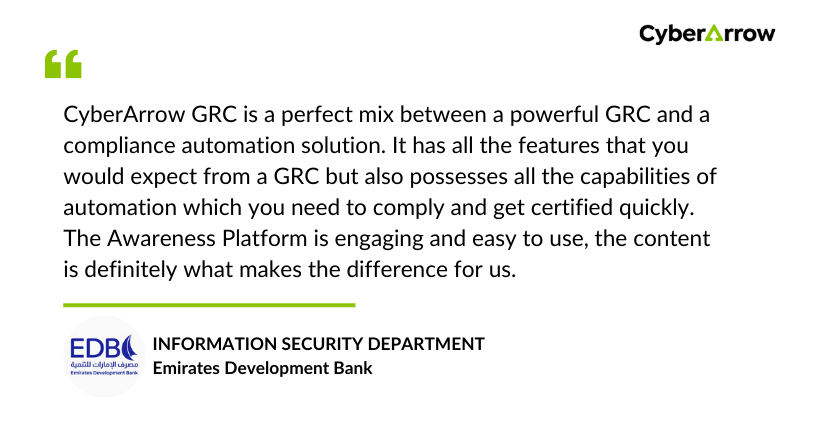
See what our clients have to say about CyberArrow GRC:
FAQs
What is GRC software?
GRC software helps companies manage governance, risk, and compliance processes in one platform. It simplifies audits, automates tasks, tracks risks, and keeps documentation organized for frameworks like SOC 2, ISO 27001, and HIPAA.
Why do startups need GRC software for SOC 2 compliance?
Startups need GRC software to automate evidence collection, map controls, and stay organized during SOC 2 audits. It saves time, reduces errors, and builds customer trust by showing a strong security posture.
How does GRC software automate SOC 2 compliance?
GRC software connects with your cloud, identity, and ticketing tools to collect audit evidence automatically. It monitors controls, sends task reminders, and provides real-time dashboards that keep you always audit-ready.
What features should startups look for in GRC software?
Startups should look for easy setup, strong integrations, policy templates, audit support, vendor tracking, and clear dashboards. The tool should grow with your business and support multiple frameworks.
Why is CyberArrow GRC a good choice for startups?
CyberArrow GRC gives startups a guided SOC 2 roadmap, built-in templates, real-time dashboards, and integrations for evidence automation. It scales to handle ISO 27001, HIPAA, and GDPR as your company grows.
