


Risk identification complete guide: Importance & process
Understanding risk is one of the most important parts of running a business. Every company, big or small, faces challenges. Some of these problems can be small, while others can seriously hurt the business. That’s why risk identification is the first step in protecting your company from surprises.
In this guide, we’ll explain what risk identification is, why it matters, how it works, and how you can make it better using tools like CyberArrow GRC and its Enterprise Risk Management (ERM) module.
What is risk identification?
Risk identification means spotting anything that could go wrong in your business. It could be a small issue, like a missed deadline. Or it could be a big problem, like a cyberattack, data loss, or a lawsuit. The goal is to find these risks before they happen, so you can stop them or reduce their impact.
Think of it like this: If you were driving a car and knew there was a pothole ahead, you’d avoid it. The same goes for business risks.
Why is risk identification important?
Here’s why every business should care about identifying risks:
- Fewer surprises – You know what might go wrong ahead of time.
- Better decisions – You plan smarter when you understand the risks.
- Save money – Fixing problems early is cheaper than fixing them late.
- Protect your reputation – Handling risks shows your customers you’re trustworthy.
- Stay compliant – Many industries have rules that require risk management.
Ignoring risks can lead to major problems. That’s why smart companies make risk identification a regular habit.
Types of risks to watch for
There are different kinds of risks that businesses face. You should try to spot each one:
- Strategic risks – Bad decisions that affect goals or direction.
- Operational risks – Failures in daily business tasks or systems.
- Financial risks – Losing money because of fraud, bad budgets, or market changes.
- Compliance risks – Breaking laws, regulations, or industry rules.
- Cybersecurity risks – Hacks, breaches, or stolen data.
- Reputational risks – Anything that makes customers lose trust in you.
Each of these risks can affect your business in a different way. But they all need to be identified early.
The risk identification process (Step by step)
Step 1: Understand the context
Before you start spotting risks, you need to know what you’re protecting. This includes:
- Your business goals.
- Your systems and processes.
- Laws and standards you must follow.
- The industry you work in.
Knowing this helps you spot what could go wrong.
Step 2: Gather a risk team
You can’t do this alone. Bring together people from different departments. They all see different risks. Someone in IT may spot a cyber risk, while someone in finance may notice budget issues.
Step 3: Use risk identification techniques
There are many ways to find risks. Some of the best methods include:
- Brainstorming – Get the team to list everything that could go wrong.
- SWOT analysis – Review your Strengths, Weaknesses, Opportunities, and Threats.
- Risk checklists – Use lists of common risks for your industry.
- Interviews and surveys – Ask employees what risks they’ve seen.
- Past reports – Look at old audit findings, incidents, and losses.
Step 4: Create a risk register
A risk register is a document that lists all your risks in one place. For each risk, include:
- A short name.
- A full description.
- The area of the business it affects.
- How likely it is.
- What would happen if it did occur.
- What can be done to stop it?
This is one of the most important tools in risk management.
Step 5: Review and update regularly
Your business changes all the time. So do the risks. Review your risk register often at least every quarter. Also, check it after big events, like system changes, company growth, or new regulations.
Standards that support risk identification
Risk identification doesn’t happen in a vacuum. There are standards and frameworks that help guide the process.
ISO 31000 – Risk management guidelines
ISO 31000 is one of the most widely used risk management standards. It helps businesses:
- Set up a risk policy.
- Understand context.
- Identify, analyze, and treat risks.
- Monitor and improve their risk plan.
ISO 31000 is not just for tech or finance. It can be used by any business, in any industry.
NIST Framework
The National Institute of Standards and Technology (NIST) offers detailed frameworks for risk, especially for cybersecurity. NIST guidelines help identify digital risks, map controls, and stay secure.
COSO ERM framework
COSO’s framework is all about enterprise risk. It connects risks with company goals, decision-making, and performance. It’s great for larger companies or complex organizations.
Using these standards makes your risk identification stronger and more reliable.
Challenges of manual risk identification
Doing all of this manually takes time. It also leads to mistakes. Here are common problems:
- Inconsistent data – Different teams may use different formats.
- Missed risks – People forget or don’t report everything.
- Lack of tracking – Hard to tell which risks are resolved.
- Too many spreadsheets – Information gets lost or outdated.
This is why more companies are turning to automated tools like CyberArrow GRC.
How CyberArrow GRC automates risk identification
CyberArrow GRC is a governance, risk, and compliance platform that takes the stress out of managing risk. Its Enterprise Risk Management (ERM) module helps companies identify, assess, and respond to risks automatically.
Key Features:
- Automated risk management: CyberArrow uses smart algorithms to handle risk assessments for you. No more spreadsheets or manual tracking.
- Pre-mapped risk library: It comes with 3000+ risks and mitigations, mapped to over 100+ frameworks and standards, including ISO 31000 and NIST.
- Real-time dashboards: You get clear visual insights into your risk posture with a real-time dashboard.
- Cross-framework mapping: CyberArrow can link a single risk across multiple frameworks saving time and reducing duplication of work.
- Boosts trust with clients and auditors: Clients and regulators want proof that you manage risks well. CyberArrow helps you demonstrate this clearly and quickly.
- Scalable for growth: As your company grows, CyberArrow grows with you. It can handle risk at the enterprise level.
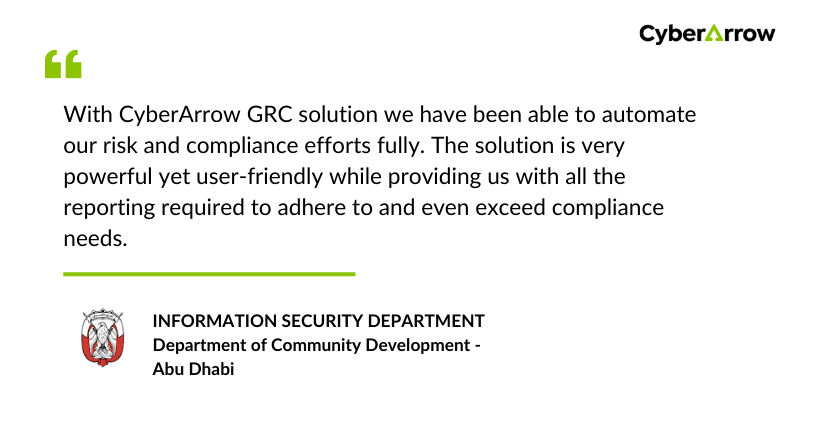
Read how CyberArrow GRC improved risk management across the departments of DCD – Abu Dhabi.
See what DCD – Abu Dhabi has to say about CyberArrow GRC:
Conclusion
Risk identification is not just a task, it’s a business necessity. Companies that take it seriously avoid problems before they happen, protect their reputation, and save money. But doing it manually is no longer enough.
With tools like CyberArrow GRC, you can take your risk identification and management to the next level. CyberArrow’s Enterprise Risk Management module does the heavy lifting, so your team can focus on growth, not chasing risks.
