


Types of risk management in cyber security: A complete guide
Cyber attacks are becoming more common, more complex, and more costly. Whether you’re a small business or a large enterprise, the truth is simple: you must manage your cyber risks.
But what does that mean exactly?
Cyber risk management is the process of identifying, assessing, and controlling risks to your digital systems, data, and operations. And just like different types of cyber threats exist, there are also different types of risk management.
In this guide, you’ll learn what the main types of risk management are in cyber security, how organizations use them, which international standards guide the process, and how tools like CyberArrow GRC automate and simplify everything.
Let’s dive in.
What is risk management in cyber security?
Risk management in cyber security is about protecting your business from potential digital dangers. These risks could come from hackers, system failures, human errors, or even natural disasters.
The goal is to:
- Identify where threats might come from.
- Assess how serious they are.
- Control or reduce them before they cause damage.
Think of it like locking your doors at night. You don’t wait for a break-in to happen. You take action to prevent it.
Now let’s talk about the different ways to handle cyber risks.
Types of risk management in cyber security
There are five main types of risk management strategies used in cyber security. Each one works differently based on the situation and the level of risk involved.
1. Risk avoidance
This means completely avoiding the activity that creates the risk. For example, if a company thinks a new software tool might be too risky, they may choose not to use it at all.
When to use it:
- When the risk is too high and not worth the reward.
- When alternatives exist with lower risk.
Example: Not allowing employees to access unsecured Wi-Fi networks with work devices.
2. Risk reduction (Mitigation)
This is the most common approach. It means taking steps to lower the chance of a risk happening or reduce its impact.
When to use it:
- When a risk can’t be avoided, but can be managed.
- When you’re able to control parts of the process.
Example: Installing firewalls and antivirus software to stop malware attacks.
3. Risk sharing (Transfer)
Here, the risk is shared with a third party, such as an insurance company or a cloud service provider. You don’t eliminate the risk, but you’re not handling it alone.
When to use it:
- When you can outsource certain risks.
- When protection through insurance makes sense.
Example: Buying cyber insurance to cover data breach costs.
4. Risk retention (Acceptance)
This means accepting the risk and choosing not to act, usually because the impact is low, or the cost of fixing it is higher than the risk itself.
When to use it:
- When the cost to mitigate is higher than the possible loss.
- When you have a clear plan in place in case something goes wrong.
Example: A small company accepts the risk of an outdated printer not having encryption because it doesn’t store or transmit sensitive data.
5. Risk monitoring
Although not always listed as a standalone type, risk monitoring is an ongoing process that involves keeping an eye on all risks. It ensures your risk management plan stays up-to-date and relevant.
When to use it:
- Always, cyber risks are constantly changing.
- After implementing any of the other four strategies.
Example: Using a dashboard to track threat alerts, policy changes, or system issues in real time.
Why are these risk management types important?
Using the right type of risk management:
- Helps protect your data, systems, and reputation.
- Reduces downtime and financial losses.
- Builds trust with customers, partners, and regulators.
- Helps meet compliance standards and pass audits.
And it’s not just about choosing one method. Most businesses use a combination of these types across different departments and systems.
Cyber security risk management standards
To manage risk effectively, companies often follow global standards. These standards offer proven frameworks and help businesses follow best practices. Let’s look at a few key ones.
1. ISO 31000 – Risk management
ISO 31000 is the most widely used risk management standard. It offers a structured approach for managing all types of risk including cyber risk.
Key principles include:
- Risk identification.
- Risk assessment.
- Risk treatment (avoid, reduce, share, accept).
- Monitoring and review.
- Communication and consultation.
ISO 31000 helps businesses build a risk-aware culture and make better decisions at every level.
2. NIST SP 800-30 – Risk assessment guide
Published by the National Institute of Standards and Technology (NIST), this guide focuses on identifying and assessing risks to information systems.
It helps organizations:
- Analyze threat sources.
- Evaluate vulnerabilities.
- Estimate likelihood and impact.
- Determine risk levels.
It’s especially helpful for U.S. federal agencies and companies working with the government.
3. ISO/IEC 27005 – Information security risk management
This standard supports the ISO/IEC 27001 framework and focuses on managing information security risks.
It provides detailed steps for:
- Risk analysis.
- Risk evaluation.
- Risk treatment.
- Risk acceptance and residual risk.
ISO/IEC 27005 works best for businesses already implementing ISO/IEC 27001.
4. COSO ERM framework
COSO stands for Committee of Sponsoring Organizations of the Treadway Commission. The COSO ERM framework focuses on Enterprise Risk Management, blending strategic planning and internal controls.
It’s used by larger organizations that want to align risk with their business goals.
5. FAIR (Factor Analysis of Information Risk)
FAIR is a newer standard that helps calculate cyber risk in financial terms. It breaks down threats and losses into numbers, which helps companies:
- Set budgets.
- Compare risk levels.
- Communicate clearly with leadership.
FAIR is gaining popularity in industries that rely on financial data, like banking and insurance.
The challenge: Managing all this risk is hard
While standards and frameworks help, managing risk manually can become overwhelming. Many businesses face problems like:
- Using too many spreadsheets.
- Lack of real-time risk visibility.
- Duplicate assessments.
- Inconsistent reporting.
- Trouble mapping risks across frameworks.
This is where CyberArrow GRC helps organizations automate the whole process with ease.
Automate risk management with CyberArrow GRC
CyberArrow GRC is a smart, modern solution that helps you take control of risk—across your entire organization. It supports enterprise risk management while removing the need for manual tracking or scattered documents.
Here’s what makes it powerful:
- Automated risk management: CyberArrow uses advanced algorithms to manage risk assessments automatically. This means less manual work and fewer chances of human error. It follows best practices from top standards like ISO 31000 and NIST.
- Enterprise risk management built-in: Support for enterprise-level risk management comes out of the box. Whether you follow ISO, NIST, COBIT, or others, CyberArrow is already set up to handle them.
- 3000+ pre-mapped risks and mitigations: CyberArrow includes a library of 3,000+ risks and mitigations mapped across 100+ frameworks and standards. This helps you save time and meet compliance with ease.
- Boost client confidence: Show your clients that you take risks seriously. Use CyberArrow to generate clean reports, track changes, and respond to incidents fast. It’s proof of your commitment to protecting their data and interests.
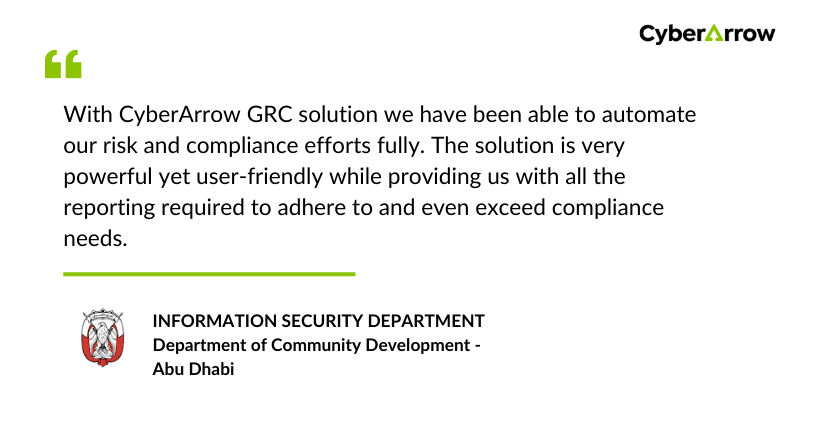
See what DCD – Abu Dhabi has to say about CyberArrow GRC:
Final thoughts
Cybersecurity risk is not something to ignore. Every organization, big or small, faces digital threats every day. The key is not to fear them but to manage them smartly.
By using the right types of risk management, following international standards, and using automated tools like CyberArrow GRC, you can stay ahead of threats and grow your business with confidence.
