Information security standards: A complete guide
In today’s digital world, protecting sensitive information is more important than ever. Cyber threats are growing, and businesses must take steps to keep their data safe. One effective way to do this is by following information security standards. These standards provide guidelines to help organizations protect their information, comply with laws, and build trust with customers and partners.
This guide will explain what information security standards are, discuss key standards, and show how businesses can use them effectively. We’ll also look at how CyberArrow GRC can help automate compliance, making the process easier and more efficient.
- What are information security standards?
- Why are information security standards important?
- Key information security standards
- How to choose the right information security standard?
- Common challenges in following information security standards
- How CyberArrow GRC helps automate information security standards
What are information security standards?
Information security standards are sets of rules and best practices designed to help organizations protect their information assets. They offer a structured approach to managing sensitive data, ensuring its confidentiality, integrity, and availability. By following these standards, businesses can reduce risks, comply with legal requirements, and show their commitment to information security.
Why are information security standards important?
Implementing information security standards is crucial for several reasons:
- Risk management: They help identify and manage potential security threats.
- Regulatory compliance: Many industries require adherence to specific security standards.
- Customer trust: Demonstrating robust security practices builds confidence among clients and partners.
- Operational efficiency: Standardized security measures streamline processes and reduce vulnerabilities.
Key information security standards
Several information security standards have been developed to address different aspects of data protection. Here are some of the most widely recognized:
1. ISO/IEC 27001
ISO/IEC 27001 is an international standard for information security management systems (ISMS). It provides a framework for establishing, implementing, maintaining, and continually improving an ISMS. Organizations that achieve ISO 27001 certification demonstrate their commitment to managing information securely and systematically.
Key Components:
- Risk assessment and treatment: Identifying and managing information security risks.
- Security controls: Implementing measures to protect information assets.
- Continuous improvement: Regularly reviewing and enhancing the ISMS.
Benefits:
- Enhanced protection of sensitive data.
- Improved compliance with legal and regulatory requirements.
- Increased customer and stakeholder confidence.
2. NIST Cybersecurity Framework
Developed by the National Institute of Standards and Technology (NIST), this framework provides guidelines for managing and reducing cyber security risks. It is widely used by organizations to strengthen their security posture.
Core functions:
- Identify: Understand and manage cyber security risks to systems, assets, data, and capabilities.
- Protect: Implement safeguards to ensure the delivery of critical services.
- Detect: Develop activities to identify the occurrence of a cyber security event.
- Respond: Take action regarding a detected cyber security incident.
- Recover: Maintain plans for resilience and restore capabilities impaired by cyber security incidents.
Benefits:
- Provides a structured approach to managing cyber security risks.
- Enhances communication of cyber security issues within the organization.
- Aligns cyber security activities with business requirements.
3. General Data Protection Regulation (GDPR)
The GDPR is a regulation enacted by the European Union to protect the privacy and personal data of EU citizens. It imposes strict requirements on organizations that process personal data, regardless of their location.
Key Requirements:
- Consent: Obtain clear consent from individuals before processing their data.
- Data protection impact assessments: Conduct assessments to identify and mitigate risks related to data processing activities.
- Data breach notification: Notify authorities and affected individuals promptly in the event of a data breach.
Benefits:
- Enhances the protection of personal data.
- Increases transparency in data processing activities.
- Builds trust with customers and partners.
4. Health Insurance Portability and Accountability Act (HIPAA)
HIPAA is a U.S. law that sets standards for protecting sensitive patient health information. It applies to healthcare providers, health plans, and other entities that handle protected health information (PHI).
Key Components:
- Privacy rule: Establishes standards for the protection of PHI.
- Security rule: Sets standards for securing electronic PHI.
- Breach notification rule: Requires covered entities to notify individuals and authorities of data breaches.
Benefits:
- Ensures the confidentiality and security of health information.
- Promotes patient trust in healthcare providers.
- Facilitates compliance with legal requirements.
5. Payment Card Industry Data Security Standard (PCI DSS)
PCI DSS is a set of security standards designed to ensure that all companies processing, storing, or transmitting credit card information maintain a secure environment.
Key Requirements:
- Build and maintain a secure network: Install and maintain firewalls and avoid using vendor-supplied defaults for system passwords.
- Protect cardholder data: Encrypt transmission of cardholder data across open networks.
- Maintain a vulnerability management program: Use and regularly update anti-virus software.
- Implement strong access control measures: Restrict access to cardholder data.
How to choose the right information security standard?
Different businesses need different standards. A hospital may need HIPAA. A software company might go for ISO/IEC 27001. If you work with the U.S. government, you may need NIST 800-53.
It depends on:
- The kind of data you manage.
- The laws in your country or region.
- Your industry.
- Your customer or partner requirements.
Before choosing, do a quick risk check. Know what type of information you must protect. Also, check what regulators ask from your industry.
Common challenges in following information security standards
Many companies struggle with these standards. They may face issues like:
- Keeping up with new updates.
- Handling too much paperwork.
- Not knowing how to start.
- Spending too much time and money.
- Failing audits due to small mistakes.
This is where automation helps a lot. You don’t have to do everything manually. Tools like CyberArrow GRC can make it much easier.
How CyberArrow GRC helps automate information security standards
CyberArrow GRC is a smart platform that helps businesses follow and manage security standards. Whether you need ISO 27001, NIST, GDPR, or UAE IA compliance — CyberArrow GRC has it covered.
Here’s how CyberArrow GRC makes your life easier:
1. Central dashboard: You can track all your compliance tasks in one place. No more spreadsheets.
2. Policy management: CyberArrow GRC provides ready-made policies that match your required standard.
3. Risk assessment automation: It helps identify, score, and manage security risks using its built-in ERM (Enterprise Risk Management) module.
4. Controls mapping: It maps your current controls to the standard you are working with (like ISO 27001 or NIST).
5. Audit readiness: CyberArrow GRC keeps you ready for audits. It stores all your proof and makes it easy to report.
6. Task automation: Assign tasks to teams, track progress, and get alerts all automatically.
7. Supports UAE IA standard: If your business is in the UAE, CyberArrow GRC is one of the few tools that support UAE’s Information Assurance (IA) framework.
8. Time & cost saving: With automation, companies save hours of manual work and reduce the costs of hiring consultants.
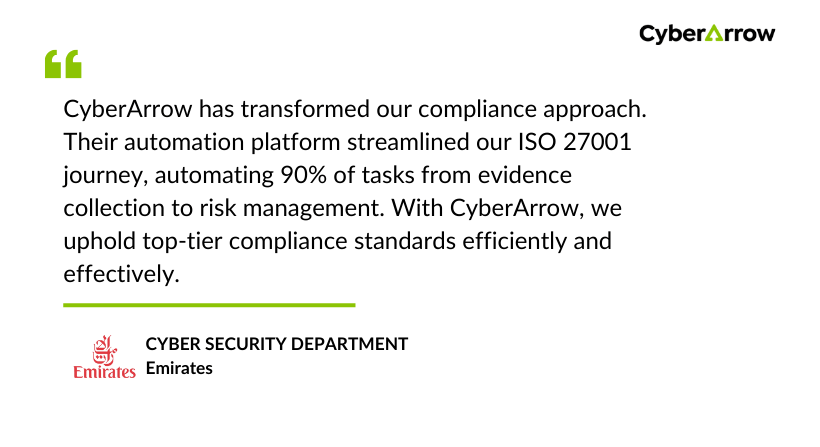
Read How Emirates enhanced Information Security by automating ISO 27001 with CyberArrow GRC.
See what Emirates has to say about CyberArrow GRC: