Spear phishing vs phishing: Understanding the difference
Cybercriminals use many tricks to steal sensitive information, and one of the most common methods is phishing. Phishing attacks come in different forms, but two of the most dangerous types are phishing and spear phishing.
While both attacks aim to steal personal or business data, they have key differences. Phishing is a broad attack sent to many people, hoping that someone will fall for it. Spear phishing, on the other hand, is a highly targeted attack that focuses on a specific person or organization.
If your employees are not aware of these threats, your business could face data breaches, financial losses, and reputational damage. That’s why cyber security awareness training is critical for keeping your organization safe.
In this article, we will explain phishing and spear phishing, their differences, and how to protect your company. We will also introduce the CyberArrow Awareness Platform, which helps automate security training and phishing simulations to ensure employees can recognize and respond to these attacks.
What is phishing?
Phishing is a cyber attack where hackers send fake emails to trick people into sharing sensitive information like passwords, credit card details, or business data. These emails often appear to come from trusted sources, such as banks, government agencies, or well-known companies.
How does phishing work?
A phishing attack typically follows these steps:
- The attacker creates a fake email – The email looks real and may include logos and urgent messages.
- The victim receives the email – The message may claim there is a security issue, unpaid bill, or prize.
- The email contains a malicious link or attachment – The victim is encouraged to click on a link that leads to a fake website or download a harmful file.
- The victim enters sensitive information – Once entered, the attacker can steal the data and use it for fraud.
Examples of phishing attacks
- Fake banking emails: Emails that appear to be from banks asking users to confirm their account details.
- Fake security warnings: Emails warning of unauthorized access and urging users to reset their passwords.
- Delivery scams: Fake emails claiming a package delivery is delayed, with a link to “track” the package.
Phishing attacks are widespread and often successful because they look real. However, spear phishing is even more dangerous because it is highly targeted.
What is spear phishing?
Spear phishing is a more advanced form of phishing that targets a specific person or organization. Unlike regular phishing, which is sent to many people, spear phishing emails are carefully designed to trick one individual or a small group.
How does spear phishing work?
- The attacker researches the victim – The hacker gathers personal details from social media, company websites, or leaked data.
- A highly personalized email is created – The email includes the victim’s name, job title, or other details to make it look real.
- The email appears to be from someone the victim trusts – It may come from a “colleague,” “boss,” or “vendor.”
- The victim is tricked into taking action – They may be asked to share login credentials, approve a fake payment, or download a malicious file.
Examples of spear phishing attacks
- CEO fraud: Hackers pretend to be a high-level executive and request an urgent fund transfer.
- Fake vendor requests: A scammer pretends to be a known supplier and asks for updated payment details.
- Targeted account theft: The attacker gathers personal details to gain access to corporate accounts.
Spear phishing is harder to detect because the emails appear genuine and personalized. This makes it one of the biggest cyber security threats today.
Spear phishing vs phishing: Key differences
| Feature | Phishing | Spear Phishing |
| Target | Large number of people | Specific individual or organization |
| Personalization | Generic message | Highly personalized |
| Research involved | Minimal or none | Extensive research on the victim |
| Attack method | Fake emails, links, or attachments | Emails designed to look like they come from trusted sources |
| Common victims | General public, employees, individuals | Executives, managers, and employees with access to sensitive data |
| Success rate | Lower, since some recipients recognize the scam | Higher, because the email looks highly convincing |
Both types of phishing can cause serious financial and security risks. However, because spear phishing is more convincing, it is harder to detect and prevent.
How to protect your organization from phishing and spear phishing
1. Train employees through security awareness programs
Employees need to recognize phishing and spear phishing attempts. Regular cyber security training can help them spot suspicious emails and avoid falling for scams.
2. Verify requests before taking action
If an email requests sensitive information or a financial transaction, verify it through official channels before responding.
3. Implement Multi-Factor Authentication (MFA)
Even if a hacker steals login credentials, MFA adds an extra layer of security by requiring a second verification step.
4. Avoid clicking suspicious links
Employees should hover over links before clicking to check if the URL is legitimate. If unsure, they should report the email.
5. Conduct phishing simulations
Phishing simulations test employees by sending fake phishing emails to see how they respond. This helps organizations measure their risk level and improve training programs.
How CyberArrow Awareness Platform helps protect your business
Phishing and spear phishing attacks are becoming more advanced, making it essential for companies to educate employees on cyber security risks. The CyberArrow Awareness Platform offers an automated training solution to help businesses keep employees informed and prepared.
Key features of CyberArrow Awareness Platform:
- Automated cyber awareness training: Employees receive interactive training sessions on phishing, spear phishing, and other cyber threats.
- Real-time phishing simulations: The platform runs simulated phishing attacks to test and train employees.
- Easy reporting & analytics: Organizations can track employee progress and identify weak spots in security awareness.
- Compliance with security standards: Helps businesses comply with NIST, ISO 27001, SOC 2, and other cyber security regulations.
By using CyberArrow Awareness Platform, businesses can build a culture of cyber security awareness and prevent phishing-related attacks.
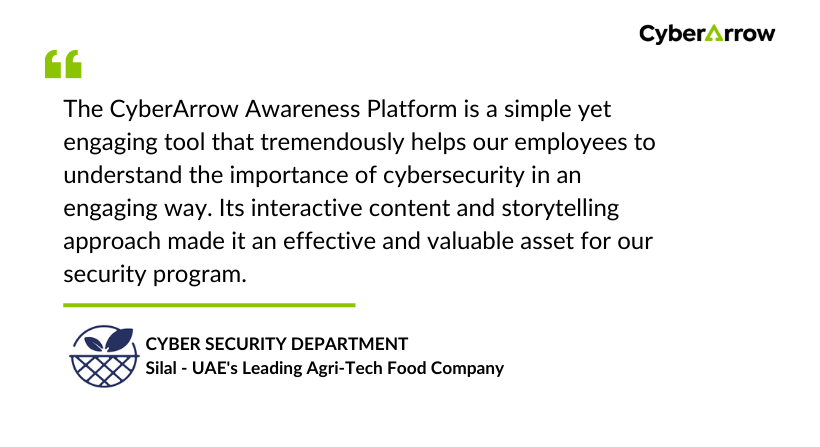
Read how CyberArrow awareness platform increased security awareness among Silal’s employees.
See what Silal has to say about CyberArrow Awareness Platform: