


A comprehensive guide to NIST CSF controls
Cyber threats are growing, and organizations must adopt strong security measures to protect sensitive data and critical systems. The National Institute of Standards and Technology (NIST) Cybersecurity Framework (CSF) provides a structured approach to managing cyber security risks.
NIST CSF is widely recognized for helping businesses strengthen their security posture by following key NIST CSF controls. These controls provide a step-by-step method to identify, protect, detect, respond to, and recover from cyber threats.
However, implementing and maintaining NIST CSF compliance manually can be time-consuming and complex. That’s where CyberArrow GRC can help you automate and simplify NIST CSF compliance.
In this guide, we will explore what NIST CSF controls are, how they work, their benefits, and how organizations can streamline compliance with CyberArrow GRC.
What is NIST CSF?
The NIST Cybersecurity Framework (CSF) is a set of guidelines created to help organizations manage cyber security risks. Originally developed for critical infrastructure, it is now used by businesses of all sizes and industries.
The framework is structured into five core functions:
- Identify: Understand risks, assets, and business environment.
- Protect: Implement safeguards to ensure security.
- Detect: Identify cyber security events in real time.
- Respond: Take action to contain and minimize impact.
- Recover: Restore operations after an incident.
Each function is further divided into categories and subcategories that form the NIST CSF controls.
Understanding NIST CSF controls
The NIST CSF controls are the specific actions organizations must take to implement cyber security best practices. These controls are categorized under the five core functions:
1. Identify – Understanding cyber security risks
The Identify function focuses on recognizing cyber security risks and assets. Key controls include:
- Asset management (ID.AM): Maintain an inventory of all devices, software, and data.
- Business environment (ID.BE): Define business objectives and security requirements.
- Governance (ID.GV): Establish security policies, roles, and responsibilities.
- Risk assessment (ID.RA): Identify vulnerabilities and threats.
- Supply chain risk management (ID.SC): Assess and monitor security risks in third-party vendors.
2. Protect – Implementing security safeguards
The Protect function helps businesses apply security measures to defend against cyber threats. Essential controls include:
- Identity management (PR.AC): Use authentication, authorization, and access controls.
- Awareness & training (PR.AT): Educate employees about cyber security best practices.
- Data security (PR.DS): Encrypt and securely store sensitive data.
- Information protection processes (PR.IP): Maintain and enforce security policies.
- Protective technology (PR.PT): Use firewalls, antivirus software, and endpoint protection.
3. Detect – Identifying cyber security events
The Detect function focuses on monitoring systems to detect threats early. Key controls include:
- Anomalies & events (DE.AE): Identify unusual behavior or security breaches.
- Security continuous monitoring (DE.CM): Use automated tools to monitor networks and systems.
- Detection processes (DE.DP): Define procedures for investigating potential threats.
4. Respond – Taking action against cyber incidents
The Respond function ensures that businesses take the right steps to contain and mitigate cyber security incidents. Important controls include:
- Response planning (RS.RP): Have a documented plan for responding to security events.
- Communications (RS.CO): Establish reporting procedures for stakeholders and regulators.
- Analysis (RS.AN): Investigate security incidents to determine the root cause.
- Mitigation (RS.MI): Implement corrective actions to reduce the impact of breaches.
- Improvements (RS.IM): Update security policies based on lessons learned.
5. Recover – Restoring business operations
The Recover function focuses on restoring business operations after a security incident. Key controls include:
- Recovery planning (RC.RP): Develop a business continuity plan.
- Improvements (RC.IM): Strengthen security measures based on past incidents.
- Communications (RC.CO): Keep stakeholders informed during recovery efforts.
Challenges in implementing NIST CSF controls
While NIST CSF controls provide a solid cyber security foundation, many organizations struggle with:
- Complexity: Managing multiple security controls across departments can be overwhelming.
- Resource constraints: Many businesses lack the staff or expertise to implement security measures effectively.
- Constantly evolving threats: Cyber threats change rapidly, requiring continuous updates to security practices.
- Compliance documentation: Maintaining detailed records for audits and regulatory compliance is time-consuming.
- Human error: Employees may unintentionally ignore security policies, leading to compliance gaps.
Quick link: NIST vs ISO 27001
How CyberArrow GRC simplifies NIST CSF compliance
CyberArrow GRC is an advanced compliance automation platform that helps businesses easily manage NIST CSF controls. Instead of handling compliance manually, organizations can use CyberArrow GRC to automate security tasks and track compliance in real time.
Key features of CyberArrow GRC for NIST CSF compliance
1. Automated risk assessment & compliance tracking
CyberArrow GRC provides automated risk assessments to identify compliance gaps. It continuously monitors and tracks security controls, ensuring organizations remain compliant.
2. Centralized compliance management
Instead of managing compliance documents manually, businesses can store all security policies, reports, and assessments in a centralized dashboard.
3. Incident & response automation
The platform provides automated security alerts and streamlines incident response procedures, helping businesses contain threats faster.
4. Continuous monitoring & reporting
CyberArrow GRC offers real-time monitoring and automated reporting, reducing the burden of manual documentation and audits.
5. Employee training & awareness programs
The platform includes cyber security awareness training to educate employees on best practices, minimizing human error.
6. Third-party risk management
Businesses can use CyberArrow GRC to assess and manage security risks in their supply chain, ensuring vendors follow NIST CSF standards.
Steps to automate NIST CSF compliance with CyberArrow GRC
Step 1: Conduct an automated risk assessment
- Use CyberArrow GRC to identify existing security gaps and risks.
- Get a compliance score to measure current cyber security maturity.
Step 2: Implement security controls with automation
- CyberArrow GRC helps enforce security controls automatically, reducing manual work.
- The platform suggests best practices for each NIST CSF function.
Step 3: Enable continuous monitoring & alerts
- Businesses can set up real-time alerts to detect threats before they escalate.
- CyberArrow GRC continuously monitors access control, encryption, and network security.
Step 4: Automate documentation & audit reports
- Generate audit-ready compliance reports in seconds.
- Maintain security records for regulators and stakeholders with minimal effort.
Step 5: Train employees on cyber security best practices
- CyberArrow GRC provides interactive security awareness training to ensure all employees follow security policies.
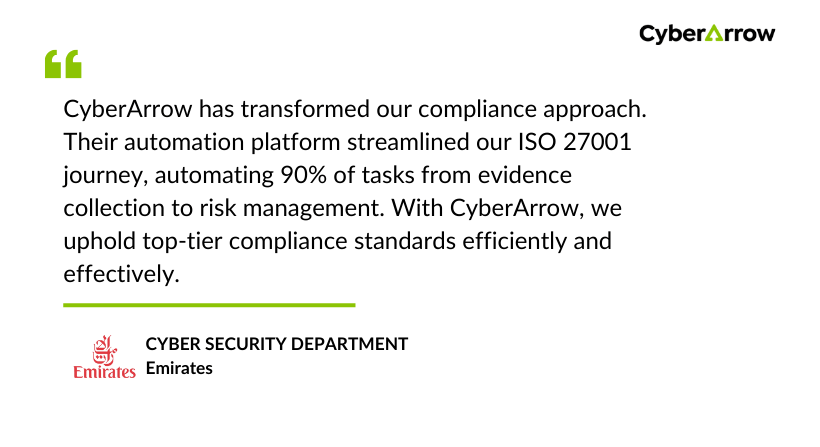
Read how Emirates enhanced Information Security by automating ISO 27001 with CyberArrow GRC.
See what Emirates has to say about CyberArrow GRC:
Conclusion
Implementing NIST CSF controls is essential for strengthening cyber security and reducing risks. However, manual compliance management is complex, time-consuming, and prone to human error.
With CyberArrow GRC, businesses can automate compliance tracking, risk assessment, incident management, and employee training, making NIST CSF compliance faster, easier, and more effective.
If your organization wants to streamline cyber security management and achieve NIST CSF compliance effortlessly, CyberArrow GRC is the perfect solution. Start automating your security framework today!
