What does ServiceNow do: Its service offerings and more
Risk and compliance management is a challenge for businesses of all sizes. Companies must follow strict regulations, track potential risks, and prepare for audits while trying to keep up with daily operations. This process can become overwhelming without the right tools, leading to inefficiencies and compliance gaps.
Governance, Risk, and Compliance (GRC) solutions can help here. They help organizations automate compliance tasks, assess risks, and meet regulatory requirements. One of the well-known platforms offering GRC solutions is ServiceNow.
But how effective is it? And is there a better alternative?
In this article, we’ll explore what ServiceNow is, its core offerings, and how its GRC solution works. We’ll also discuss its limitations and introduce CyberArrow GRC as a simpler, more efficient alternative.
What is ServiceNow?
ServiceNow is a cloud-based platform that helps businesses automate workflows and improve operational efficiency. Originally known for its IT Service Management (ITSM) capabilities, ServiceNow has expanded into various areas, including security operations, HR service delivery, customer service, and Governance, Risk, and Compliance (GRC).
The platform is widely used by enterprises looking to replace manual processes with automated workflows, offering better visibility, control, and integration across departments.
What does ServiceNow do?
ServiceNow provides several solutions that help businesses manage different aspects of their operations. Some of its key offerings include:
Quick link: What is IBM OpenPages?
1. IT service management (ITSM)
- Helps IT teams manage incidents, service requests, and changes.
- Automates ticketing and workflow processes.
- Provides self-service portals for employees to request IT support.
2. IT operations management (ITOM)
- Monitors IT infrastructure and services.
- Helps detect and prevent system failures.
- Ensures better performance of IT assets.
3. IT asset management (ITAM)
- Tracks and manages IT assets such as software and hardware.
- Helps reduce costs by optimizing asset usage.
- Ensures compliance with licensing agreements.
4. Security operations (SecOps)
- Detects and responds to security threats.
- Automates security incident management.
- Integrates with security tools to improve threat detection.
5. Customer service management (CSM)
- Improves customer support through automated workflows.
- Provides AI-powered chatbots and self-service portals.
- Helps businesses track customer issues more effectively.
6. Governance, risk, and compliance (GRC)
- Helps businesses manage compliance requirements.
- Assesses risks and automates audit processes.
- Ensures policies are enforced across the organization.
Benefits of the ServiceNow platform
ServiceNow platform streamlines operations, enhances productivity, and drives digital transformation. Here are some key benefits:
1. Workflow automation
The platform automates manual tasks and processes, reducing human effort and minimizing errors. Businesses can simplify work across departments by creating digital workflows, increasing efficiency and faster task completion.
2. AI-powered insights
With built-in artificial intelligence (AI) and real-time analytics, ServiceNow helps businesses predict issues, identify trends, and optimize decision-making. AI-driven automation ensures that resources are allocated efficiently and proactively addresses potential risks.
3. Unified experience and architecture
ServiceNow operates on a single platform with a unified data model, ensuring consistency across all business processes. This eliminates data silos and makes it easier for different teams to collaborate and share information seamlessly.
4. No-code workflow creation
The platform enables users to build automated workflows without coding expertise. This empowers non-technical employees to create, modify, and optimize workflows, increasing agility and innovation within the organization.
5. Faster issue resolution
Routing and prioritization tools help teams address issues more effectively. With real-time insights, businesses can quickly identify bottlenecks, assign tasks to the right personnel, and ensure smooth operations.
6. Built-in security and compliance
ServiceNow includes automated security controls, certified integrations, and multilayer encryption to protect enterprise data and processes. It also helps organizations comply with industry regulations by enforcing security policies and automating compliance tracking.
How ServiceNow GRC manages risks and regulatory requirements
ServiceNow GRC helps organizations control compliance and risk better by providing a centralized platform for monitoring, managing, and automating governance processes. Replacing outdated manual methods with structured workflows enables businesses to make informed decisions and improve collaboration across teams and vendors.
1. Policy and compliance management
ServiceNow GRC allows businesses to create a standardized framework for policies, controls, and regulatory compliance requirements. It automates compliance tracking, helping organizations stay on top of evolving regulations while ensuring policies are consistently enforced across departments.
2. Risk management
The platform provides tools to identify, assess, and mitigate risks in real time. By integrating risk management into daily operations, ServiceNow enables organizations to respond proactively to potential threats and maintain business continuity.
3. Audit management
ServiceNow simplifies audit planning by leveraging risk-based insights. It helps organizations streamline audit workflows, allocate resources efficiently, and reduce recurring compliance issues.
While ServiceNow GRC offers valuable capabilities, it comes with certain challenges, such as complexity, high costs, and a steep learning curve.
Limitations of ServiceNow GRC
Despite its capabilities, ServiceNow GRC has some challenges:
- Complexity: ServiceNow GRC is not a plug-and-play solution. It requires extensive customization to fit an organization’s compliance needs, making setup time-consuming and highly dependent on IT teams or external consultants.
- High cost: The platform has expensive licensing fees, and implementation costs can increase quickly. Businesses must also factor in ongoing maintenance, support, and training costs.
- Steep learning curve: The system’s complexity makes it difficult for non-technical users to navigate. Employees often require dedicated training to understand and use the platform effectively, which can slow down adoption.
- Integration challenges: While ServiceNow GRC offers integrations, connecting it with existing business systems can be lengthy and complicated. Poor integration can lead to inefficiencies in risk tracking and compliance monitoring.
Why CyberArrow GRC is a better alternative
CyberArrow GRC provides a more user-friendly, cost-effective approach to compliance and risk management. Unlike ServiceNow GRC, it is designed for simplicity and automation, making it easier for businesses to stay compliant without complex configurations.
Key advantages of CyberArrow GRC:
- Easy to use: Simple, intuitive interface with minimal setup required.
- Cost-effective: More affordable compared to ServiceNow GRC.
- Automated evidence collection: Reduces manual effort in audits and compliance tracking.
- Dedicated support: Personalized customer support for a seamless experience.
- Built-in security training: Helps organizations educate employees on compliance requirements.
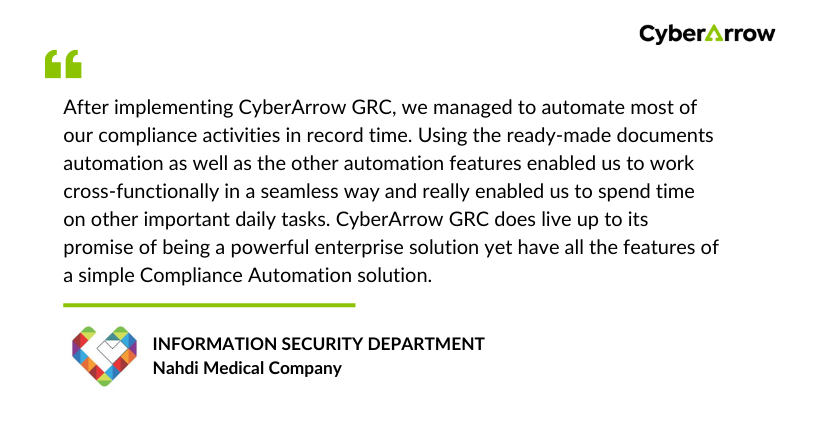
See what companies like Nahdi Medical say about CyberArrow GRC: