What is the Purple Team? Everything you need to know
Cybersecurity is a constantly evolving field. As organizations face new and more sophisticated cyber threats, they need advanced strategies to protect themselves. One such strategy is the Purple Team approach. This method bridges the gap between defensive and offensive security teams, helping organizations build stronger defenses.
In this article, we’ll dive into what a Purple Team is, how it works, why it’s essential, and how tools like CyberArrow GRC can simplify risk management and enhance security strategies.
- What is a Purple Team?
- Why is the Purple Team important?
- How does a Purple Team work?
- Purple Team vs. Red and Blue Teams
- When should an organization use a Purple Team?
- Steps to building a Purple Team
- Tools and techniques for Purple Teams
- The role of Purple Teams in compliance
- How CyberArrow GRC enhances Purple Team efforts
What is a Purple Team?
A Purple Team combines the efforts of two critical cybersecurity groups:
- Red Team: Responsible for offensive strategies. They simulate cyberattacks to find vulnerabilities in systems, networks, and applications.
- Blue Team: Focuses on defensive strategies. They monitor, detect, and respond to threats, ensuring the organization’s security posture is strong.
The Purple Team doesn’t replace the Red or Blue Teams. Instead, it acts as a bridge, fostering collaboration between the two. The goal is to create a feedback loop where both teams learn from each other to improve an organization’s overall cybersecurity.
Why is the Purple Team important?
Cyber threats are becoming increasingly sophisticated. Traditional approaches that separate offensive and defensive teams can leave gaps in an organization’s security. A Purple Team addresses these gaps by ensuring better communication and collaboration between Red and Blue Teams.
Key benefits of a Purple Team:
- Enhanced collaboration: Fosters a culture of teamwork between offensive and defensive teams.
- Comprehensive security: Identifies and addresses vulnerabilities more effectively.
- Real-time learning: Blue Teams learn from Red Teams’ tactics, improving their defenses.
- Cost efficiency: Reduces the time and resources spent on fixing vulnerabilities post-attack.
How does a Purple Team work?
A Purple Team works by blending the methodologies of Red and Blue Teams. Here’s how:
- Simulating attacks: The Red Team performs simulated attacks to test the organization’s defenses.
- Collaborative analysis: The Purple Team analyzes the results alongside the Blue Team.
- Developing solutions: Both teams work together to address vulnerabilities and enhance security measures.
- Continuous feedback: This process repeats, ensuring that the organization’s defenses are continuously improving.
Quick link: Cyber security roadmap
Purple Team vs. Red and Blue Teams
| Aspect | Red Team | Blue Team | Purple Team |
| Focus | Offensive strategies | Defensive strategies | Bridging offensive and defensive efforts |
| Goal | Find vulnerabilities | Defend against threats | Strengthen overall security |
| Approach | Simulated attacks | Monitoring and responding | Collaboration and learning |
While Red and Blue Teams often work in silos, Purple Teams ensure that both groups collaborate effectively.
When should an organization use a Purple Team?
Organizations can benefit from Purple Teams in several scenarios:
- Complex threat environments: When facing advanced threats that require a coordinated approach.
- Skill gaps: To improve knowledge-sharing between Red and Blue Teams.
- Compliance requirements: When regulatory standards demand rigorous security assessments.
- Risk management: To ensure vulnerabilities are addressed proactively.
Steps to building a Purple Team
- Define objectives: Start by identifying your organization’s cybersecurity goals.
- Assemble a team: Select skilled members from both Red and Blue Teams.
- Develop a strategy: Create a roadmap for collaboration and continuous improvement.
- Implement tools: Use tools like CyberArrow GRC to streamline risk assessments and monitor progress.
- Evaluate and adjust: Regularly review the team’s performance and refine your strategy as needed.
Tools and techniques for Purple Teams
Purple Teams rely on a variety of tools and techniques to improve security:
Tools:
- Vulnerability scanners: Identify weaknesses in systems and networks.
- SIEM (Security Information and Event Management): Centralizes security data for better analysis.
- Risk management platforms: Automate risk assessments and track remediation efforts, like CyberArrow GRC.
Techniques:
- Penetration testing: Simulates real-world attacks to find vulnerabilities.
- Threat hunting: Proactively searches for hidden threats.
- Incident response drills: Prepares teams for real-life cyber incidents.
The role of Purple Teams in compliance
Many regulatory standards require organizations to perform regular security assessments and manage risks effectively. Purple Teams play a critical role in ensuring compliance with these standards.
Key standards requiring Purple Team efforts:
- ISO 27001: Information security management.
- SOC 2: Security, availability, processing integrity, confidentiality, and privacy.
- PCI DSS: Protecting payment card data.
- GDPR: Safeguarding personal data of EU residents.
By addressing vulnerabilities and improving security controls, Purple Teams help organizations meet these compliance requirements.
Quick link: SANS training vs. CyberArrow Awareness Platform
How CyberArrow GRC enhances Purple Team efforts
Purple Teams rely on accurate risk assessments and effective collaboration to succeed. CyberArrow automatically manages your risk assessments utilizing advanced algorithms. Enterprise risk management methodologies and frameworks are supported out of the box.
Key features of CyberArrow GRC:
- Automated risk assessments: Simplifies the process of identifying and addressing vulnerabilities.
- Streamlined compliance: Helps organizations meet regulatory requirements like ISO 27001, SOC 2, and PCI DSS.
- Collaboration tools: Enhances teamwork between Red and Blue Teams.
- Real-time insights: Provides actionable data to improve security strategies.
CyberArrow’s Enterprise Risk Management (ERM) module is particularly valuable for Purple Teams.
It allows organizations to:
- Analyze risks in real-time.
- Monitor the effectiveness of security measures.
- Ensure alignment with compliance standards.
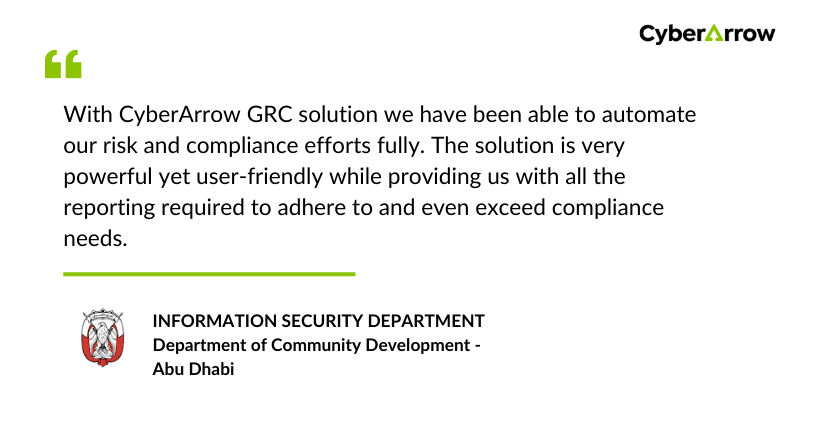
Read how CyberArrow improved risk assessment across departments for the DCD – Abu Dhabi.
See what DCD – Abu Dhabi has to say about CyberArrow GRC: