What is SecOps (Security Operations)? A complete guide
Cyber threats are more dangerous than ever, with new attacks happening daily. Organizations struggle to protect sensitive data and keep up with ever-changing security requirements.
Traditional security teams often work in isolation, leading to slow response times and vulnerabilities that attackers can exploit. Without a coordinated strategy, businesses face higher risks of breaches and data loss.
SecOps, or Security Operations, offers a better way. By bringing security and IT operations together, SecOps improves threat detection, response times, and overall security posture.
What is SecOps?
SecOps stands for Security Operations. It is a collaborative approach where security teams and IT operations work together to detect, respond to, and prevent security threats. This approach aims to break down the silos that often exist between these two departments. With better communication and shared goals, organizations can quickly address security issues and protect their data.
The key components of SecOps
- Collaboration between teams: SecOps brings together IT operations and security teams to work side-by-side. This ensures everyone is on the same page when it comes to protecting the organization from threats.
- Continuous monitoring: SecOps involves 24/7 monitoring of systems to detect and respond to security incidents in real-time. This proactive approach helps identify potential risks before they become serious problems.
- Incident response: When a security threat occurs, the SecOps team quickly responds to minimize damage. This involves investigating the issue, containing the threat, and making necessary changes to prevent future incidents.
- Automation of repetitive tasks: Automating repetitive tasks like log analysis and incident tracking reduces human error and allows the SecOps team to focus on more critical issues.
- Threat intelligence: SecOps teams use threat intelligence to stay informed about the latest attack methods and vulnerabilities. This knowledge helps them develop strategies to defend against emerging threats.
The importance of SecOps
In today’s digital world, data breaches can have devastating consequences. These breaches can lead to financial losses, damage to a company’s reputation, and even legal penalties. SecOps helps organizations prevent these issues by creating a stronger security framework.
Here’s why SecOps is so important:
- Faster detection and response: SecOps enables organizations to detect and respond to threats faster than traditional methods. This minimizes the impact of security incidents.
- Improved collaboration: By breaking down barriers between teams, SecOps encourages better communication and cooperation.
- Reduced costs: Preventing a security incident is much cheaper than dealing with its aftermath. SecOps helps reduce costs by stopping threats before they cause serious damage.
Cyber security compliance standards that require SecOps controls
Many cyber security compliance standards require organizations to implement security controls similar to those found in SecOps practices. Here are some of the key standards:
1. ISO/IEC 27001
This international standard focuses on managing information security. It requires organizations to implement risk management processes, conduct regular assessments, and continuously monitor their systems.
2. General Data Protection Regulation (GDPR)
GDPR is a regulation in the European Union that focuses on data protection and privacy. It requires organizations to protect personal data and respond quickly to breaches.
3. NIST Cybersecurity Framework
This framework, developed by the National Institute of Standards and Technology, provides guidelines for improving the security of critical infrastructure. It emphasizes risk assessment, threat detection, and incident response.
4. PCI DSS (Payment Card Industry Data Security Standard)
This standard applies to organizations that handle credit card data. It requires strict controls to protect cardholder data and prevent breaches.
5. HIPAA (Health Insurance Portability and Accountability Act)
HIPAA applies to healthcare organizations and requires them to protect patient data. It includes security controls for access management, threat detection, and incident response.
How CyberArrow GRC helps implement security controls for SecOps
SecOps relies on efficient processes, collaboration, and real-time threat detection. CyberArrow GRC (Governance, Risk, and Compliance) plays a key role in helping organizations build and maintain a strong SecOps framework. Here’s how:
1. Automating security controls
CyberArrow GRC automates compliance processes, making it easier for organizations to implement security controls and stay compliant with standards like ISO 27001, GDPR, and NIST. Automation reduces manual work, lowers the risk of human error, and speeds up incident response.
2. Centralized platform for collaboration
SecOps requires teams to work together effectively. CyberArrow GRC provides a centralized platform for tracking tasks, sharing updates, and managing security incidents. This improves collaboration and ensures everyone is aligned on security priorities.
3. Real-time threat monitoring
CyberArrow GRC integrates with security tools and offers real-time threat monitoring. It provides alerts and updates on vulnerabilities, enabling organizations to respond quickly and protect sensitive data.
4. Customizable risk management
With CyberArrow GRC, organizations can customize their risk management strategies based on their specific needs. This helps prioritize and mitigate risks, improving their overall security posture.
5. Compliance made simple
Staying compliant with multiple standards can be challenging. CyberArrow GRC simplifies this process by providing templates, automated workflows, and continuous monitoring for compliance. Organizations can meet regulatory requirements and enhance their SecOps practices more efficiently.
Real-life example: CyberArrow GRC and SecOps
Imagine a medium-sized company that handles customer payment data. They need to comply with PCI DSS and detect threats quickly to protect sensitive information. Before using CyberArrow GRC, they struggled with manual processes and delayed responses to security incidents.
After adopting CyberArrow, they saw immediate improvements:
- Automated compliance processes saved hours of work.
- Real-time threat alerts reduced their incident response times.
- Centralized collaboration improved teamwork and communication.
This led to a stronger security posture and easier compliance with standards.
Conclusion
SecOps is essential for organizations that want to protect themselves from cyber threats and meet compliance requirements. By bringing security and IT teams together, SecOps improves detection, response times, and overall security.
CyberArrow GRC makes it easier to implement SecOps practices by automating compliance, improving collaboration, and offering real-time threat monitoring. With CyberArrow, you can simplify your security processes, stay compliant, and protect your business.
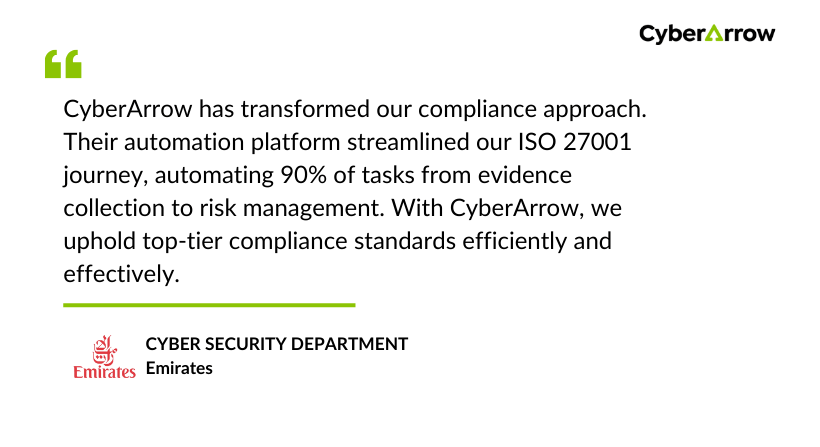
Read how Emirates enhanced Information Security by automating ISO 27001 with CyberArrow GRC.
See what Emirates has to say about CyberArrow GRC: