


Guide to Saudi Arabian Monetary Authority (SAMA) Cyber Security Framework
The number of successful cyberattacks on financial institutions is on the rise. In Q3 of 2023, unique cyber incidents doubled compared to the same period in the previous year. This highlights increased criminal attention to the financial industry. In this regard, the Saudi Arabian Monetary Authority (SAMA) has established a Cyber Security Framework (CSF) to help organizations navigate the complexities of the financial sector.

Consequences of successful cyberattacks
As technology advances, so do the challenges faced by financial institutions. This makes cyber security a crucial component for the continued trust and security of the financial ecosystem in Saudi Arabia. Between mid-2021 and 2022, Saudi Arabia and UAE organizations experienced the highest ransomware attacks among Gulf Cooperation Council (GCC) countries.
The SAMA Cyber Security Framework aims to equip financial institutions, industry professionals, and decision-makers with the necessary knowledge to implement cyber security best practices.
In this guide, we will explore the SAMA CSF, its control domains, and a case study for SAMA compliance automation.
So let’s get started!
What is the SAMA Cyber Security Framework?
The Saudi Arabian Monetary Authority (SAMA) Cyber Security Framework is a set of mandatory guidelines developed to provide prescriptive measures and strengthen security for SAMA-regulated financial institutions. SAMA continuously monitors and redefines the cyber security framework to ensure robust security against unexpected threats.
The framework aims to create a common approach for addressing cyber security. It also mandates achieving an appropriate maturity level of cyber security controls and ensuring that cyber security risks are appropriately managed throughout the member organizations.
What are the control domains of the SAMA Cyber Security Framework?
In the SAMA Cyber Security Framework, four distinct domains shape the comprehensive approach to strengthening the cyber security posture of financial institutions. These domains include a strategic blend of governance, risk management, technical architecture, operational protocols, and regulatory alignment.

Let’s explore them below:
1. Cyber security leadership and governance
It covers the following aspects.
- Ultimate responsibility: The board of the Member Organization holds the ultimate responsibility for cyber security.
- The role of the cyber security committee: It sets the member organizations’ cyber security strategy.
- Policy definition: The cyber security committee defines a comprehensive cyber security policy.
- Operational effectiveness: Ensuring the operational effectiveness of the cyber security policy is a crucial responsibility of the cyber security committee.
- Establishment of cyber security function: An independent cyber security function is essential to developing and maintaining the cyber security policy and executing cyber security activities.
2. Cyber security risk management
The principles and objectives of this domain include the following:
- Principle: Definition, approval, and implementation of a cyber security risk management process.
- Objective: Properly manage cyber security risks to safeguard information assets’ confidentiality, integrity, and availability.
- Cyber security risk management: Alignment of the cyber security risk management process with the Member Organization’s enterprise risk management process.
3. Cyber security operations and technology
This domain entails the following:
- Protection objective: Safeguarding the operations and technology of Member Organization’s information assets.
- Security requirements: Definition, approval, and implementation of security requirements for information assets and supporting processes.
- Monitoring and evaluation: Monitoring compliance with cyber security requirements and periodically measuring and evaluating the effectiveness of cyber security controls.
- Revision identification: Identifying potential revisions of controls or measurements based on periodic evaluations.
4. Third-party cyber security
This control domain includes the following.
- Equal cyber security protection: Ensuring the same level of protection at third parties as within the Member Organization.
- Implementation at third parties: Outlining the implementation of cyber security requirements at third parties.
- Monitoring third party compliance: Establishing mechanisms for monitoring and ensuring third-party compliance with cyber security standards.
- Scope of third parties: Defining third parties within the framework, including information services providers, outsourcing providers, cloud computing providers, vendors, suppliers, governmental agencies, etc.
Case study: Strengthening cyber security through SAMA compliance automation
A prominent financial institution in Saudi Arabia strategically employed the CyberArrow compliance automation platform to enhance its cyber security posture and achieve SAMA Compliance.

Recognizing the growing importance of automation in cyber security, the bank sought a solution to streamline compliance processes and elevate overall security measures.
Learn more about SAMA with our SAMA compliance hub.
Challenges
- Manual compliance processes: The Bank faced challenges with manual compliance processes, leading to inefficiencies and delays.
- Complex regulatory landscape: The complex SAMA compliance requirements demanded a sophisticated approach to ensure accuracy and completeness.
- Resource intensiveness: The manual nature of compliance tasks consumed valuable human resources, diverting focus from strategic initiatives.
Results
- Efficient compliance processes: Implementing the CyberArrow automation platform streamlined SAMA compliance procedures. It helped reduce manual efforts and expedite the overall process.
- Enhanced accuracy and precision: Automation ensured higher accuracy and precision in adhering to the intricate SAMA compliance requirements.
- Optimized resource utilization: The Bank freed up valuable human resources by automating compliance tasks, allowing teams to concentrate on strategic cyber security initiatives.
This case study highlights the transformative impact of automation. It demonstrates how the Bank efficiently utilized the CyberArrow to strengthen its cyber security defenses, meet SAMA Cyber Security Framework requirements, and optimize operational efficiency.
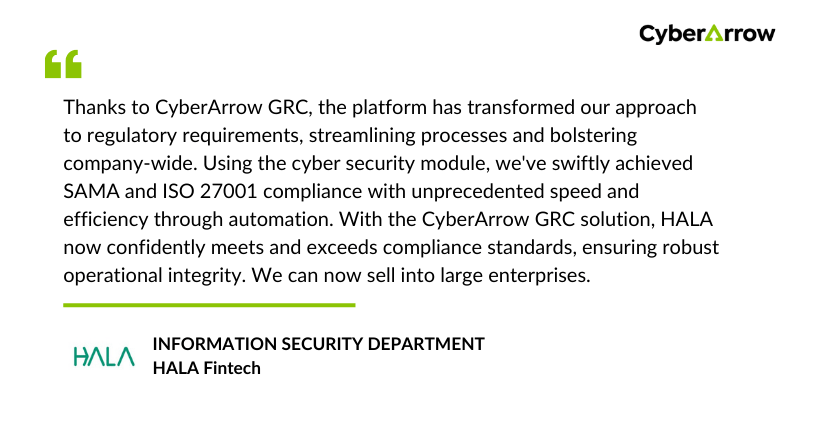
See what our clients have to say about CyberArrow GRC:
Want to achieve SAMA compliance automation as the bank did with CyberArrow? Schedule a free demo today!
Join the ranks of industry leaders like HALA and Bupa Arabia, which successfully achieved SAMA compliance with the CyberArrow compliance automation platform.
Download your free SAMA checklist.
FAQs
What is the SAMA Cyber Security Framework?
SAMA CSF is a set of mandatory guidelines developed to provide prescriptive measures and strengthen security for SAMA-regulated financial institutions.
What are the cyber security regulations in Saudi Arabia?
The cyber security regulations in Saudi Arabia include the Cyber Crime Law, the National Data Regulations, and the SAMA Cyber Security Framework.
What is the national cyber security strategy in Saudi Arabia?
The National Cyber Security Strategy of Saudi Arabia aims to establish a secure, resilient and trusted cyber security posture in KSA that enables growth and security. It focuses on integrated cyber security governance at a national level and effective management of cyber risks to protect cyberspace.
