A quick start guide to ISO/IEC 27001 standard
Protecting sensitive information is crucial as the digital landscape becomes dynamic and challenging. Exploring information security standards, such as the ISO/IEC 27001, becomes essential for organizations to strengthen their information security posture.
Since cyber criminals and hackers are on the lookout for exploiting vulnerabilities in organizations’ security posture, prioritizing information security is important. ISO/IEC 27001 is the first step to achieving compliance and enhancing information security.
In this article, we will explore the ISO 27001:2022 standard, the importance of ISO 27001 automation, and how it aligns with other security frameworks.
What is ISO/IEC 27001?
ISO/IEC 27001:2022 compliance is an international standard that directs organizations in managing, monitoring, reviewing, implementing, and maintaining information security. The standard helps organizations ensure their Information Security Management System’s (ISMS) confidentiality, availability, and integrity.
ISO 27001 is part of the extensive ISO/IEC 27000 family, a set of interlinked standards offering collective cyber security best practices for organizations of diverse scales and types. These standards, when combined, foster a comprehensive approach to managing information security across a broad data spectrum.
Importance of ISO/IEC 27001 compliance
The significance of adhering to ISO/IEC 27001 Compliance for Information Security cannot be overstated in today’s digital world.
Let’s explore why organizations should prioritize and embrace ISO/IEC 27001 compliance as a fundamental aspect of their information security strategy.
- Global recognition and standardization: ISO/IEC 27001 compliance provides global recognition, positioning organizations as entities committed to adhering to internationally recognized standards. This standardization enhances credibility and fosters trust among stakeholders, clients, and partners.
- Robust information security management: By implementing ISO/IEC 27001, organizations establish a robust Information Security Management System (ISMS). This systematic approach ensures the confidentiality, integrity, and availability of sensitive information, mitigating risks and strengthening the security posture.
- Legal and regulatory compliance: ISO/IEC 27001 compliance aids organizations in meeting legal and regulatory requirements concerning information security. This helps avoid legal consequences and penalties and demonstrates a commitment to ethical and lawful business practices.
- Mitigation of cyber security risks: The standard’s emphasis on risk assessment and management enables organizations to identify and mitigate cyber security risks. This proactive approach is crucial in safeguarding against evolving threats and vulnerabilities.
- Competitive edge in the market: ISO/IEC 27001 compliance provides a competitive edge. Organizations adhering to this standard showcase their dedication to ensuring the highest standards of information security, which can be a differentiator in a competitive business environment.
- Continuous improvement culture: ISO/IEC 27001 encourages a culture of continuous improvement. Organizations committed to this standard regularly review and enhance their information security practices, adapting to emerging threats and technological advancements.
Why should you automate ISO 27001 compliance?
Automating ISO 27001 compliance emerges as a strategic imperative for organizations seeking regulatory adherence and a comprehensive and dynamic approach to managing their information security landscape.

Let’s explore why your organization should automate ISO 27001 compliance.
1. Efficiency and accuracy
Automation streamlines compliance processes, reducing the reliance on manual efforts. This enhances efficiency and significantly minimizes the risk of human errors, ensuring a more accurate and reliable compliance framework.
2. Real-time monitoring and reporting
Automated systems, such as CyberArrow, provide real-time monitoring capabilities, allowing organizations to identify and address any deviations from compliance standards. The ability to generate instant reports facilitates proactive decision-making and timely corrective actions.
3. Timely identification of security risks
Automation enables continuous monitoring of security controls, promptly identifying potential risks and vulnerabilities. This approach is crucial in mitigating security threats before they increase, safeguarding the organization against potential breaches.
4. Consistent compliance across processes
Automated systems ensure consistency in implementing and maintaining compliance measures across various processes and departments. This uniformity is essential for meeting the comprehensive requirements of ISO/IEC 27001.
5. Resource optimization
Organizations can optimize resources and allocate human expertise to more strategic and value-added activities by automating routine compliance tasks. This enhances productivity and ensures skilled personnel focus on critical security initiatives.
6. Scalability and adaptability
Automated systems are inherently scalable, accommodating the evolving needs of organizations. They can adapt to changes in the regulatory landscape, ensuring the compliance framework remains robust and aligned with the latest standards and regulations, including ISO 27001, GDPR, PCI DSS, and SAMA.
7. Audit trail and documentation
Automation provides a comprehensive audit trail, documenting every step of the compliance process. This facilitates regulatory audits and serves as a valuable resource for internal reviews, enabling a culture of transparency and accountability.
ISO/IEC 27001 vs. other security standards
ISO 27001, the globally recognized standard for information security management, plays an essential role in harmonizing organizations with various international laws and regulations concerning information security.
Also, check out ISO 27001 vs. Other Data Security Standards & Regulations: Which One is Right for Your Organization?
Global recognition
ISO 27001 stands as a universally acknowledged benchmark for information security best practices. Numerous international laws and regulations recognize it as a valuable framework for achieving compliance in the realm of information security.
General Data Protection Regulation (GDPR)
Tailored for the European Union (EU), GDPR prioritizes the protection of personal data. ISO 27001 for managing and securing information closely aligns with GDPR requirements, offering organizations a valuable tool for addressing data protection principles.
Health Insurance Portability and Accountability Act (HIPAA)
ISO 27001’s emphasis on information security controls and risk management proves beneficial for healthcare organizations striving to comply with HIPAA. It provides a structured approach to safeguarding sensitive health information and ensuring the confidentiality, integrity, and availability of healthcare data.
International Organization for Standardization (ISO) Standards
ISO 27001 forms part of an extensive family of ISO standards, including ISO 27002, offering guidelines for implementing controls outlined in ISO 27001. Collectively, these standards contribute to a holistic approach to information security, aligning with international best practices.
Automate and comply with ISO/IEC 27001 and other security standards
Looking to enhance your cyber security posture by complying with security standards? CyberArrow Compliance Automation Platform is here to help.
With CyberArrow, you can automate and simplify complying with several security standards, including ISO/IEC 27001, GDPR, HIPAA, and more. Compliance automation enables efficiency, accuracy, and real-time monitoring. It helps you mitigate risks proactively, optimize resource allocation, and foster a culture of continuous improvement in your organization.
Ready to enhance your cyber security resilience with CyberArrow? Book a free demo today!
FAQs
What does being ISO 27001 certified mean?
ISO 27001 certification signifies that an organization has implemented and maintains an Information Security Management System (ISMS) in line with international standards. It demonstrates a commitment to ensuring the confidentiality, integrity, and availability of sensitive information, reflecting a robust information security posture.
How do I comply with ISO 27001?
To ensure compliance with ISO 27001, begin by conducting a thorough risk assessment to identify potential threats and vulnerabilities. Develop and implement robust information security policies and procedures tailored to your organization’s needs. Undergo external audits by a certification body to attain ISO 27001 certification, solidifying your commitment to international information security standards.
What are the 6 stages of the ISO 27001 certification process?
After successfully navigating the certification audit, prioritize continuous improvement. Regular internal audits and management reviews ensure your Information Security Management System (ISMS) remains effective and aligned with ISO 27001 standards. Actively engaging in the certification renewal process to maintain the robustness of your ISMS, fostering adaptability and resilience against emerging threats in the ever-changing digital landscape.
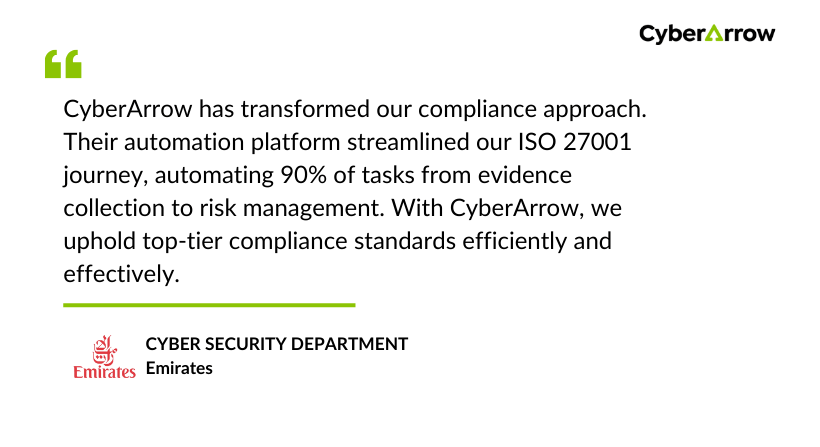
Read how Emirates enhanced Information Security by automating ISO 27001 with CyberArrow.
See what Emirates has to say about CyberArrow GRC: