A comprehensive guide to SOC 2 common criteria list
Organizations today are increasingly entrusted with sensitive data. With 42% of US consumers being very concerned about their online data, organizations must demonstrate their commitment to maintaining security and privacy. SOC 2 compliance is a recognized standard that helps organizations establish and validate the effectiveness of their controls and practices in these areas.
At the core of SOC 2 compliance lies the SOC 2 common criteria list, which outlines the specific requirements and criteria that organizations must address within nine key areas.
This comprehensive guide will explore each criterion and provide insights into achieving compliance.
What is SOC 2 common criteria list?
The SOC 2 common criteria list refers to specific requirements and criteria that organizations must address within the SOC 2 framework. It serves as the foundation for evaluating service organizations’ security controls and practices.
Let’s explore the SOC 2 common criteria list below.
CC1 – Control environment
The control environment criterion assesses the organization’s commitment to integrity, ethical values, and governance. To meet this criterion:
- Establish a culture of compliance and ethical behavior throughout the organization.
- Develop and communicate clear policies and procedures that align with industry best practices and legal requirements.
- Implement effective oversight mechanisms and a system of internal controls to ensure compliance.
CC2 – Communication and information
Effective communication and information management are crucial for maintaining a secure and compliant environment. Consider the following:
- Develop clear communication channels to ensure the accurate and timely dissemination of information to relevant parties.
- Implement processes to address and manage internal and external communication regarding security incidents, breaches, and updates.
- Establish procedures for securely sharing information with authorized parties while safeguarding against unauthorized disclosure.
CC3 – Risk assessment
Organizations must identify and assess risks that could impact the achievement of their objectives. Consider these steps:
- Conduct a comprehensive risk assessment to identify potential threats, vulnerabilities, and impacts.
- Implement a risk management framework to prioritize and mitigate identified risks.
- Continuously monitor and reassess risks to ensure they are adequately managed.
CC4 – Monitoring of controls
The monitoring of controls ensures ongoing compliance and effectiveness. Follow these guidelines:
- Establish monitoring processes to assess the performance and adequacy of implemented controls.
- Regularly review and test controls to identify any deficiencies or areas for improvement.
- Develop mechanisms to track and report on control deficiencies, remediation efforts, and their resolutions.
CC5 – Control activities
Control activities focus on the specific controls implemented to mitigate risks and achieve objectives. Consider the following:
- Implement access controls to manage logical and physical access to systems, networks, and facilities.
- Establish policies and procedures for data classification, encryption, and secure handling of sensitive information.
- Develop and enforce change management processes to manage system, application, and process changes.
CC6 – Logical and physical access controls
Secure access controls are vital to prevent unauthorized access to sensitive systems and data. Consider these measures:
- Implement strong authentication mechanisms, such as multi-factor authentication, to verify user identities.
- Restrict access privileges based on the principle of least privilege, ensuring users only have access to the resources necessary to perform their roles.
- Regularly review and update access controls to reflect user roles, responsibilities, and organizational structure changes.
CC7 – System operations and availability
Organizations must ensure the continuous availability and proper functioning of their systems and services. Consider the following:
- Implement robust system monitoring and incident response processes to promptly detect and address system vulnerabilities and incidents.
- Establish redundant systems, disaster recovery plans, and business continuity strategies to minimize disruptions and maintain service availability.
- Conduct regular performance and capacity planning to ensure systems can handle anticipated workloads.
CC8 – Change management
Change management processes help organizations implement changes to systems, applications, and processes in a controlled manner. Follow these guidelines:
- Develop a formal change management policy that outlines the process for requesting, reviewing, approving, and implementing changes.
- Implement thorough testing and validation procedures to ensure changes do not negatively impact system integrity or security.
- To maintain an audit trail, document and track all changes, including the rationale, approvals, and implementation details.
CC9 – Risk mitigation
Organizations need to assess and manage risks associated with vendors and business partners. Consider doing the following:
- Conduct comprehensive vendor risk assessments to identify potential threats and vulnerabilities.
- Develop and implement risk mitigation plans and controls that align with best practices and regulatory requirements.
- Regularly monitor and evaluate the effectiveness of risk mitigation measures, and make necessary improvements based on changing threats and lessons learned.
FAQs
What is the purpose of the SOC 2 common criteria list?
The SOC 2 common criteria list is a framework for evaluating service organizations’ security controls and practices. It outlines nine key criteria organizations must address to achieve SOC 2 compliance. By adhering to these criteria, organizations can demonstrate their commitment to data security, privacy, and reliability.
How is the Risk Mitigation criterion different from the other criteria?
The Risk Mitigation criterion focuses on identifying, assessing, and mitigating third-party risks that could impact achieving an organization’s objectives. It involves implementing strategies and controls to minimize the potential impact of identified risks. While other criteria address areas such as control environment, communication, access controls, and system operations, the Risk Mitigation criterion specifically deals with managing and reducing vendor risks.
Can compliance automation tools like CyberArrow help with SOC 2 implementation?
Compliance automation tools like CyberArrow can greatly assist with SOC 2 implementation. These tools streamline compliance by automating control assessments, providing centralized control management, and generating reports. CyberArrow, in particular, is a compliance automation tool that simplifies the implementation, monitoring, and reporting of SOC 2 controls. It can significantly enhance an organization’s compliance efforts by reducing manual workloads, improving efficiency, and ensuring ongoing compliance.
Streamline your SOC 2 compliance efforts with CyberArrow
Understanding and managing the SOC 2 Common Criteria can be complex, especially for businesses aiming to meet the high standards of data security and privacy. From security and availability to confidentiality and privacy, SOC 2 compliance ensures your organization is trusted by clients and partners alike.
However, handling SOC 2 compliance manually can be time-consuming and error-prone. That’s where CyberArrow GRC comes in, providing an automated solution to simplify and accelerate your SOC 2 compliance journey.
Why choose CyberArrow GRC for SOC 2 automation?
- Automated compliance: CyberArrow GRC automates the majority of SOC 2 compliance tasks, helping you reduce manual effort and focus on your core business.
- Real-time monitoring: Keep track of your compliance status through real-time dashboards that give you a clear view of your SOC 2 readiness.
- Comprehensive audit support: Automatically generate and store the required documents for SOC 2 audits, making the audit process smoother and faster.
- Cross-standard mapping: Align your SOC 2 controls with other frameworks like ISO 27001 to save time and ensure a more unified compliance approach.
A tech company used CyberArrow GRC to automate their SOC 2 compliance process, reducing the time spent on manual documentation by 70%. The platform provided real-time insights, allowing them to stay ahead of their compliance requirements and pass audits with ease.
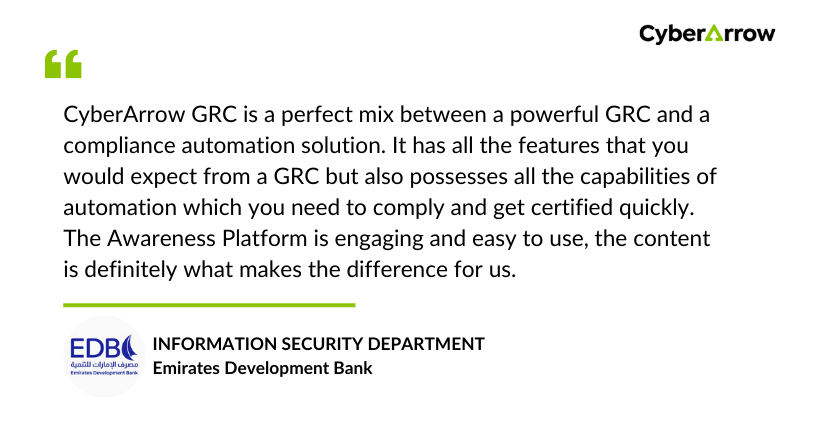
See what Emirates Development Bank have to say about CyberArrow GRC: